




Hello everyone! 🙂
Welcome to ‘Bradley’s Basement’ blog and I’m Tim Bradley!
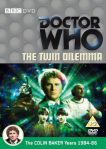
Season 21 is quite an unusual ‘Doctor Who’ season in the classic TV series. It’s Peter Davison’s third season as the Fifth Doctor, but it ends with Colin Baker introduced as the Sixth Doctor in ‘The Twin Dilemma’. Usually, the new Doctor’s introduction is saved for the next season, not at the end of one.
Speaking personally, Season 21 is my least favourite season in Peter Davison’s era of ‘Doctor Who’. Not that any of the Season 21 stories are terrible, but I preferred the Fifth Doctor, Nyssa, Tegan and Adric team featured in Season 19 and the Fifth Doctor, Nyssa and Tegan team featured in Season 20.
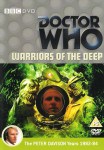
Also, the tone of the season was veering more into violent territory, and it became less ‘fun’, as Tegan would put it. This is especially the case in stories like ‘Warriors of the Deep’, ‘Resurrection of the Daleks’ and ‘The Caves of Androzani’ where the death-toll at the end of each story became high.
With that said, some of the stories are quite compelling to watch. Whilst ‘Warriors’ is a disappointment, ‘Resurrection’ is filled with action-packed drama and contains an emotional, albeit rushed, departure for Janet Fielding as Tegan. ‘Planet of Fire’ also featured several cast changes in it.
As well as the departure of Mark Strickson as Turlough, the departure of robot companion Kamelion, and the seeming ‘death’ of Anthony Ainley as the Master, the story also featured the introduction of Nicola Bryant as new companion Peri. Peri paved the way for audiences to be introduced to the Sixth Doctor.
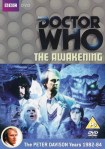
The aforementioned ‘Caves of Androzani’ is ranked as a highly favoured ‘Doctor Who’ story by the fans, and whilst ‘The Awakening’ and ‘Frontios’ have flaws, they have fascinating concepts. So, whilst Season 21 is my least favourite Fifth Doctor era season, it’s still fascinating and enjoyable to check out. 🙂
Thanks for reading!
Bye for now!
Tim 🙂
 Bradley's Basement
On the subject of violence, too, Tim:
Season 21 also feels like a turning point for the perpetrators of violence in ‘Doctor Who’. The fantasy veneer of an Ergon, a Wirrin, an Ice Warrior or an Auton is being stripped away. It’s all about to become very human with very humanistic forms of violence. To quote Saward from “30 Years in the TARDIS”, the violence is going to be shown “that it hurts”.
However, an interesting point that I find about this period isn’t necessarily the *level* of violence. That’s part of it, but a bigger component will be the *approach* to it. Remember, in Season 19, we saw the Terileptil Leader burn alive in a house fire in “The Visitation”. Quite a graphic scene. But it’s not one that the story dwells upon in any great detail. As part of blending with the mid-1980s trend of ‘Rambo’, ‘The Terminator’, ‘A View to a Kill’, ‘Temple of Doom’, and so on; these next few years — Seasons 21, 22, 23 — will engage (quite aggressively, actually) with that discourse.
‘Doctor Who’ is about to step into the age of ultraviolence, as surely as the First and Second Doctors had to step into the mid-60s spy craze. The question is… Where does the Sixth Doctor fit now?
LikeLiked by 2 people
Hi Wolfie,
Thanks for sharing your thoughts on Season 21 of ‘Doctor Who’. I agree, the level of violence isn’t as prominent as what you would get in say 1980s action-packed movies like ‘The Terminator’, ‘Rambo’ and ‘Die Hard’. As long as the stories have engaging characters and enjoyable action scenes despite the violence, that’s fine. I think my issue is that sometimes the lighter moments don’t often come to the forefront and that’s where I feel some of the stories in Seasons 21 and 22 aren’t exciting and enjoyable enough for me compared to the stories in Seasons 19 and 20. I appreciate Eric Saward bringing in more grounded elements in terms of depicting the violent aspects as real, but it’s not something I would want to watch very often, as I prefer variety in terms of comedy-drama and action-packed adventure. The Sixth Doctor is a bit of an oddity, especially at the end of Season 21 and all of Season 22, since his Doctor is dressed up as a multicoloured figure and he could have been a jovial and happy go-lucky person whereas in most of his TV tenure, he can be quite belligerent and often, the violent aspects in some stories don’t help. I’m pleased the Big Finish audios present a more happier Sixth Doctor, especially when he’s travelling with companions like Evelyn, Flip, Constance and Mel.
Many thanks for your comments.
Tim 🙂
LikeLiked by 1 person
It’s interesting you bring up the Big Finish stories. That’s the crux of what fascinates me about reactions to this. It says something very interesting about us as the audience.
It reminds me of a frequent change made for science fiction, in general. “Star Trek VI: The Undiscovered Country” has the massacre of the Klingon diplomatic party. Red blood couldn’t get past the censors… but *purple* blood was fine. Similarly, in Saturday morning cartoons, the heroes couldn’t shoot their way through legions of living henchmen… But bipedal *robots*, who acted more or less identical, were acceptable.
Because? It didn’t *look* human, and being human we have human biases towards things like pain, violence and death. Think of it this way… We don’t react in the same way to a Dalek being blown up vs. Professor Laird being shot in the back.
The audio stories are beloved. Evelyn Smythe’s tenure aboard the TARDIS is discussed in reverent whispers. Quite rightly so, but it’s not fair and easy sailing for Doctor or companions. In fact, I’d say that the most bloodless tales, for the longest time, tended to come from the Sixth Doctor’s Lost Stories. Remounted Season 22 and 23 submissions with the early Sixth Doctor and Peri. The worst I can think of from that range, off the top of my head, are the melting Sontarans.
When we look at Evelyn’s stories, however, there’s a very clear pattern of quite gruesome death and disfigurement. To name a few examples:
— “The Apocalypse Element” features a Chancellery Guard’s eyes ripped from its sockets by the Daleks;
— “Project: Twilight” has a memorably exploding corpse and what happens to poor Cassie;
— “The Sandman” has a skin-flaying bogeyman among the Galyari;
— “Bloodtide” has electrocutions and the Silurian virus (with Tulok, memorably, telling the dying infected victim he should be grateful);
— “Real Time” has pulverised skulls and cybernisations without anaesthetic, and;
— “Jubilee” is a league of its own with severed hands, legs and knife-play to rival “The Two Doctors”.
Interestingly, Evelyn’s time isn’t alone in this depiction, either. Mel sees the results of Davros’s Juggernaut experiments first-hand and is even dropped down a lift shaft in “Thicker Than Water”. However, there is a very keen difference between the two depictions on television versus on audio. Can you pick it out?
It’s not the change in medium. Audio actually invites far more graphic depictions than would be possible on television (this is true in novels, too, Ian Marter was legendary for his Target novelisation gore). No, with a larger sample size, we can see that the more striking pieces of violence are humanoid against humanoid.
“The Apocalpyse Element” example is deeply gruesome, but it isn’t intense like the examples from “Jubilee”. In the former example, we have a Dalek in the way. The perpetrator of the violence is non-human and quite strikingly so. There’s that fantasy element. That cushion. That buffer. However, the stabbing in “Jubilee” is done by one human being to another. Badly. There is no cushion in that scene. No buffer.
In these next few stories, the buffer is going to be very thin and it’s going to ask some important questions. Would “Vengeance on Varos” have been so visceral if the bad Varosians were aliens in make-up? Do you feel the same pain for the boiling Cryon, Flast, that you do for the bloodied human, Lytton? What is the measure of empathy in an audience member who is disturbed when an Ice Warrior mows down humans, but feels nothing when the humans mow down an Ice Warrior?
What happens when the metaphorical mask comes off and you can see the face? And no one is “alien” any more?
That’s a really interesting topic to explore. Especially, as we look back across the programme’s long history.
LikeLiked by 2 people
Hi Wolfie,
Thanks for sharing your thoughts on how the Big Finish stories of ‘Doctor Who’ depict violence in the audio medium. I wouldn’t say it’s as bad compared to how the TV series stories depicts violence, but imagining what the violence would look like can be quite effective. I’ve discovered that when listening to an audio story like ‘Plague of the Daleks’, which features zombies and some would argue that the graphic violence can be depicted quite strongly if one wishes to visualise it in that manner in his/her/their mind. Even ‘Doctor Who’ audios spin-offs can take advantage of depicting the violence to an extreme, like the ‘I, Davros’ series, which features a mother drowning her daughter in a swimming pool in the second episode.
I myself have depicted violence quite graphically in stories like ‘Doom of the Daleks’ and ‘Dawn of the Dwaxi’, though I’d like to think those stories have moments of levity and light relief for people to enjoy whilst also taking the strong anti-violence messages into consideration. I hope that applies to both TV and audio mediums in ‘Doctor Who’, especially with the programme reaching its 60th anniversary year.
Many thanks for your comments.
Tim 🙂
LikeLiked by 1 person
A different-colored blood from aliens being more tolerable for censors, certainly when CGI-ed for floating in zero-G, never occurred to me before. Thanks for that point. This day and age, the CGI availability for the modern Dr. Who might make content easier to accept, even if it might have included a gruesome death scene. So the thoughts of how some classic series violence might be mellowed in CGI updates for Blu-Rays can be my easiest remedy.
LikeLiked by 2 people
Hi scifimike,
Thanks for sharing your thoughts on how violence is depicted in classic ‘Doctor Who’ as well as in ‘Star Trek VI’. 😀 I don’t think it bothers me very much as long as the violence isn’t too graphic like it would be in say some ‘Torchwood’ episodes as well as horror movies, which I’ve not seen many of. I’d like to think the production teams at the time were taking younger viewers into consideration when making these stories. Quite often, the violence levels aren’t so bad, though it depends on which production team is making a certain story, like the JNT/Eric Saward team tended to do for certain Season 21/22 stories.
Incidentally, the Klingons having pink/purple blood in ‘Star Trek’. I don’t think I was too surprised by that, since Vulcans have green blood. Same with the Sontarans who turned out to have green blood in ‘The Two Doctors’. I’m not sure about Time Lords having blue blood, according to one attempt made by Tom Baker, which I discovered on the info-text commentary for the ‘State of Decay’ DVD.
Many thanks,
Tim 🙂
LikeLiked by 1 person
I once thought of giving the Gemingans (in my Dr. Who spin-off story Continuum City) orange blood. But the scenes for that would have been too violent and so I just took them out.
LikeLiked by 2 people
Hi scifimike,
Thanks for letting me know about your ‘Doctor Who’ story ‘Continuum City’. I found it via this link here and liked it – https://junkyard.blog/continuum-city/
That’s fair enough. I think mentioning that the Gemingans have orange blood would be okay. I like how you’ve written your story in script form. Same thing I’ve done with my ‘Doctor Who’ stories.
Tim 🙂
LikeLiked by 1 person
Thank you, Tim. Of course given the multidimensional diversities for the Gemingans, each Gemingan individual’s blood could be any color.
LikeLiked by 2 people
Hi scifimike,
That’s fair enough.
Thanks,
Tim 🙂
LikeLiked by 1 person
You’re welcome. Blue blood for Time Lords would have been interesting. Except that after Spock’s green blood, and knowing how the Doctor can more successfully pass as human on Earth, maybe giving him a different blood color than red would have been pushing it.
LikeLiked by 2 people
Hi scifimike,
Yeah, even I wasn’t keen on the idea of Time Lords having blue blood, so it was probably for the best it was cut from the transmitted version of ‘State of Decay’.
Many thanks,
Tim 🙂
LikeLiked by 1 person
No worries, scifimike70. The discussion on violence is constantly in motion and one that I think will continue to be redefined as more becomes plausible to depict on film.
To give an example where people don’t even bat an eyelid any more — “The Tomb of the Cybermen” was controversial for one particular depiction of violence. The foaming, seething froth of a Cyberman’s chest unit overheating as it was destroyed. At the time, considered quite a disturbing image. To modern audiences, more than fifty years on, I doubt most people would remember it.
With violence, audiences I think latch more onto the emotional content attached to it. It’s the difference between an action film and a murder mystery film. One where death so frequent that it’s treated almost casually, the other where death is given a grim sort of reverence for how unusual it is.
LikeLiked by 2 people
Thank you for your feedback.
LikeLiked by 2 people
Hi Wolfie,
I quite like that moment where the Cyberman’s chest unit was foaming and frothing in ‘The Tomb of the Cybermen’. I’m sure it would have been considered horrific and violent imagery at the time, but to me, it confirms that there’s something organic about the Cybermen, despite giving the impression that they’re robots. It’s those subtle moments I often appreciate when it comes to checking out the Cybermen in certain ‘Doctor Who’ stories – more so in the 1960s and more new series Cybermen stories than the 1970s and 1980s stories (but that’s my humble opinion).
Many thanks,
Tim 🙂
LikeLiked by 1 person
Hi Tim,
Great reflection on Season 21. I actually do mostly agree with your thoughts on it. Also, even though I can’t entirely agree with how you feel about Tegan as a character, I suppose her departure was rushed, looking back on it. That being said, I don’t find ‘Resurrection of the Daleks’ to be that good a story, which I hope to elaborate on when it comes to re-reviewing it sometime in the future. Actually, I find that the only good Season 21 stories are ‘The ‘Awakening’ and ‘Planet of Fire’. So it’s overall, not a good season for me. To quote the Doctor from ‘Warriors of the Deep, “there should have been another way.” 😔
Hopefully I’ll get around to revisiting ‘The Two Doctors’ soon in order to start my review of it, along with ‘The Keys of Marinus’ and ‘The Rescue’. ‘The Two Doctors’ will actually be the first colour ‘Doctor Who’ story I’ve watched in 2023 😆.
Take care, Xavier.
LikeLiked by 2 people
Hi Xav,
Thanks for sharing your thoughts on Season 21. Glad you enjoyed my reflection on the season and that you mostly agree with what I’ve said. 😀 Interesting that you don’t find ‘Resurrection of the Daleks’ as good a ‘Doctor Who’ story compared to me. I look forward to your re-review on the story when it becomes available on your blog. Interesting you find ‘The Awakening’ and ‘Planet of Fire’ to be good stories out of Season 21. I look forward to revisiting Season 21 when it’s released in a Blu-ray box set. Thus, I can update my revews on the stories in the season.
Looking forward to your reviews on ‘The Keys of Marinus’, ‘The Rescue’ and ‘The Two Doctors’. Hope you enjoy revisiting ‘The Two Doctors’ especially.
Many thanks for your comments.
Tim 🙂
LikeLiked by 2 people