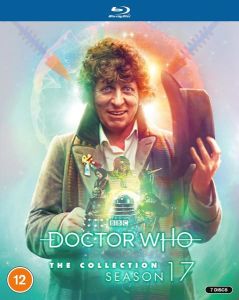
‘THE HORNS OF NIMON’
Please feel free to comment on my review.
The Nimon Be Praised with the Fourth Doctor, Romana and K-9
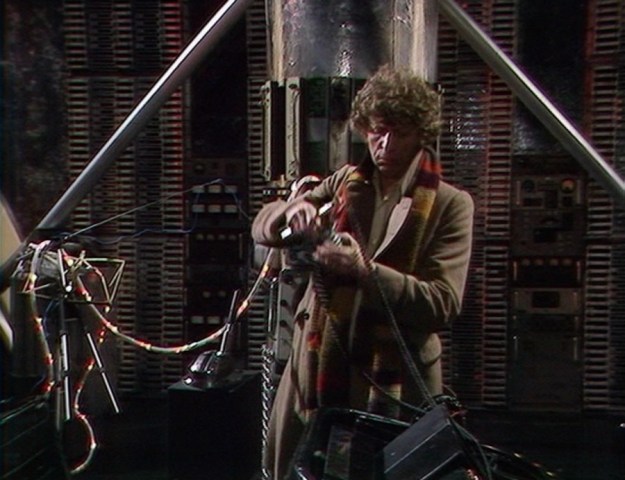
We come now to (technically) the penultimate story of Season 17 of ‘Doctor Who’! This is ‘The Horns of Nimon’, a four-part adventure by Anthony Read, who was the script editor of ‘Doctor Who’ for Seasons 15 and 16. This story has Tom Baker as the Doctor, Lalla Ward as Romana and K-9, voiced by David Brierley.
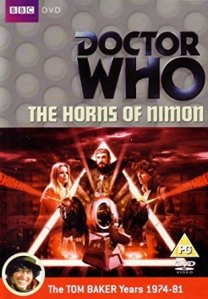
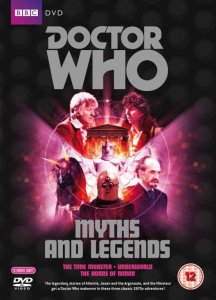
This story was actually the third in a trilogy of ‘Doctor Who’ stories in the ‘Myths and Legends’ DVD box set, which I had for my birthday, along with ‘The Creature From The Pit’ DVD, in May 2010. Out of the three stories in the ‘Myths and Legends’ DVD box set, ‘The Horns of Nimon’ is my favourite. 🙂
The other two stories in that box set were ‘The Time Monster’ and ‘Underworld’. All three stories have connections to Greek myths told in a ‘Doctor Who’ manner. In this adventure, the Fourth Doctor, Romana and K-9 are tackling the minotaur-like Nimon inside their quite dangerous labyrinth.
As established, Anthony Read was a former ‘Doctor Who’ script editor, working heavily on ‘The Key to Time’ season. He had been encouraged by producer Graham Williams and Graham MacDonald, the BBC Head of Drama, to do another ‘Doctor Who’ season, but Anthony politely declined the offer.
Despite him not being the script editor anymore, Anthony Read was invited back by new script editor Douglas Adams to write a brand-new ‘Doctor Who’ story for Season 17. Anthony happily accepted and thus he penned this freelance tale, which is a sci-fi take on Theseus and the Minotaur.
At this point, Douglas Adams was getting desperate in terms of commissioning new ‘Doctor Who’ stories from new talent. This especially overwhelmed the workload he had with being script editor on ‘Doctor Who’ as well as writing the many ‘Hitchhiker’s Guide to the Galaxy’ projects at the time. 🙂
With Anthony being an experienced writer as well as script editor and former producer, Douglas knew he could rely on him to deliver the scripts on time before they went into production. However, there are setbacks regarding the scripting of the story and how the production was finally realised. 😐
I’ve made it clear that I really like ‘The Horns of Nimon’. I consider it one of my favourites from Season 17 of ‘Doctor Who’. Not everyone shares the same opinion as me though. The story has divided a lot of fan opinion over the years, especially with the pantomime aspects that it contains. 😐
This isn’t helped by the fact that this story was released from December 1979 to January 1980. In fact, ‘Part One’ of ‘The Horns of Nimon’ was shown on the 22nd of December, a few days before Christmas came along. So, does this mean that ‘The Horns of Nimon’ is a festive ‘Doctor Who’ story?
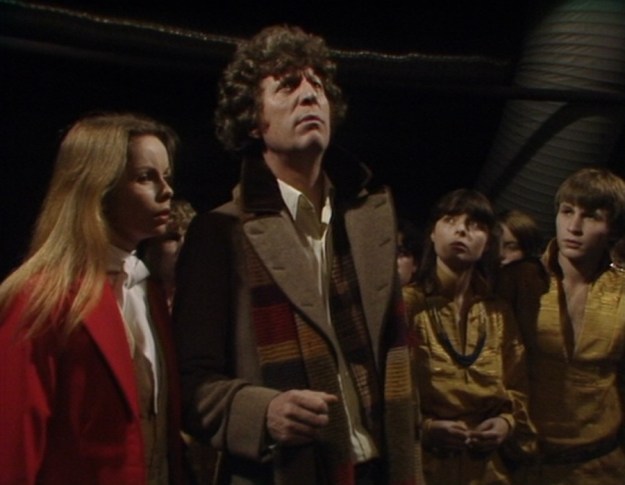
Whilst some fans don’t like ‘The Horns of Nimon’ much, I consider this to be a guilty pleasure. I found it an intriguing story, especially as it’s based on the Greek legend of Theseus and the Minotaur. It somewhat appealed to me. A shame this isn’t on the forefront of many people’s minds…

Timelord007: (interrupts; rants) ARGH!!!!!!!!!! ‘The Horns of Nimon’! ARGH!!!!!!!!!! Graham Crowden as Soldeed still gives me nightmares! (mimics Soldeed) My dreams of conquest!!! (normal voice) ARGH!!!!!!! This was teeth-pulling painful to watch! Tom Baker, I swear, is taking the pee and acting utter stupid like he doesn’t care. He goes completely [over-the-top on several occasions…]
Tim reacts to Timelord007’s ranting with a stony face. He then picks up his mobile phone and dials a number. Timelord007 still rants away whilst Tim waits for an answer on his phone. Meanwhile, WilliamsFan92 works on his blog until his mobile phone rings. He picks it up and answers it.

WilliamsFan92: Hello?

Tim Bradley: (through phone) Hi, WF92. It’s Tim Bradley.
WilliamsFan92: (puzzled) How did you get this phone number?
Tim Bradley: (through phone) Just to say, as well as ‘Love and Monsters’, Jim Carrey as the Riddler in ‘Batman Forever’, ‘Batman & Robin’, ‘The Last Jedi’, 2004’s ‘Thunderbirds’, Benedict Cumberbatch as Khan in ‘Star Trek Into Darkness’, ‘Iron Man 3’, ‘A Good Day to Die Hard’, ‘Mad Max: Fury Road’, 2016‘s ‘Ghostbusters’, ‘Venom’, ‘Venom: Let There Be Carnage’, ‘No Time to Die’ and ‘The Matrix Resurrections’, don’t mention ‘The Horns of Nimon’ to Timelord007. He goes ballistic whenever that ‘Doctor Who’ story is mentioned.
WilliamsFan92: Oh great. Another one to add to the list.
Tim Bradley: (through phone) You’ll probably have seen the story by the time of this review to form an opinion.
WilliamsFan92: Of course. You’ll see some of my thoughts when I comment on this review, as well as my full thoughts on the story in my blog review.
Tim Bradley: (through phone) Anyway, I got to go. Take care.
WilliamsFan92: Bye, Tim.
Both Tim and WilliamsFan92 hang up. Meanwhile, Timelord007 still rants away.
Timelord007: (rants) Pantomime twaddle, hammy acting, awful Nimon costumes, awful story; and possibly the worst story of the Fourth Doctor era! ARGH!!!!!!! Graham Crowden is shocking as Soldeed! I’d forgotten how bad he is with his hammy overacting. Thank goodness he never became the Fourth Doctor! Ugh! That has to be the worst acting in ‘Doctor Who’ ever [and the Nimon costumes are awful…]
(sighs) Anyway, back to my review…
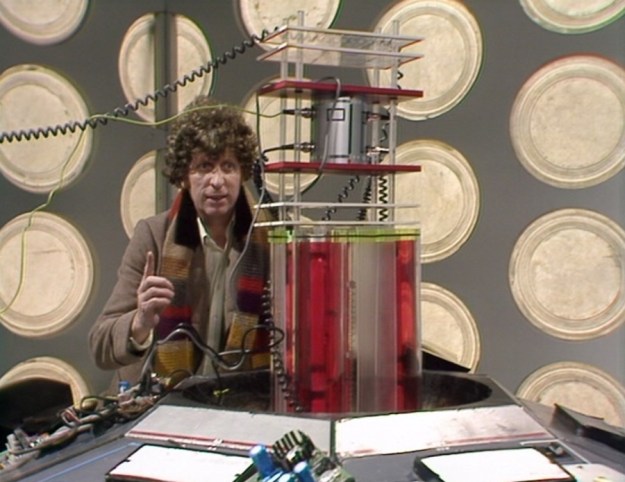
‘The Horns of Nimon’ ultimately became the season finale to Season 17 of ‘Doctor Who’. This wasn’t part of the original plan, as the season finale was actually meant to be ‘Shada’. Unfortunately, due to industrial action at the BBC, the making of ‘Shada’ was broken. It never saw the light of day on TV. 😦
This is a shame, as ‘Shada’ could have ended Season 17 on a high note instead of a fairly average note. Despite that, Season 17 got high ratings from its ‘Doctor Who’ audience at the time. ‘Part Four’ of ‘The Horns of Nimon’ received 10.4 million viewers at the time it was shown on BBC TV. That’s incredible!
Although the story is by Anthony Read, ‘The Horns of Nimon’ contains plenty of Douglas Adams humour. Like previous Season 17 stories, you can easily taste the humour in them. Some of the humour worked well in the story, some of it didn’t, as we’re about to explore in the actual tale itself.
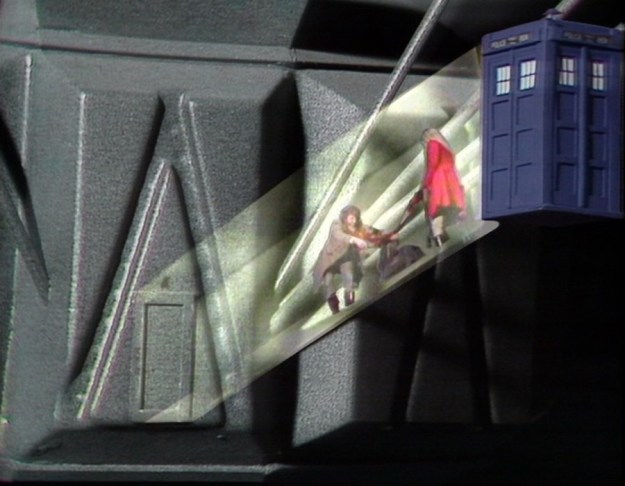
In the story, the TARDIS ends up in what seems to be a black hole. With the Doctor, Romana and K-9 aboard, the TARDIS collides with another spaceship on its way to the planet Skonnos. The Doctor and Romana investigate and explore the ship. They uncover the horrific truth about the ship’s cargo.
The cargo happens to be young sacrifices from the planet Aneth. They include Seth, who is claimed to be a young hero of Aneth, and Teka, who is the princess of Aneth. These young sacrifices are meant to be given by the Skonnans of Skonnos to the powerful, horned creature, simply known as the Nimon.
Having to deal with the annoyingly bullying Co-Pilot, who we’ll call Sardor here (his captain – the Pilot, whom we’ll call Sekkoth here – died at the story’s beginning), the Doctor and Romana help out to repair the Skonnan battle cruiser on its way to take the Anethan tributes to the planet Skonnos. 🙂
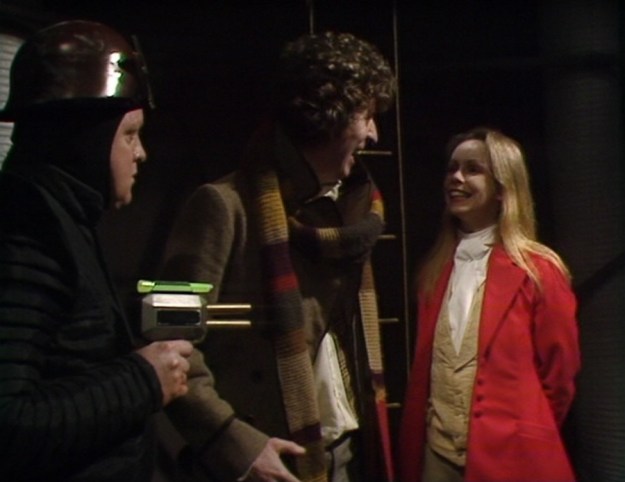
Sardor becomes a backstabber by leaving the Doctor and K-9 behind in the TARDIS within the black hole whilst taking Romana and the Anethan tributes to Skonnos. Once on Skonnos, Romana and the Anethans as well as Sardor (once his duplicity has been exposed) are forced into the Power Complex.
Inside, the Nimon awaits for Romana and the Anethan tributes. The Doctor soon comes along and he meets up with Romana, Seth and Teka in order to foil the Nimon’s plans when he and his kind are about to take over Skonnos. Will our heroes be able to save everyone on the planet Skonnos? 😐
Okay, so like with ‘Time-Flight’, I’m able to see the potential this story has. ‘The Horns of Nimon’ has the making of a thumping good ‘Doctor Who’ story and I like the angle Anthony Read uses in telling his story. I’ve had a lot of fun watching this story on DVD and Blu-ray. But like I said, there are setbacks.
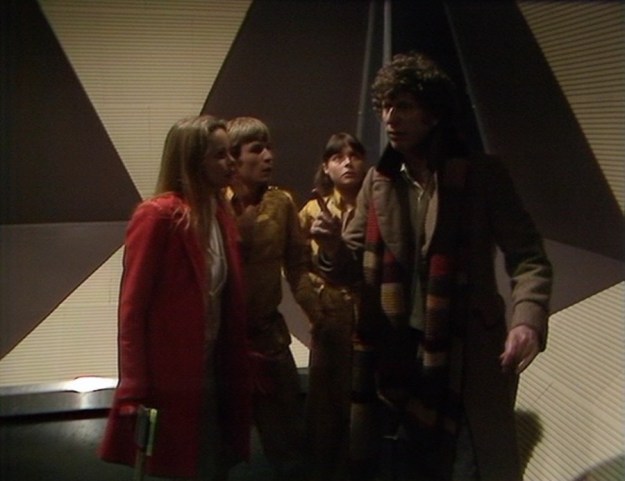
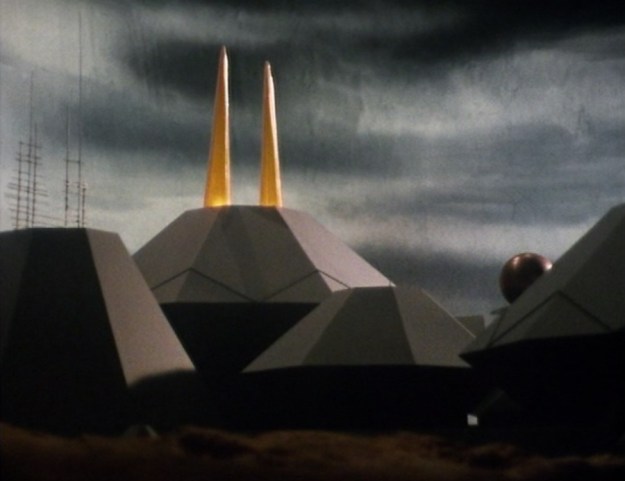
In crafting his story, Anthony Read had the inspiration of using a printed circuit board (you know, like what you see inside a computer) to form the labyrinth for the Nimon to dwell in its Power Complex of Skonnos. That’s great! In all fairness, I found this to be a clever and very intriguing concept to follow.
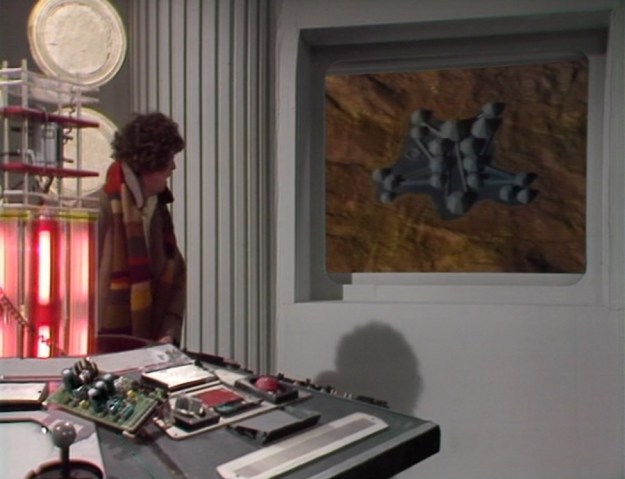
I’m sure Douglas Adams liked the idea as well when he was script-editing the story for TV. Sadly, the execution for the concept is poorly handled. It wasn’t what Anthony Read had envisaged. I can see why. Looking at the Power Complex from a TARDIS view, it doesn’t look like a printed circuit board. 😦
A shame that wasn’t communicated well to the late director Kenny McBain and his production team, as the Power Complex looks like a lot of domed buildings instead of a printed circuit board. It would have been great to have seen Anthony Read’s concept in its proper glory if it was properly realised. 😦
I wish I could tell you what went on in terms of the making of the story and why Kenny McBain’s production team decided to go in the direction they wanted to go in with ‘The Horns of Nimon’ as opposed to what Anthony Read wanted. Sadly, on DVD and Blu-ray, there isn’t a making-of documentary.
Yeah, whilst ‘Destiny of the Daleks’, ‘City of Death’ and ‘Shada’ have proper treatment in terms of behind-the-scenes making-of documentaries, ‘The Creature From The Pit’, ‘Nightmare of Eden’ and ‘The Horns of Nimon’ don’t get that same treatment. I can’t understand why that is for this season.
And yes, I know ‘The Creature From The Pit’ and ‘Nightmare of Eden’ have making-of featurettes on their Blu-ray discs, but those don’t count since they’re featurettes, not making-of documentaries. ‘The Horns of Nimon’ barely has a look-in and I feel that’s very negligent on ‘The Collection’ makers’ part.
Now to be fair, making-of documentaries can take a while to be made and sadly, at the time of this review, we’re currently living in an age of Covid-19 where documentaries on all the stories of Season 17 are tricky to be made. But at least give ‘The Horns of Nimon’ the making-of featurette treatment!
It’s just as well that we have the ‘Read the Writer’ interview with the late Anthony Read on how he perceived the story and how he compares it to how it eventually ended up. I felt more appreciation for ‘The Horns of Nimon’ as a story from his point-of-view compared to how many others perceive it.
I did like it when the labyrinth-like corridors in the Power Complex kept changing, acting like how a printed circuit would perform in changing its power outlets. The Doctor and his friends do get lost in the reconfiguring labyrinth. It saved the production team using up lots of corridors in the labyrinth. 🙂
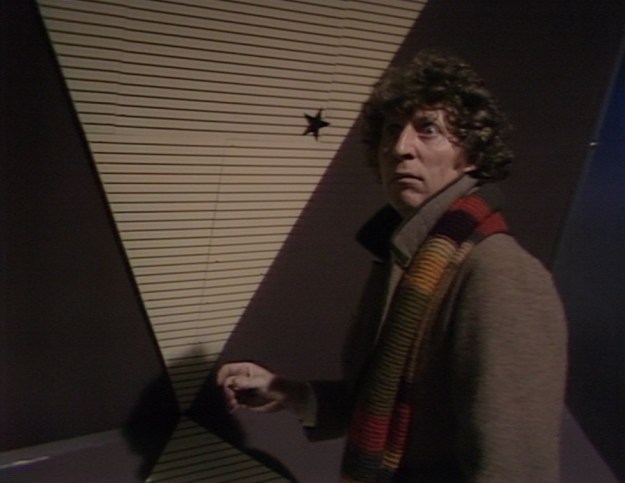
As I’ve stated before, ‘The Horns of Nimon’ contains plenty of humour, especially on the part of Douglas Adams’ script-editing the story. Now as I’ve established in previous reviews for Seasons 17 and 24, I like there to be a balance of comedy and drama featured throughout ‘Doctor Who’ stories.
I’m sure Douglas Adams felt the same way. It’s easy to understand from his point of view how frustrated he became when the actors didn’t deliver the lines needed to be said in a comedic fashion but with a straight face. Sometimes, some of the cast did go way over-the-top in their performances.
It was evident in ‘The Creature From The Pit’, it was evident in ‘Nightmare of Eden’ and it’s clearly evident in ‘The Horns of Nimon’. I know I’ve said ‘The Horns of Nimon’ is one of my favourite stories from Season 17 of ‘Doctor Who’, but I’m willing to admit there are over-the-top performances in it.
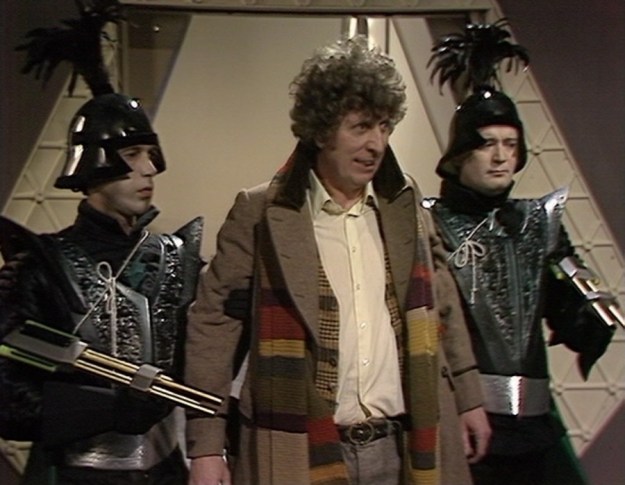
Tom Baker as the Fourth Doctor is pretty bonkers in this ‘Doctor Who’ story. I enjoyed his performance featured throughout and he’s a delight to watch. Timelord007 has said he gives a lazy performance and goes completely over-the-top on several occasions, but…I sort-of disagree on that. 😐
Timelord007: WHAT?!!!
Okay, look. Whilst I acknowledge he can be too flippant at times and often reckless in his performance, I honestly can’t help like what he does throughout this story. I forgive him for seeming to be over-the-top on several occasions here because…well, let’s be honest, he’s not human, is he? 🙂
There are times when the Doctor can be serious, especially when he confronts Soldeed and asks the whereabouts of Romana upon his arrival to Skonnos. The moment where he’s angry about the Co-Pilot Sardor abandoning him and K-9 aboard the TARDIS, I can get behind that when viewing this.
It’s clear that Tom Baker shows off his confidence as the Doctor in this adventure and him being flippant and reckless at times illustrates how he’s the hero and is determined to thwart the bad guys. But I wouldn’t say that aspect was a sign of him being lazy. He’s clearly enthusiastic throughout this.
Timelord007: Look, Tim. You know Tom Baker’s my favourite Doctor. One hundred per cent. But I can’t excuse [how lazy his performance is here…]
Tim switches Timelord007 off by this point.
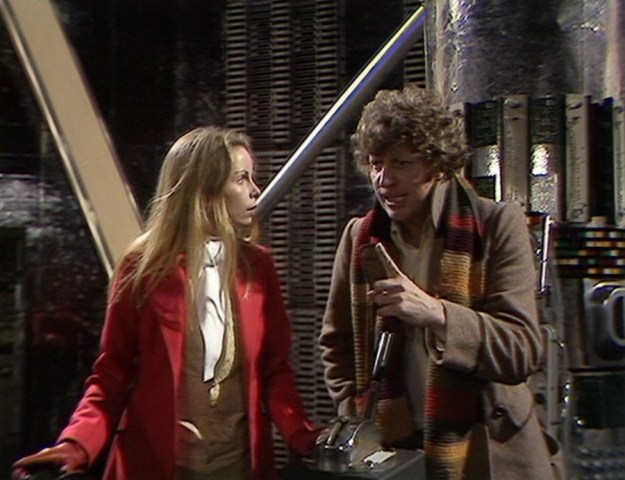
(continues) Anyway, Lalla Ward is equally great as Romana. I like how Romana gets to have her own story when she’s accompanying the young Anethians on their way to Skonnos and into the Power Complex. She’s without the Doctor for quite some time in the whole of ‘Part Two’ of this adventure.
When writing my Fifth Doctor story ‘Chieftain’s Caves’, I had the inspiration to have the Fifth Doctor and Nyssa separated from Billy for most of the story when they visited Scotland. This came from watching ‘The Horns of Nimon’ and seeing how Romana was separated from the Doctor for a time. 🙂
Incidentally, I watched both ‘The Creature From The Pit’ and ‘The Horns of Nimon’ to help me in terms of inspiration for writing a Douglas Adams-style of story in ‘The Space Hotel’ back in 2010. I know they sound like bad examples, but the comedic aspects of those stories helped with my writing. 🙂
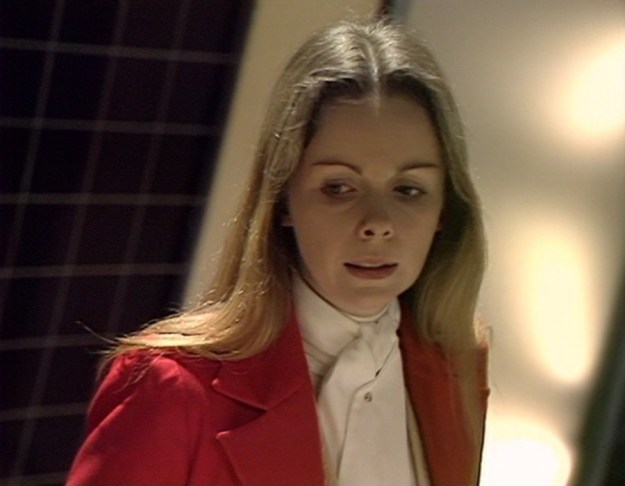
The idea behind Romana as a companion was to make her the Doctor’s equal in being a Time Lady from Gallifrey. Whilst that idea wasn’t used to a great extent as intended with Mary Tamm’s Romana, Anthony Read hoped to apply it to Lalla Ward’s Romana when writing for her in this tale. 🙂
I could see that in Romana’s journey in ‘Part Two’ when she had to be the Doctor for a while in looking after the young Anethians and answering their questions when they were inside the Power Complex. Romana also gets to visit the planet Crinoth when sent there by mistake in ‘Part Four’.
Once again, K-9 is voiced by David Brierley, not John Leeson, in this particular Season 17 story of ‘Doctor Who’. As already established in my reviews for ‘The Creature From The Pit’ and ‘Nightmare of Eden’, I prefer John Leeson’s K-9 voice as opposed to David Brierley’s when viewing these stories.
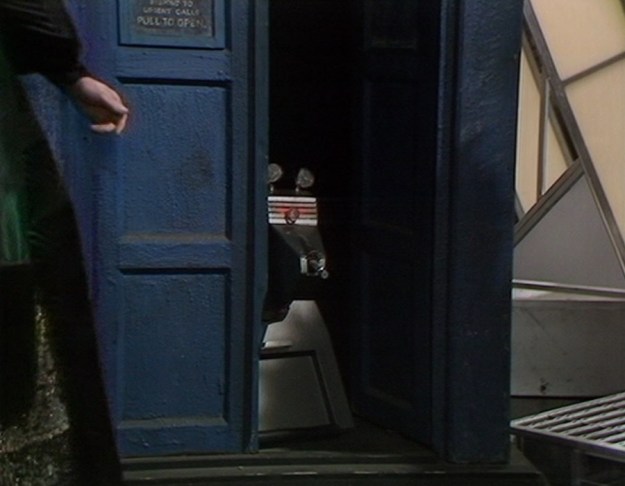
And let me stress, I don’t think David Brierley is awful in voicing K-9. I’m sure he’s doing his best here, but it just doesn’t sound like K-9 when hearing him in the Season 17 stories. I wish we were given the option on Blu-ray to have John Leeson dub over K-9 in the Season 17 stories when watching them. 😐
Despite that, K-9 does have some great moments featured throughout this adventure. This is when he’s with the Doctor aboard the TARDIS; when they’re trying to figure out more about the Skonnans and how to escape from the planet-like asteroid that’s heading for the TARDIS within the black hole.
I also liked it when K-9 handled things alone when summoned by the Doctor into the Power Complex before getting captured by Soldeed and his lot. He’s able to get out of the room he’s in when firing a warning shot at Sorak before locking him in the room he was in and going out to assist the Doctor. 🙂
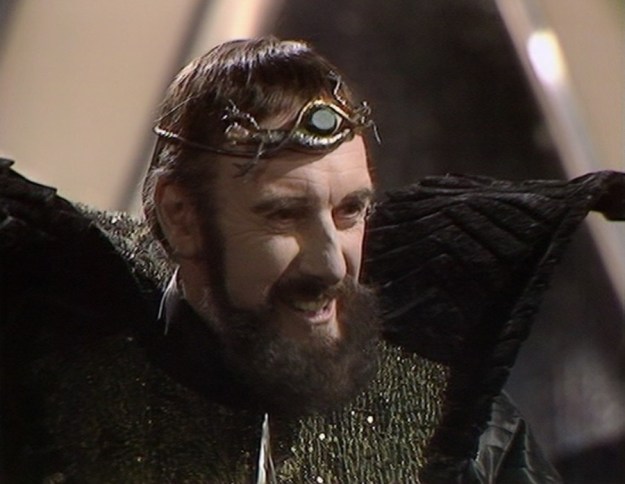
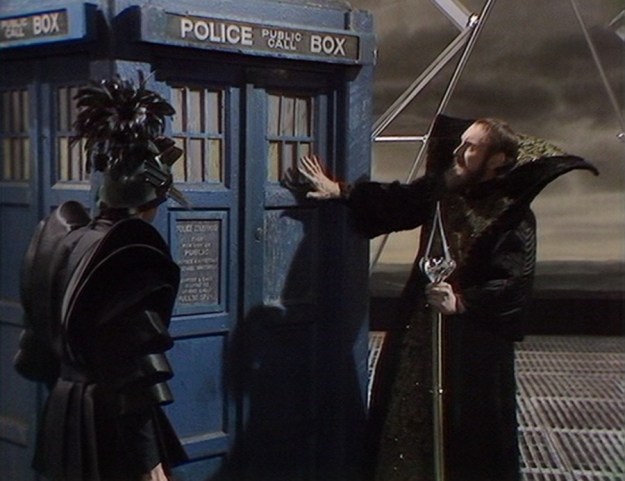
And now we come to the story’s main guest star – the late Graham Crowden as Soldeed, the arrogant leader and head scientist on the planet Skonnos. And yes, apparently Graham Crowden was a potential contender to play the Fourth Doctor in ‘Doctor Who’ before Tom Baker played the part. 🙂
I don’t know what Graham Crowden would’ve been like had he played the Fourth Doctor instead of Tom Baker, but I imagine he would’ve played it in the same way he played Soldeed. 😀 Graham Crowden later did ‘A Very Peculiar Practice’ with Peter Davison, Barbara Flynn and David Troughton.
I must get around to watching that series on Britbox sometime. 😀 But yes! What can I say about Graham Crowden as Soldeed that others haven’t said before? He is way over-the-top in this story! But in a strange way, and I know you’ll think I’m totally crazy, I really enjoyed how over-the-top he is.
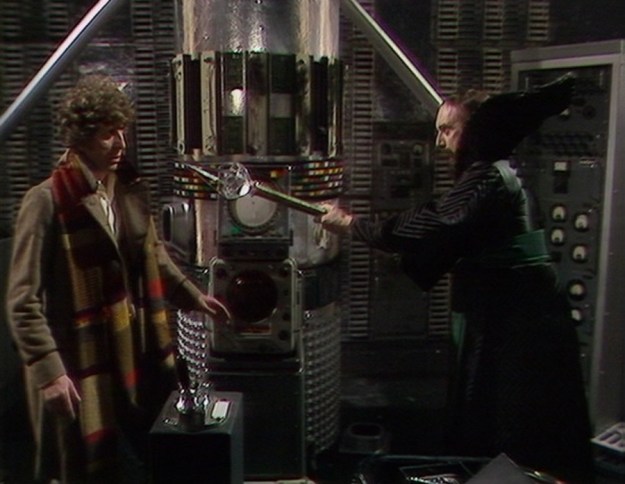
I know I should hate what he’s doing in playing the villainous character here, but I couldn’t help feel utter joy in watching him play Soldeed in ‘The Horns of Nimon’. He’s clearly enjoying himself as the story’s villain and…God bless him, I’m glad he’s having fun. It’s almost irresistible to watch him here.
The lines he should say in an intimidating manner are clearly said as if this was a pantomime and I had a fun time watching him do that in the story. It also illustrates what an idiot Soldeed can be when he doesn’t realise the Nimon’s true agenda, as he’s so corrupt with power for his own empire.
I know this goes against everything I’ve said about a balance needed to be struck between comedy and drama in ‘Doctor Who’, but knowing how hammy Graham Crowden’s acting is in this adventure makes it all the more wonderful. I take immense pleasure out of watching Graham Crowden’s acting.
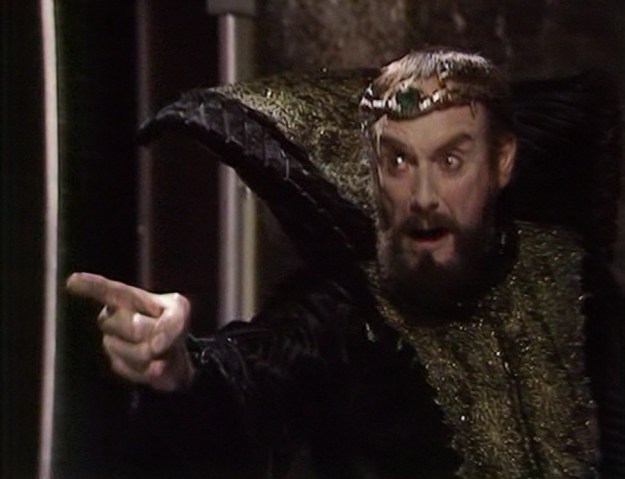
Soldeed: My dreams of conquest! (Pause) You have brought this calamity upon me!
Romana: You’ve brought it on yourself!
Also, when he says the line!
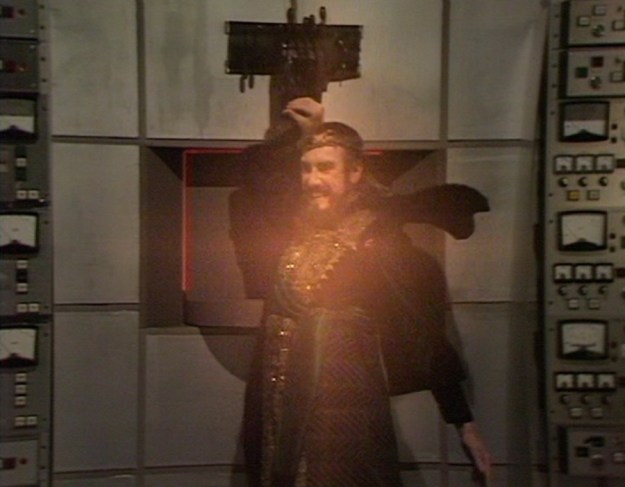
Soldeed: You fools! You are all doomed! Doomed!
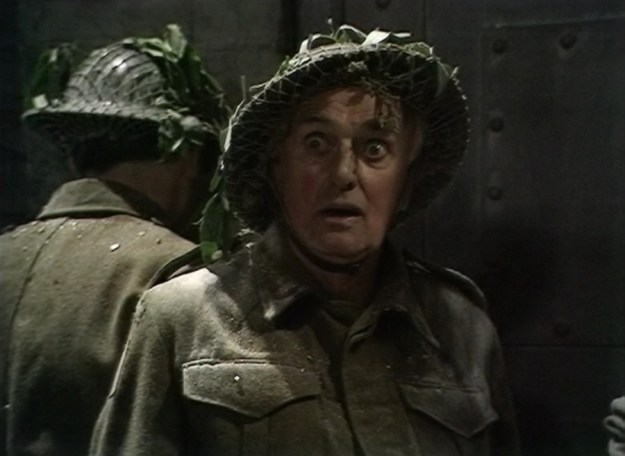
Frazer: We’re doomed, doomed!
Both my Dad at home and Matthew Waterhouse in the ‘Behind the Sofa’ item for ‘The Horns of Nimon’ quoted Frazer’s line “We’re doomed, doomed!” from ‘Dad’s Army’ once Soldeed said “You are all doomed! Doomed!” whilst revisiting this story on Blu-ray. How ironic, is that? And so surreal!
Incidentally, the Doctor says his line “Oh my prophetic soul!” in the story. I’m surprised the director Kenny McBain didn’t allow Graham Crowden to say his final line “I’ve caught an everlasting cold.” Yeah, I know it’s a ridiculous line, but I’m surprised the story was restrained in its ridiculousness here.
Janet Ellis guest stars as Princess Teka from the planet Aneth in this ‘Doctor Who’ story. Janet Ellis followed in the footsteps of Peter Purves, as she later became a ‘Blue Peter’ presenter. You can check out Janet Ellis’ appearances on ‘Blue Peter’ on the other classic ‘Doctor Who’ DVDs/Blu-rays. 🙂
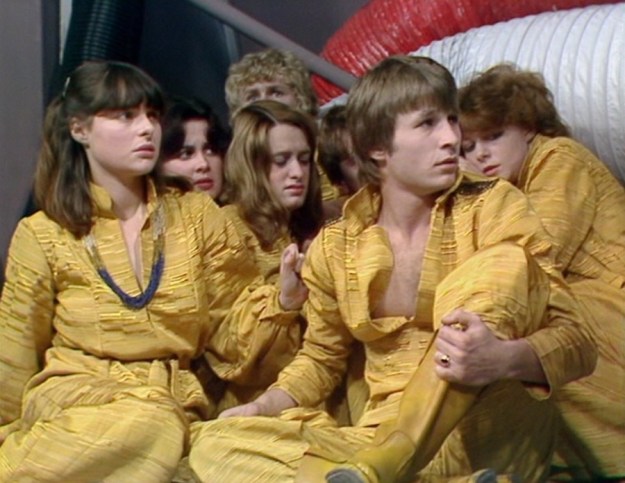
I enjoyed Janet Ellis’ performance as Teka (pronounced ‘Teeka’, I believe). It’s clear that Teka is in love with Seth and she’s confident that he will save her and Aneth’s people from the menace of the Nimons on Skonnos. I wish more of their relationship was explored further in this ‘Doctor Who’ story.
Simon Gipps-Kent guest stars as Seth, the supposed prince and hero of Aneth who will defeat the Nimon on Skonnos, but he turns out not to be a prince or even a hero. As I understand it, Simon Gipps-Kent auditioned to play Adric in ‘Doctor Who’, which I think would’ve been interesting casting.
He certainly worked with Matthew Waterhouse in ‘To Serve Them All Days’. This was before Matthew played Adric in ‘Doctor Who’. Simon Gipps-Kent sadly passed away in 1987. In the story, Seth doubts he can save Aneth’s people, despite Teka’s faith in him, but he turns out to be very brave. 🙂
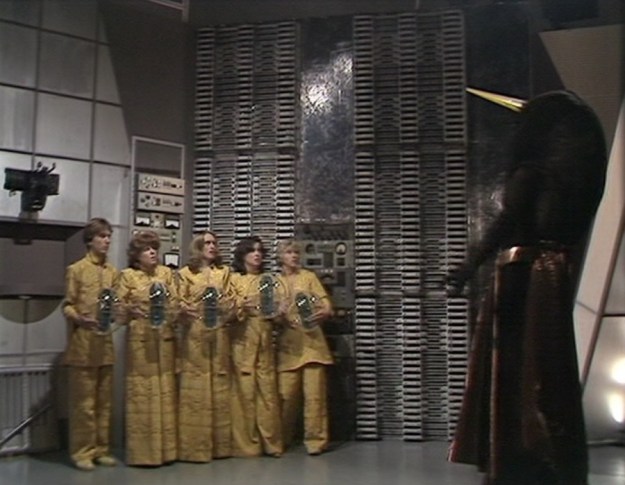
The other Anethian tributes are useless in this. 😀 As well as not being able to say a line of dialogue because they’re extras and not speaking roles like Seth and Teka are, they don’t run when Romana tells them to from the Nimon in ‘Part Three’. Seriously, why didn’t they run when Romana told them to?
Aboard the Skonnan battle cruiser that’s taking the Anethan tributes to Skonnos, Bob Hornery guest stars as Sekkoth the Pilot, and Malcolm Terris (who was in ‘The Dominators’) guest stars as Sardor the Co-Pilot. Yeah, I’m using the Pilot and Co-Pilot’s names from Terrance Dicks’ novelization here. 🙂
Just calling these characters ‘the Pilot’ and ‘the Co-Pilot’ in the story doesn’t make sense or work for me. I’d like to identify them as characters and thank goodness Terrance Dicks identifies them in his book. A shame that Pilot Sekkoth died because of Co-Pilot Sardor’s recklessness throughout this tale!
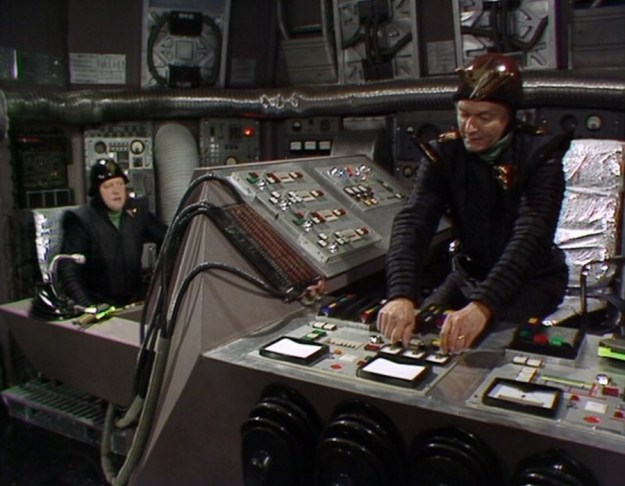
Sekkoth and Sardor could easily be Laurel & Hardy in this story, especially as Sardor is a ‘BLUNDERING IDIOT’ when getting his mate killed. Sardor believes himself as superior. He bullies the Anethans, calling them ‘weakling scum’ for most of the time, and he bullies the Doctor and Romana.
Honestly, I’m surprised Sardor wasn’t played by Thomas F. Wilson who played Biff in the ‘Back to the Future’ trilogy. 😀 Seriously, I could hear Sardor calling the young Anethans ‘buttheads’ instead of ‘weakling scum’. It was funny when Sardor ended up ripping his trousers once the Nimon killed him.
The story also features Michael Osborne as Sorak, Soldeed’s confidante on the planet Skonnos. Whilst Michael Osborne delivers a good performance as Sorak, I’m not sure I care for his feathered helmet in the story. I found the Gondorian helmets in ‘The Return of the King’ way better than that. 🙂
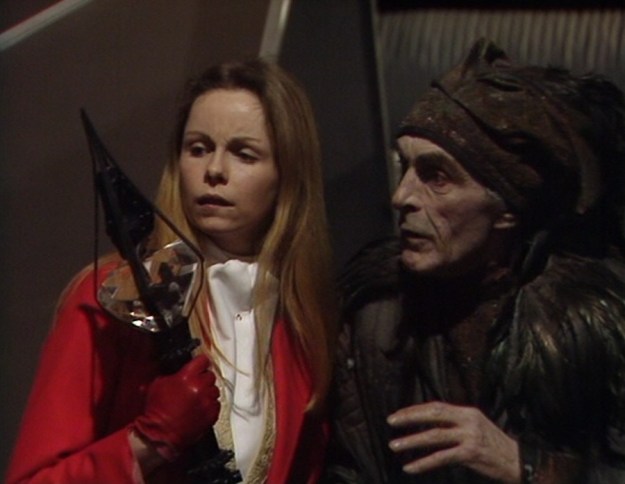
There’s also John Bailey as Sezom, whom Romana meets on the planet Crinoth. John Bailey previously played Victoria’s father Edward Waterfield in ‘The Evil of the Daleks’. I enjoyed his performance as Sezom in the adventure and it’s nice when he helped Romana to escape the Nimons.
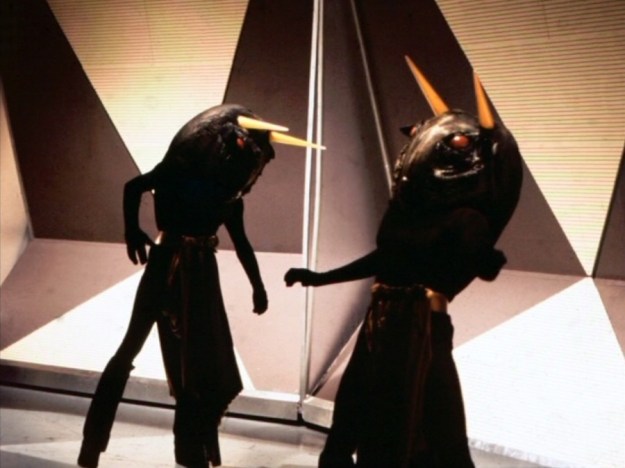
And now we come to the Nimons, played by Robin Sherringham, Bob Appleby and Trevor St. John Hacker, and voiced by Clifford Norgate. The Nimons are terribly unconvincing as ‘Doctor Who’ monsters. They’re meant to be minotaur-like, but they end up appearing like lumbering creatures.
They also look like they can’t see where they’re going with those awkward minotaur-like heads they had to wear. The eyes and the mouths also don’t move when they talk. At least David Prowse as the Minotaur in ‘The Time Monster’ looked convincing compared to how the Nimons ended up here.
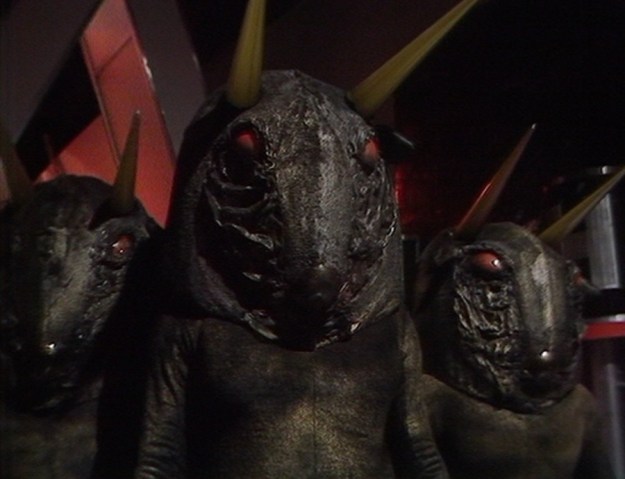
I feel sorry for the actors who had to play the Nimons in this. They must have been well-trained to wear those suits, especially since they were ballet dancers in real-life. The Nimon do seem ridiculous with those…’dresses’ (?)… they had to wear whilst they were walking about the Complex’s corridors.
Sometimes, the Nimons’ voices provided by Clifford Norgate can be menacing when hearing them speak, but it doesn’t help in how the Nimons appear as ‘Doctor Who’ monsters when their eyes and mouths don’t move. I wish a CGI makeover option was given to the Nimons throughout this story. 😐
Also, some lines of dialogue don’t help. There’s a line of dialogue said by one of the Nimons to another that’s supposed to be funny (I think), yet it sounds completely ridiculous. When two Nimons find the Doctor fiddling about with the controls in their power hub, one of the Nimons says to the other…
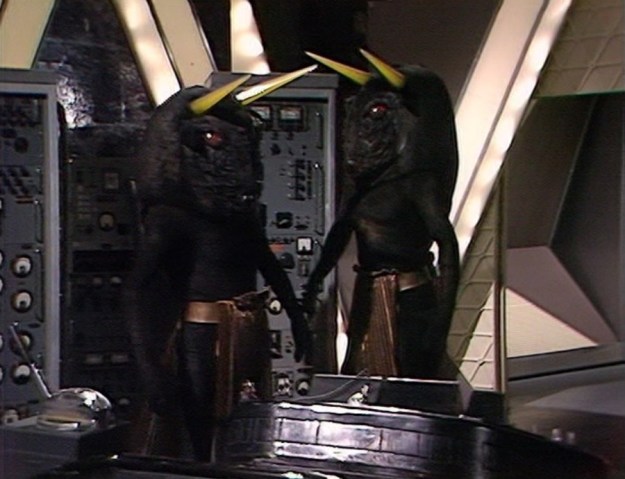
Nimon: Kill him. But not yet.
That makes no sense! Do you want him killed now or later? Make up your mind, Nimon! I know it’s supposed to sound funny, but it just illustrates how ridiculous the story can be sometimes when some of the humour doesn’t come off that well. It’s just adding onto the pantomime effect we have.
Despite my criticisms about the Nimon, they must have had an impact on me, as I included them in the fourth episode of ‘The Coins of Deno’ anthology called ‘The Scavenger Station’. They’ve also appeared in the Big Finish audio called ‘Seasons of Fear’ with Paul McGann. They’ve had their legacy.
They were also referenced in ‘The God Complex’ with Matt Smith and have appeared in the Thirteenth Doctor story ‘The Maze of Doom’. Regardless of whether you like the Nimon or not, they’re a part of ‘Doctor Who’s history, and hopefully in a better manner than what their debut gave us.
The original DVD special features were as follows. There was the ‘Who Peter – Partners in Time’ documentary, which focused on ‘Blue Peter’s relationship with ‘Doctor Who’ from 1963 to 1989; and the ‘Read the Writer’ interview with writer Anthony Read, who shares his thoughts about writing ‘The Horns of Nimom’ and the outcome of it. There were the ‘Peter Howell Music Demos’ for ‘The Horns of Nimon’ and a photo gallery of the story. There was a mono sound audio mix option for the story; and an audio commentary with Lalla Ward, Janet Ellis, Graham Crowden and writer Anthony Read. There was an info-text commentary option to enjoy; PDF materials including a ‘Radio Times Listings’ of the story and studio floor plans; and a ‘coming soon’ trailer for ‘The Creature From The Pit’, starring Tom Baker, Lalla Ward and K-9 (now available on Disc 2 of the Season 17 Blu-ray box set of ‘Doctor Who’, containing ‘City of Death’). There was also an Easter Egg to look out for on the DVD, which turned out to be a sketch featuring the Scottish Falsetto Sock Puppets.
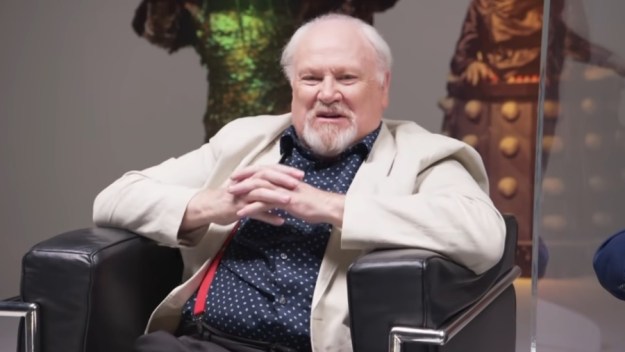
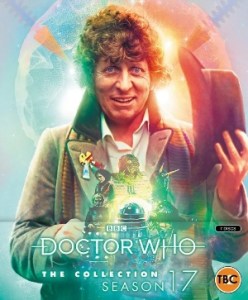
On Disc 5 of the ‘Doctor Who – The Collection – Season 17’ Blu-ray, the ‘Read the Writer’ interview with writer Anthony Read, the ‘Peter Howell Music Demos’, the mono sound audio mix option, the DVD audio commentary and the sketch featuring the Scottish Falsetto Sock Puppets can be found on there. The photo gallery and the info-text commentary option have been updated for 2021 on the Blu-ray. The ‘Who Peter – Partners in Time’ documentary is now included on Disc 7 of the Season 26 Blu-ray box set of ‘Doctor Who’. 🙂
The new special features on Blu-ray include the ‘Behind the Sofa’ feature on ‘The Horns of Nimon’ with Colin Baker (The Sixth Doctor) and Matthew Waterhouse (Adric) as well as Katy Manning (Jo Grant) and Nicola Bryant (Peri) as well as visual effects designer Mat Irvine, costume designer June Hudson and director Graeme Harper. There’s the ‘A Matter of Time’ documentary which looks into the Graham Williams era of ‘Doctor Who’ (taken from ‘The Ribos Operation’ DVD), ‘The Doctor’s Composer – Part Two’ interview with music composer Dudley Simpson (taken from ‘The Sun Makers’ DVD), a ‘Swap Shop’ item with Lalla Ward, a ‘Nationwide’ item with Lalla Ward and K-9, the ‘Ask Aspell’ interview with Lalla Ward (taken from the ‘Nightmare of Eden’ DVD), ‘The Panopticon Archive’ panel interview with Tom Baker from 1997, the LP audio version of ‘Genesis of the Daleks’, BBC trailers and continuity announcements of the story, and a ‘coming soon’ trailer for ‘Shada’ (the 2017 version), starring Tom Baker, Lalla Ward and K-9.
On the PDF front, as well as the ‘Radio Times Listings’ of the story and the studio floor plans (or are they now called ‘set design drawings’ on the Blu-ray?), there are production documents; scripts for the story, including four rehearsal scripts and four transmission scripts; and the ‘Genesis of the Daleks’ LP production documentation.
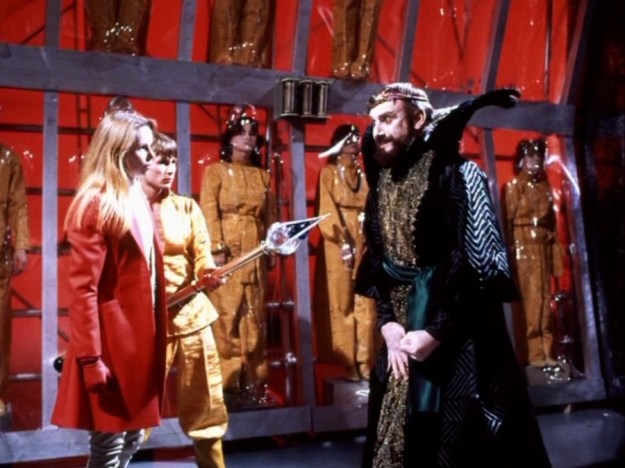
‘The Horns of Nimon’ is definitely a ‘Doctor Who’ pantomime of an adventure. It’s silly and ridiculous in places, but saying that…I had a fun time watching it, both on DVD and Blu-ray. I enjoyed it very much for the fun and inventive style that it had and I can’t help but love it for its ridiculousness here.
Even if the story doesn’t always work, especially in its pantomime aspects, I can’t help but get a sense of pleasure out of watching this ‘Doctor Who’ story. It’s very entertaining to watch, especially through Tom Baker’s performance as the Doctor and Graham Crowden’s performance as Soldeed. 🙂
The ‘Myths and Legends’ collection of ‘Doctor Who’ stories ended up being a fun collection for me, featuring sci-fi takes on the Greek myths. ‘The Horns of Nimon’ is definitely my favourite out of the collection, but they were all inventive and imaginative, which is what I like to find in ‘Doctor Who’. 🙂
It’s a pity Season 17 ended with ‘The Horns of Nimon’ on TV, as it was hoped by cast and crew that they would end the season on a high with ‘Shada’. Thankfully, for us ‘Doctor Who’ fans, we can enjoy how Season 17 could’ve ended with ‘Shada’ now available for us to enjoy on DVD and Blu-ray.
‘The Horns of Nimon’ rating – 8/10

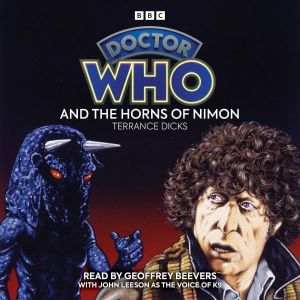
‘DOCTOR WHO AND THE HORNS OF NIMON’
Please feel free to comment on my review.
The Great Journey of Life
For Terrance Dicks
This ‘Doctor Who’ Target novelization/audiobook by Terrance Dicks is pretty solid! 🙂
‘The Horns of Nimon’ is definitely a ‘Doctor Who’ story that divides fan opinion. Some like it, some loathe it. Me personally, I consider it to be one of my favourite ‘Doctor Who’ stories from the Tom Baker/Fourth Doctor era as well as the classic TV series in general. It’s something I cherish very fondly.
It’s a guilty pleasure and I can forgive it for its ridiculousness and over-the-top acting. Even from revisiting the ‘Doctor Who’ story in the Season 17 Blu-ray box set, I was able to get a sense of pleasure and enjoyment. It’s one of those ‘Doctor Who’ stories I would happily revisit again and again.
But as ever, due to my curiosity getting the better of me, I wondered whether ‘The Horns of Nimon’ would simply be remembered for its ridiculousness and over-the-top-ness. I hope I won’t be. As far as I’m concerned, ‘The Horns of Nimon’ is a decent story, especially from the mind of Anthony Read.
I know it’s something that ‘Doctor Who’ fans can’t agree with, especially from the surface of what the story is like, but it’s something that I can get past without a problem. Like I did what with the ‘Batman Forever’ novelization, I pursued to read ‘The Horns of Nimon’ Target novelization in 2018. 🙂
I hoped Terrance Dicks’ take on the story would provide a solid narrative of what ‘The Horns of Nimon’ is about. Years later in 2024, I revisited the Target novelization with the audiobook release on Audible, read by Geoffrey Beevers and John Leeson providing the voice of K-9, which I enjoyed. 🙂
From what I could gather, the tale’s original author Anthony Read was commissioned to write a new novelization of ‘The Horns of Nimon’ for audiobook publisher AudioGo in 2013. I’m not sure if he completed the novelization by the time it was due to go into production for an audiobook release. 😐
I would have liked to have heard the new audiobook novelization by Anthony Read and delve more into the world of ‘The Horns of Nimon’ via his viewpoint. It’d match to how David Fisher interpreted ‘The Stones of Blood’ and ‘The Androids of Tara’ in novelization form when he wrote them for audio.
Unfortunately, AudioGo went into bankruptcy by the end of 2013, which meant the new ‘Horns of Nimon’ audio novelization by Anthony Read never saw the light of day. This is a shame, as I hoped the new ‘Horns of Nimon’ novelization audiobook wouldn’t be forgotten about and left unattended.
It’s also sad that Anthony Read passed away not long afterwards in November 2015. I was shocked to discover that when I did my research on ‘The Horns of Nimon’ novelization for my original review. I hoped the new ‘Horns of Nimon’ audio novelization would get released soon so we could hear it. 😐
Sadly, like when David Whitaker’s novelization for ‘The Enemy of the World’ never saw the light of day and was instead novelized by Ian Marter, it’s unlikely Anthony Read’s novelization of the story will be released anytime soon, especially with the audiobook for Terrance Dicks’ book now available.
That’s not to say that Terrance Dicks’ novelization of ‘The Horns of Nimon’ is bad. Oh no! On the contrary, I’m rather pleased with what Terrance provided in his novelization of the story, since he has made it stronger and compelling compared to how the tale was presented in its original TV form.
It also helps that Geoffrey Beevers is a very good narrator throughout the audiobook version of the Target novelization. I would question why Geoffrey Beevers is the narrator, considering he had no involvement in ‘The Horns of Nimon’ at all, but it’s a recurring pattern for these audiobook releases.
The fact that Geoffrey Beevers was in ‘The Keeper of Traken’, playing both the voice of the Melkur and the Master, and it was set during the Tom Baker/Fourth Doctor era seems to justify him being the right person to read the story. It’s weak reasoning, but still, Geoffrey Beevers is a superb reader.
It’s also great that John Leeson is the voice of K-9 throughout the audiobook version of ‘The Horns of Nimon’ novelization. At least we have a voice that sounds like K-9 compared to David Brierley (no disrespect) and it makes me wish John Leeson voiced K-9 throughout the Season 17 TV stories in 1979.
The original Target novelization by Terrance Dicks was published in October 1980, not long after the TV story was transmitted from December 1979 to January 1980. I’m quite amazed the original 1970s ‘Doctor Who’ logo was used for the Target novelization’s cover and not the 1980 ‘Doctor Who’ logo.
‘Doctor Who and the Horns of Nimon’ as a book is divided into 12 chapters with a prologue at the beginning. The book itself is slimmer compared to other ‘Doctor Who’ novelizations by Terrance Dicks. The audiobook release is about 3 hours and 4 minutes in total. A reflection on the book perhaps? 😐
It’s made clear Terrance Dicks didn’t regard ‘The Horns of Nimon’ very highly as a ‘Doctor Who’ story, according to author Paul Cornell in the ‘On Target: Terrance Dicks’ documentary, which I saw on ‘The Monster of Peladon’ DVD. You can also view it on the ‘Robot’ disc in the Season 12 Blu-ray box set. 🙂
I found this a very intriguing revelation to uncover when I did my research in preparation for the original review on the Target novelization back in 2018. You wouldn’t be able to tell that Terrance Dicks had a disdain for ‘The Horns of Nimon’, as his enthusiasm to write the book shines throughout.
Terrance also didn’t regard Douglas Adams highly as a ‘Doctor Who’ script editor, according to an interview with him in an issue of ‘Doctor Who Magazine’, which I read a while back. This I can appreciate, as Douglas Adams isn’t good on narrative and structure, despite his being good on ideas.
What I like about the official Target novelization by Terrance Dicks is that he doesn’t shy away from tackling some of the weaker aspects of the story that were clearly identified in the TV version during transmission. He amends on a lot of the dialogue given to the supporting characters featured in this.
He also clarifies some plot points featured throughout the tale. This helps in the book’s favour, as what were considered failings in the TV version are made up for when Terrance does his best to establish why certain things happen, particularly with the Skonnans, the Anethans and the Nimon. 🙂
The big selling point of ‘The Horns of Nimon’ novelization by Terrance Dicks is that he includes a brand-new prologue for the story. I enjoyed reading the prologue, as it gives us a history of the Skonnan Empire, Soldeed and what occurred with the Nimon’s arrival during Skonnos’ crisis – specifically the civil war.
There’s a sense of history in the prologue as well as certain parts of the novelization concerning Skonnos. For example, the First Empire Wars are referenced. Not given in full detail, but it illustrates what the First Skonnan Empire was like before its downfall as well as detailing the Nimon’s arrival. 🙂
Soldeed is developed rather interestingly as a character. Terrance makes it clear that Soldeed is no scientist. It was by luck he found a scientific resonance when he encountered the Nimon for the first time. It’s also made clear that Soldeed is a lunatic and is only interested in military value for Skonnos.
The advantage of a ‘Doctor Who’ Target novelization is that you can dispel the over-the-top acting that was featured in the story performed by the actors. This is certainly the case with Soldeed, since most of the hammy acting given by Graham Crowden is toned down by Terrance Dicks in the writing.
It’s also good when Geoffrey Beevers is reading and performing Soldeed’s lines instead of Graham Crowden, as he’s able to provide gravitas to the characters and not be over-the-top. Perhaps it was best that Geoffrey Beevers was chosen to be the narrator of ‘The Horns of Nimon’ Target audiobook.
I also like how the Nimon are voiced by the Geoffrey Beevers in the audiobook. Yes, there’s the electronic treatment provided to make them sound more ferocious and somewhat demon-like, but it’s a lot better compared to how they sounded in the TV version and they sound more intimidating.
I feel other guest characters are strengthened by Terrance Dicks’ writing. For example, Seth seems to be more heroic and strongly-written in terms of his dialogue compared to how Simon Gipps-Kent played him. Not that Simon Gipps-Kent’s acting is bad, but he did come across as wimpy sometimes.
When I originally read the book on its own in 2018, I found myself reading Seth’s dialogue as a character and found he was more competent in handling tricky situations during the story compared to how it was performed in the TV version. You emphasise more with Seth as a character in the story.
This is especially when he expresses doubts on his abilities to save Aneth and defeat the Nimon and how he wishes to please Teka without letting her down once he shares this with Romana. There are times where I wished I played Seth in the story. Working opposite Janet Ellis would be a plus for me. 🙂
Speaking of Teka, her capture by Soldeed in the ‘Part Four’ section of the story is handled well in the novelization than in the TV version. In the TV version, Teka had a gun but couldn’t fire it on Soldeed. In the novelization, Teka has no gun. She tried to flee before she ended up running into the Nimon.
The novelization’s chapter structure is unusual for ‘The Horns of Nimon’. Usually, it’s three chapters comprising an episode in the usual Terrance Dicks twelve-chapter structure. This time, it’s four chapters for ‘Part One’, three chapters for ‘Part Two’, two for ‘Part Three’ and three for ‘Part Four’. 😐
I’m not sure why Terrance divided up the story up like that compared to what he would normally do for a ‘Doctor Who’ Target novelization. Clearly, Terrance saw weaknesses in the plot, and he found certain scenes padding in the ‘Part Three’ section that he compressed to make the pace flow better.
I think this might be the case for the awkward pantomime “He’s behind you!” moments when the Doctor was seen coming up behind the Nimon whilst it was working away in pulling levers to bring a transmat capsule over from Crinoth. I’m glad those moments got omitted in the Target novelization.
I’ve mentioned in my TV review of this story that the Pilot and Co-Pilot characters are given names in the novelization. The Pilot is called Sekkoth and the Co-Pilot is called Sardor. I prefer those names compared to what they’re called in the TV story. Simply called ‘Pilot’ and ‘Co-Pilot’ isn’t that good. 😐
Sardor is also competent as a character in the book compared to the TV adventure. He’s still an idiot, but he’s an idiot with motives in wanting Skonnos to have new weapons and spaceships from the Nimon and gets impatient once things are in the way. He also says “Weaking scum!” less in the book.
Soldeed is also devious and cunning in the Target novelization than how he was on TV. The reasons why he has Sardor go through the Power Complex doorway as well as the Doctor are handled very effectively in the book, as he wishes to please the Nimon and not to be blamed for anything that goes wrong.
A lot of the story’s silly moments from the TV version are omitted in the novelization. The “Kill him, but not yet!” line by the Nimon for the Doctor is omitted, which is a relief for me, as it sounded silly anyway. The TARDIS console exploding and making comical sound effects have been removed too. 🙂
The story’s ending in the novelization is expanded on well compared to the TV version. There’s more information given between the Doctor and Romana about what happened after the Power Complex was destroyed with the Nimon still inside on Skonnos, since the two didn’t simply just leave Skonnos.
Information is given on how Skonnos and Aneth will cope following the events of this story, which I enjoyed reading. Sorak gets promoted to Skonnos’ new leader and the young Anethans’ journey back to Aneth is touched upon, including how the black Skonnan ship they came in is painted white.
The Doctor also makes a reference to the Theseus and the Minotaur legend in ‘The Horns of Nimon’ story. This was hinted at in the TV version of this story, but not explicitly referenced, which is a pity. I wondered why it was cut from the story’s TV version, as it was Anthony Read’s source of inspiration.
Terrance Dicks must have written his novelization based on the original scripts by Anthony Read. After all, the Doctor’s explanations for connecting the Theseus and the Minotaur legend to Seth’s battle with the Nimon are meant to stress that ‘The Horns of Nimon’ is based on that specific legend. 🙂
The Doctor also makes a reference to ‘Underworld’ in the closing moments of ‘The Horns of Nimon’. The same lines and interaction between the Doctor and K-9 from the closing moments of ‘Underworld’ are repeated here too. It’s just so surreal to hear that repeated in ‘The Horns of Nimon’. 🙂
Mind you, this could be down to the fact that Terrance Dicks novelized ‘Underworld’ too. 😀 In a way, Terrance wrote the ‘Myths and Legends’ trilogy of ‘Doctor Who’ in novelization form. He did ‘The Time Monster’ novelization, the ‘Underworld’ novelization and ‘The Horns of Nimon’ novelization. 🙂
‘Doctor Who and the Horns of Nimon’ is a great novelization by Terrance Dicks. I enjoyed reading and hearing it very much, finding it a faithful novelization of the ‘Doctor Who’ story. Terrance strengthens some of the story’s weaker points and it was very refreshing to check out his take on the story.
I’ve enjoyed revisiting the Target novelization with the audiobook release via Audible. Geoffrey Beevers does well with narrating the story and making it work better compared to how the TV version did things. I’m also happy John Leeson voiced K-9 in this ‘Doctor Who’ story for the first time. 😀
It’s a shame Anthony Read’s version of the audio novelization of ‘The Horns of Nimon’ hasn’t seen the light of day. I’d be very interesting to uncover what extra material he would have provided in his novelization of the ‘Doctor Who’ story, as it would be a tremendous tribute given to him by the BBC.
But for now, I’m happy that I’ve checked out Terrance Dicks’ novelization of the story and that I’ve been able to hear Geoffrey Beevers’ reading of the story along with John Leeson voicing K-9. It makes me appreciate ‘The Horns of Nimon’ even more and regard it as one of my favourite stories. 🙂
‘Doctor Who and the Horns of Nimon’ rating – 8/10
| The previous story
For the Fourth Doctor was
For Romana was
For K-9 Mk II was
|
The next story
For the Fourth Doctor is
For Romana is For K-9 Mk II is |
| Return to The Fourth Doctor’s Timeline | |
| Return to Romana’s Timeline | |
| Return to The Timelines of K-9 | |
| Return to The Doctors’ Timelines Index | |
| Return to The Companions’ Timelines Index | |
| Return to Doctor Who Timelines | |
| Return to Doctor Who | |
| Return to The World of Douglas Adams | |
| Return to Sci-Fi |
 Bradley's Basement
(Deep breath) Arrrrrrrrggggggghhhhhhhhhhhh The Horns Of Nimon, Arrrrrrrrrgggggggghhhhhhh……(Ok focus Simon focus) i do not like this one as you know from my review lol, Tom Bakers my favourite Doctor but i can’t excuse his lazy performance here going completely over the top on several occasions, Graham Crowden as Soldeed still gives me nightmares because his performance is pure pantomime & when the actor’s chew the scenery it takes away the drama from the story.
A excellent review as ever Tim & i appreciate you hold this one in higher regard than i do, it’s just not one i can rewatch often.
“My dreams of conquest”……Arrrrrrrrrrrgggggggggggghhh mind probe, mind probe, weres the mind probe.
LikeLiked by 2 people
Yeah. I knew this was coming. I know this isn’t one of your favourite Tom Baker stories and I appreciate that.
I know Tom Baker is bonkers as the Doctor in this, but I honestly can’t help but like his performance. He goes over the top on several occasions yes, but there are moments where I think he’s really good, especially when he confronts Soldeed about where Romana is.
I can’t help but enjoy Graham Crowden in this story. He’s over-the-top yes, but it’s a performance I find easy to enjoy especially when he’s the villain and misguided in believing the Nimon will save Skonnos for him. The downfall for him is in those last scenes with ‘My dreams of conquest…’ line and him saying “You are all doomed!” just like Frazer from ‘Dad’s Army’. At least he didn’t say “I’ve got an everlasting cold!” as he originally intended since that was cut.
I found this story an improvement from ‘Underworld’ in the ‘Myths and Legends’ DVD box set. At least this story’s not ‘Love and Monsters’! 😀
I’m looking forward to reading the novelization of ‘The Horns of Nimon’ by Terrance Dicks soon. I hope that’ll be an improvement on the TV story when I come to read it.
Glad you enjoyed my review on this story that I know divides fan opinion. I know you don’t hold this story in high regard as I do, but I’m glad you appreciate my thoughts on it.
Tim. 🙂
LikeLiked by 1 person
If the novelization had been the tv story this would’ve been a far better adventure, i completely agree with your review on this novel, the novelization of the story is richer, the silliness from the tv episodes is removed & the story’s plot makes more sense & is far more engaging than that seen on tv.
Excellent reviewing Tim.
LikeLiked by 2 people
Hi Simon.
Very pleased you enjoyed my review on ‘The Horns of Nimon’ novelization. I’m glad you agree with me on my thoughts on this novelization and that the TV story could have been better with the weaker elements removed including some of the sillier moments.
I hope Anthony Read’s novelization/audiobook will get released soon as I’d like to find out what that version of the story is like from the original author’s point of view with a new perspective on it.
Tim. 🙂
LikeLiked by 1 person
Excellent re-review of the blu ray Tim, sadly a change in format cannot change how bad this story is, the production values are one of the worst, nobody is trying create drama or suspense & the acting is terrible.
A shame because the novelization is a cracking story & that adaption is one I’d wish we’d seen on tv instead of the pantomime version we ended up with.
LikeLiked by 2 people
Hi Simon,
Glad you enjoyed my updated review on ‘The Horns of Nimon’. I appreciate your feelings about this ‘Doctor Who’ story, but I still get enjoyment out of watching it every time I see it. Yeah, the novelization version of the story would’ve worked better compared to the TV version. I hope we’ll get the audiobook for the Target novelization of ‘The Horns of Nimon’ soon.
Many thanks for your comments.
Tim 🙂
LikeLiked by 1 person
Great review Tim.
I don’t think ‘The Horns of Nimon’ is a great ‘Doctor Who’ story, even though I don’t rate it as low as Timelord007 does. I’d actually forgotten that you’d given me a cameo in this. 😀
I actually found this story to be better than ‘Destiny of the Daleks’. I found Graham Crowden’s performance to simply be eccentric for the most part, although it did get OTT by the final part I felt. Graham Crowden was typecast as eccentric authority figures, ‘A Very Peculiar Practice’ being a fine example. Did you know that Graham Crowden was an old friend of Tom Baker?
I think Malcolm Terris gave Graham a run for his money, especially when he was killed by the Nimon. I agree that he was annoying, mostly given that he called the sacrifices “Weakling scum!” every time he saw them. As for the Nimon, I didn’t mind their design or voices. I found it funny when Nicola Bryant said their voices sounded like electronic indigestion.
Interesting that Anthony Read wrote a new novelisation for AudioGo before his death. I believe David Fisher did the same with ‘The Stones of Blood’ and ‘The Androids of Tara’. They’ve both been released by BBC Audio, so I think there’s a possibility of us seeing the expanded ‘Horns of Nimon’ novelisation.
Just as a side-note, there’s something I’d like to mention about ‘Destiny of the Daleks’. You said “You’d think that (Douglas Adams) would know the Daleks since he is a ‘Doctor Who’ fan’.” I suppose that’s a good point, but then again you and Nick Briggs thought that Terry Nation had forgotten that the Daleks are organic creatures on the inside, and he created them.
I’m sure I’ll enjoy ‘Shada’ when I get around to it. Tomorrow morning, I will be sharing my thoughts on ‘Invasion of the Dinosaurs’. I must also read more of ‘The Scavenger Station’.
Take care, WF92.
LikeLiked by 2 people
Hi WF92,
Glad you enjoyed my review on ‘The Horns of Nimon’. Thanks for sharing your thoughts on the story. I still consider this a guilty pleasure, even though I’m willing to admit it’s not one of the greatest stories in ‘Doctor Who’s history. Thanks for your cameo in my review. 😀 I must check out ‘A Very Pecuilar Practice’ sometime. I sort-of guessed that Tom Baker and Graham Crowden were friends whilst making ‘The Horns of Nimon’. There’s that amusing story where Tom, Lalla and Graham watched ‘Alien’ at the cinema and Tom suggested in his booming voice that the crew should ‘bore the alien to death’. 😀
Yeah Malcolm Terris did get annoying with his ‘weakling scum’ repetition. It’s amusing when he ripped his trousers once the Nimon killed him. 😀 I enjoyed the Nimon in this adventure, even if their costumes are poor and I don’t mind the voices they had. I must get around to reviewing ‘Seasons of Fear’ with Paul McGann sometime. 🙂 I hope an expanded version of ‘The Horns of Nimon’ will be released soon, whether it’s by the late Anthony Read or not.
Regarding ‘Destiny of the Daleks’, I’m not sure who’s to blame on the Daleks being more robotic than usual – whether it was Douglas Adams or Terry Nation. Either way, the Daleks weren’t impressive in that story. I wrote ‘Doom of the Daleks’ in reaction to ‘Destiny’ with the Daleks and the Movellans being enemies to each other in terms of their intellect and had the Daleks and the Dwaxi be enemies to each other in terms of their aggression.
Hope you enjoy ‘Shada’ when you see it. I look forward to your thoughts on it. Also looking forward to your thoughts on ‘Invasion of the Dinosaurs’. Hope to hear from you soon about ‘The Scavenger Station’. Hope you’re enjoying it so far.
Many thanks for your comments.
Tim 🙂
LikeLiked by 2 people
The Horns Of Nimon was a sure sign that the Graham Williams era had gone as far as it could creatively go. Indeed when John Nathan-Turner took over, Tom Baker had the better chance of recapturing some of his 4th Doctor seriousness and certainly when opposing the Deciders in Part 3 of Full Circle. I understood that Douglas Adams saw his comedic impositions on Doctor Who’s S17 as a way to show the BBC would he could do for sci-fi comedy on British TV. Chiefly as a way to give the TV series version of The Hitchhiker’s Guide To The Galaxy off the ground. But speaking as someone who nowadays prefers the more serious stories of the classic Doctor Who, even with Tom Baker’s humor, The Horns Of Nimon is one of the few that wouldn’t be high on my re-watch list. Even though I once found it in my heart to get the DVD for my nephew’s Doctor Who collection. Thank you, Tim, for your review.
LikeLiked by 2 people
Hi scifimike,
Thanks for sharing your thoughts on ‘The Horns of Nimon’. It’s a shame that Season 17 ended on ‘The Horns of Nimon’ instead of ‘Shada’, as ‘Shada’ would have provided the swansong the Graham Williams era of ‘Doctor Who’ deserved after three years before John Nathan-Turner took over as producer. I didn’t think that Douglas Adams was attempting to demonstrate to the BBC what could be done with doing sci-fi comedy on TV as well as getting the TV version of ‘The Hitchhiker’s Guide to the Galaxy’ off the ground. Thanks for sharing your insight on that. I appreciate ‘The Horns of Nimon’ not having so many fans, but I still enjoy revisiting the story now and again and I’ve greatly enjoyed revisiting the story through its Target novelization/audiobook, read by Geoffrey Beevers with John Leeson as the voice of K-9.
Many thanks,
Tim 🙂
LikeLiked by 1 person
I’ll have to echo the thoughts of others that have commented here. The Horns of Nimon is the kind of story that tends to be brought up in ironic tones. I’d consider it a pretty unworthy finale for the Graham Williams era as a whole.
Stepping out from the shadow of Philip Hinchcliffe and Robert Holmes was hard. It was — and still is, many some circles — regarded as a golden age of Doctor Who. Where the strengths of the Pertwee era soared into global popular consciousness. If you don’t know the programme, you know still know Tom Baker in his multicoloured scarf.
Williams had to succeed that success with no budget, an increasingly unstable lead actor and against cries that Doctor Who had become too violent (it’s an old, old cry). While he didn’t have a conclusive break from his predecessors’ style as Hinchcliffe and Holmes had with The Ark in Space, there was nevertheless a continental shift that rippled through Williams’s first season.
It was a post-Star Wars era of Doctor Who. Things swung towards fantasy and myth. We started focussing on mythology, satire, and bold strokes. Baroque. The increasingly irascible behaviour of the Doctor culminated in a finale — The Invasion of Time — that painted him the starring villain. That’s a pretty bold concept.
Williams continued that in The Key to Time. A whole season devoted to a singular quest to save the Universe. We left the pragmatism of Holmes behind and embraced a far starker battle of light and dark. Romana stepped into the fold, succeeding Leela as a worthy deuteragonist to a bombastic, but nevertheless “toned down” Fourth Doctor.
And while that tone of comedic slapstick is there in all three seasons, it’s only in Williams last — the one he’s typically remembered for — that things go off the rails. The City of Death, for all its praise, is the exception, rather than the rule. It’s a season about not judging things by appearances. In everything from the Movellans to the Vraxoin smugglers to Professor Chronotis. Good concepts. But drowned by a sketch comedy tone more at home in The Goodies than here.
As The Invasion of Time felt like an exorcism of the Doctor’s “grey anarchist” persona from Holmes’s time, so too does The Horns of Nimon feel like a final hurrah to slapstick. We get it out here, so we don’t have to carry it through to the John Nathan-Turner era. You know how badly something has misfired when a story about human trafficking (the sacrifices for the Nimon) is done as farce.
Nevertheless, I will say that The Horns of Nimon does one thing terribly well, as the Williams era did as a whole. As goofy as the story is… It’s a great showcase for Lalla Ward’s Romana. She leads it, she steps up to fulfil the role of the Doctor, and this is something that the Williams era tended to do quite well. Distinctive roles for women — Leela, Rodan, Mother Tyler, the Seeker, Professor Rumford, Adrasta, the Countess Scarlioni, to name a few.
The Horns of Nimon is not a good story, but credit to Lalla Ward — she’s trying her darndest despite that. She might be the only one outside of Sezom or Seth who is on this one…
LikeLiked by 2 people
Lalla Ward, whom I’ve always liked as Romana, did a very good job holding it together in this one which, indeed in the wake of Star Wars, can always be greatly appreciated within the visually underwhelming production values of sci-fi shows like classic Dr. Who, The Tomorrow People and Blake’s 7.
LikeLiked by 2 people
Hi Wolfie,
Thanks for sharing your thoughts and insight on ‘The Horns of Nimon’ and the Graham Williams era of ‘Doctor Who’ overall. I’ve more fondness for Graham Williams’ era as the producer of ‘Doctor Who’ compared to others, but I do appreciate the comedy went too far by the time we got to Season 17. It’s with the benefit of hindsight that we can see how things could have turned out differently had ‘Shada’ been made as the season finale instead and we could see the potential of how good the Graham Williams/Douglas Adams period could have been. The competition that ‘Doctor Who’ went up against with ‘Star Wars’ must have been a strain for the production team.
I can’t despise ‘The Horns of Nimon’ as many fans seem to have taken to it, particularly in its pantomime-like atmosphere, but I acknowledge that it might have been best if Season 17 and the Graham Williams era overall didn’t end on that note. The concepts by Antony Read as the story’s writer are very good, especially with it being a sci-fi take on Theseus and the Minotaur. It’s something I’ve appreciated when revisiting the story in its Target novelization/audiobook. It’s such a shame that the execution of that story on TV isn’t as good as it could have been. I’m pleased with how Lalla Ward as Romana is depicted in this ‘Doctor Who’ story and it’s something that’s inspired me with how I’ve written companions in my ‘Doctor Who’ stories when they’re without the Doctor for a bit.
Many thanks,
Tim 🙂
LikeLiked by 1 person
Cheers, Tim and Scifimike. Doctor Who does seem to have something of an Achilles’s Heel when it comes to Greek mythology, doesn’t it? Whether its Minotaurs, lost continents or argonauts, the programme did seem to struggle quite a bit with bringing them flawlessly to life.
Ripped from its production constraints, Terrance Dicks’s novelisation wrings as much atmosphere as he can from the script’s ideas. Skonnos is given a strong sense of doom and decay. It’s a world ripe for harvest even before the Nimon showed up. If not them, the Skonnans would’ve have fallen on their own sword before long.
I don’t think it’s a story deserving of out-and-out loathing. It’s… Well… It’s not distinctive enough, really, to really warrant such an expenditure of energy. I can understand it for something like Time and the Rani — the new debut of a new Doctor — but not here. It’s a meat-and-potatoes piece. Nothing revolutionary, just standard Doctor Who.
That said, it’s not an easy serial to “fix”, as such. Warriors of the Deep suffers from a diabolical production, but the script itself is quite tight. It’s a techno-thriller with what could have been nail-biting suspense. The Doctor at its centre. The Horns of Nimon, in contrast, keeps forgetting what to do with him. He’s… Where is he now…? He’s… Oh, hell, it’s misplaced him. Hold on, hold on…
It reminds me a little of The Time Monster, actually. There, it’s one of the very few times that the Doctor isn’t leading events. It’s the Master. It’s actually his story. Unfortunately, because the serial doesn’t realise this, it’s doing a lot of “hurry up and wait” with both the Doctor and Jo.
Romana can still have her story. It’s fine for her to lead (and Ward takes to it like a duck to water). But, the Doctor is oddly superfluous in every aspect. He doesn’t have to be there. More so, the story feels like it doesn’t want him there, either. Like he’s upstaging the narrative itself.
That’s… definitely a problem.
LikeLiked by 2 people
Hi Wolfie,
Interesting how you’ve highlighted the Doctor being absent in most of this ‘Doctor Who’ story as well as in a story like ‘The Time Monster’. I’ve enjoyed Tom Baker’s performance in this ‘Doctor Who’ story, although I can see your points on how his role turns out here. I think the humorous lines given to him are meant to compensate for some of his absence whilst Romana takes up most of the action. I sort-of did a similar thing in one of my stories called ‘Chieftain’s Caves’, although I did the reverse on that where the Fifth Doctor and Nyssa were at the forefront and Billy was kind-of taking a backseat.
I’m looking forward to revisiting ‘The Time Monster’ in Season 9 on Blu-ray and in novelization/audiobook form as well as ‘Underworld’ in Season 15 on Blu-ray to re-examine what are considered mediocre stories, as the ‘Myths and Legends’ stories of ‘Doctor Who’ in the classic TV series aren’t regarded very highly. I acknowledge them for being interesting sci-fi takes on Greek myths and legends, but it’s clear how fans don’t seem to take a liking to them. I’ve enjoyed all three stories despite their absurdity at times and ‘The Horns of Nimon’ adds to that guilty pleasure I have in checking it out as a ‘Doctor Who’ story.
Many thanks,
Tim 🙂
LikeLiked by 1 person
Romana’s time with Sezom in Part 4 was very nice.
LikeLiked by 2 people
Hi scifimike,
Well, when Sezom is played by John Bailey, the actor who played Edward Waterfield, Victoria’s father, in ‘The Evil of the Daleks’, it’s hard not to appreciate, enjoy and love the scenes between Romana and Sezom. I believe Lalla Ward got on well with John Bailey, as it’s clearly shown in their scenes together. I’ll have to re-check the audio commentary to be sure of that.
Many thanks,
Tim 🙂
LikeLiked by 1 person
From the man who brought you the exquisitely anguished: “How many people must die so that my daughter can live?“
Bailey adds a much needed edge of pathos to a character who exists primarily for exposition. Nothing really beyond that. If you tilt your head and squint, he was probably intended to be a bit of commentary on Soldeed. Sezom being a preview of what was to come with the scientist.
Ooh, actually… Sezom looks a lot like Romana’s companion for the story. Beyond Seth and Tekka. I like that interpretation a lot.
The Crinoth scenes are a rare part of the story that are played dead straight and it’s genuinely apocalyptic. Everything feels as though it’s gone badly wrong. With just a handful of reused sets, a unique character, and darker lighting.
LikeLiked by 2 people
Hi Wolfie,
Yes, I agree with you. The Crinoth scenes featuring Romana and Sezom are played dead straight and it’s where you can take the story seriously compared to being on Skonnos where Soldeed can be over-dramatic at times. Even with the Nimon lumbering about on Crinoth, you can take their threat seriously, especially when Romana’s trying to flee from them and when Sezom is helping her to get back to Skonnos. Arguably, the Crinoth scenes are the best in ‘The Horns of Nimon’.
Many thanks,
Tim 🙂
LikeLiked by 1 person
I must agree and certainly with Romana being able to keep it all together without the Doctor on Crinoth.
LikeLiked by 2 people
It’s actually got me thinking about Season 17, as a whole. Excluding City of Death, which is a statistical and tonal outlier, the most successful all-round story of the production block might just be Nightmare of Eden.
Probably because “Doctor Who fights drug dealers” would have been in spectacularly bad taste if it had been done as a send-up. The central concept is very strong and the weaknesses in the production itself are typically only the visual/special effects. Not a unique problem to Nightmare by any stretch.
It also has some genuinely disturbing developments. Captain Rigg being spiked to unknowingly become an addict. The police officer who decides killing the Doctor (and later Romana) is easier than admitting he’s lost control. K9’s genuine fear at crossing the dimensional threshold.
I’d put the massacre of the passengers in there, too, but the production doesn’t quite pull it off. The idea is genuinely good horror. Its execution… Not quite. Very close, though. (Rigg’s attack on Romana is more effectively uncomfortable.)
The best all-round production may just be The Creature from the Pit. Excluding the obvious prop problems with Erato. The studio-bound jungle set is only matched by the intricacy of the one for Planet of Evil. The programme will never top it again. It’s only the unnecessary fourth episode and the reliance on a kaiju-style creature (another recurring VFX struggle — Kroll, the Skarasen…) that hold it back.
Destiny of the Daleks shows Douglas Adams’s interest in computerised warfare (something that I think The Armageddon Factor actually did better) and Shada would have been the last of the Gallifrey Lite stories (a la Underworld, The Brain of Morbius, et al.).
I think Season 17, as a whole, struggled because:
a) The goofier gags were upstaging the drama (Season 24 will, too, struggle from this), but also;
b) The visual effects department couldn’t keep up with some of the grander ideas, and;
c) Coming off The Key to Time, a return to stand-alone adventures was always going to feel like a step down.
When John Nathan-Turner steps into the role of a producer, Doctor Who is actually — ironically enough — going to veer away from science-fiction for a season into science-fantasy. Tom Baker’s final stories will be filled with doppelgangers, vampires, lion-men, murderous golems, and monks chanting chaos into order. The creations of children’s storybook fiction.
The pendulum won’t swing back to science-fiction, really, until the Fifth Doctor arrives on the scene. Earthshock will solidify it and the programme will start looking at ideas that are a lot more… Well, “mature”, is a word that could be used. “Bleaker”, is another. It will depend on your mood.
Doctor Who will throw off the overt gags and goofery and show that — like the drugged-up Captain Rigg or power-crazed Soldeed — maybe we shouldn’t be laughing while people are being killed… Maybe that’s something that we should actually be treating with a bit of gravitas…
LikeLiked by 2 people
Hi Wolfie,
Thanks for sharing your overall thoughts on Season 17 of ‘Doctor Who’. I like it when a ‘Doctor Who’ season can do a variety of storytelling from having a light-hearted adventure to a dangerous more serious adventure. Some seasons can pull this off quite well in both classic and new series terms. Seasons 17 and 24 do struggle with trying to tell stories that have good concepts overlaid by comedic atmospheres. Unless you strike the right balance in a ‘Doctor Who’ season with a blend of comedy-drama and serious stories, there’s always a risk of the season not going to be credible as it can be. I prefer ‘The Key to Time’ season over Season 17 because it manages to strike a balance of comedy, drama and horror whilst Season 17 veers in the more pantomime areas, particuarly in ‘The Horns of Nimon’. Again, it’s a shame ‘Shada’ never got completed as a TV production in 1979 as that would have sealed the Graham Williams era of ‘Doctor Who’ on a more satisfying and decent note compared to what ‘The Horns of Nimon’ does as a season finale (even though it’s not supposed to be that).
Many thanks for your comments.
Tim 🙂
LikeLiked by 1 person