
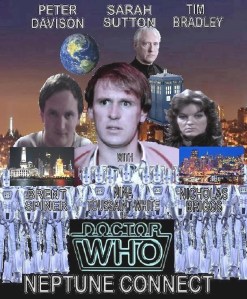
Hello everyone! 🙂
Welcome to ‘Bradley’s Basement’ blog and I’m Tim Bradley.
At long last! I’ve finished uploading my latest ‘Doctor Who’ story called ‘Neptune Connect’ on ‘Bradley’s Basement’. I apologise that this has taken me longer than I intended, but I’ve been sidetracked with other projects and there has been a lot to edit and improve upon with sharing the story online compared to when I first wrote it back in 2014. Anyway, here it is! Today, I’m sharing ‘Part Four’ of ‘Neptune Connect’ in ‘The Fifth Doctor by Tim Bradley’ series. I’m very pleased I’ve been able to complete this epic ‘Doctor Who’ story featuring the Fifth Doctor, Nyssa and Billy battling against the Cybermen in San Francisco in the year 2054.
Whether you’re picking up where you left off with this story from the end of ‘Part Three’ or whether you’re checking out this story for the first time, I’m sure you’ll enjoy it. Hopefully, I get onto uploading and sharing the next ‘Doctor Who’ story in my ‘Fifth Doctor’ series called ‘Swing Time’ sooner than later. I’m aiming to start sharing the story at least by early 2026. There are other projects for me to do such as the 10th anniversary celebrations in September this year as well as the upcoming ‘Nyssa Challenge’ mini-review season for December, but hopefully it won’t stop me with making a start on uploading ‘Swing Time’. I’m looking forward to it.
Here’s a summary of what ‘Neptune Connect’ is all about.
The Doctor once lost a friend because of the Cybermen. When a fleet attacks the planet Earth, the TARDIS intervenes, only for the Cybermen to escape through a temporal vortex into Earth’s timeline. The Doctor, Nyssa and Billy glimpse an alternative Earth dominated by the Cybermen. To find out what happened and how the timeline was altered, the TARDIS crew follow them back to Earth’s past in the year 2054.
Please check out the link to ‘Neptune Connect’ where you can find the introduction to the story by me as well as ‘Parts One, Two, Three and Four’. ‘Part One’ contains the prologue and Chapters 1 to 4 of the story. ‘Part Two’ contains Chapters 5 to 8, ‘Part Three’ contains Chapters 9 to 13, and ‘Part Four’ contains Chapters 14 to 17. You can access the introduction, the prologue and the chapters in ‘Parts One, Two, Three and Four’ of the story by clicking on the available links on the ‘Neptune Connect’ page.
Enjoy!
Stay tuned for ‘Swing Time’ coming soon to ‘Bradley’s Basement’.
Please also feel free to check out my other stories in the rest of ‘The Fifth Doctor by Tim Bradley’ series as well as in ‘The First Doctor by Tim Bradley’, ‘The Second Doctor by Tim Bradley’, ‘The Third Doctor by Tim Bradley’, ‘The Fourth Doctor by Tim Bradley’, ‘The Sixth Doctor by Tim Bradley’, ‘The Seventh Doctor by Tim Bradley’, ‘The Eighth Doctor by Tim Bradley’, ‘The Ninth Doctor by Tim Bradley’, ‘The Tenth Doctor by Tim Bradley’, ‘The Eleventh Doctor by Tim Bradley’, ‘The Twelfth Doctor by Tim Bradley’ and ‘The Thirteenth Doctor by Tim Bradley’.
Thanks for reading!
Bye for now!
Tim 🙂
 Bradley's Basement
Hold up… You wrote the draft back in 2014?? That’s ten years ago.
Okay, I want to know what changed in your writing processes between 2014 and 2025. Did anything have to be tweaked to keep it Doctor Who or was it otherwise timeless?
LikeLiked by 2 people
Hi Wolfie,
There were plenty of cosmetic changes required when uploading ‘Neptune Connect’ to my blog. There were also improvements needed for the characters’ dialogue, particularly for the Cybermen, and I needed to improve a part of the story’s ending involving Nyssa. And I changed the future year of this story from 2024 to 2054. Otherwise, most of what I wrote back in 2014 is about the same as my story is now in 2025.
Best wishes,
Tim 🙂
LikeLiked by 1 person
Cyber-dialogue is deceptively tricky, yes. Contrary to initial impressions, they actually have quite a lot variety over their half-century of appearances.
The Daleks, naturally, have remained broadly consistent. Their dialogue has truncated. Their cadence has become more clipped. The essence of what they say and how they say it, however, isn’t too far removed from their first appearances in 1964:
‘We do not have to adapt to the environment. We will change the environment to suit us.’ (The Daleks)
‘Yes. You gave us life. [We bring you death.]’ (The Power of the Daleks)
‘When it is time for you to die, you will, in your agonies, beg to pay homage to the Daleks.’ (Resurrection of the Daleks)
‘You would make a good Dalek.’ (Dalek)
Cruel judgement. An edge of sadism. The refutation of empathy. Daleks are racism personified.
The Cybermen, conversely, are an absence of motive. Their dialogue is heavily predicated on whoever they’re acting against. The conversation that the Cyber-Leader has with the First Doctor and Polly in The Tenth Planet is wholly different to the one with the Fourth Doctor in Revenge of the Cybermen.
Nevertheless, we can point to dialogue and say: ‘That sounds like a Cyberman.’ Big Finish played a large part in homogenising them in their language. ‘You belong to us, you will be like us,’ was only used verbatim in The Tomb of the Cybermen (and rehashed with Lytton, after a fashion, in Attack of the Cybermen). However, it would be hard to go through an audio from the company’s beginnings and not find some variation on that line.
‘You will become like us,’ was the most common.
After The Reaping: ‘There is nothing to fear,’ was added to that.
The overt emotionalism of 70s and 80s Cybermen was always a sticking point. I really loved Steve Lyons’s explanation in Killing Ground. The Sixth Doctor identifies the mimicry of emotion as a psychological tool against the unconverted. The use of body language, replicating a feeling, without the actual feeling itself. It’s a sociopathic response.
Someone also suggested the possibility that with certain kinds of Cybermen, the emotional repression spills over into unpredictable — and often violent — demonstrations of unchecked feeling. Hence why certain Cybermen go rogue and stay rogue. It’s pain or rage or another emotion superseding the hardware and taking over all autonomic function. Essentially, death spasms.
In that context, David Banks’s Cyber-Leader is a bit of an oddity. He’s the Cyberman who goads his opponents. It fits the more psychological interpretation of the post-Earthshock Cybermen.
Why attack the conference on Earth? It will demoralise the Cybermen’s enemies. Why let Stratton and Bates run free? There’s scientific value in watching them fail. Why let Lady Peinforte see into her own tomb? Her mania will give her a psychological handicap in combat.
In The Tenth Planet, there’s a sense the Cybermen genuinely don’t understand empathy and compassion (The Doctor’s response to their apathy is an enraged: ‘”Why…?” “Why”?). By Earthshock, they’ve not only understood it, they’ve weaponised it against their enemies (‘You have affection for this woman? […] I now have power over you, Doctor.’).
LikeLiked by 1 person
Hi Wolfie,
Thanks for sharing your thoughts on Cyber-dialogue and how it’s evolved considerably over the years. I suppose in my writing of ‘Neptune Connect’, I was basing the Cybermen’s dialogue more from how I’ve seen and heard them in the new TV series as opposed to classic TV stories like ‘Earthshock’. I wanted to experiment with how a new series-styled set of Cybermen would match against the Fifth Doctor, Nyssa and Billy.
From what I’ve seen in the Cybermen in stories like ‘Rise of the Cybermen’/’The Age of Steel’, the dialogue comes across as more robotic and monotone compared to how they’d sound in 1980s stories, as the emotion is clearly absent in how they speak. It’s what I often expect cybernetic creatures to sound, matching to how the Borg in ‘Star Trek’ communicate with each other and to those they come into contact with.
It’s been a fascinating experience writing the Cybermen and their dialogue in ‘Neptune Connect’, but it’s been fun to do, especially when they have scenes with each other as well as with the Doctor and other characters. I’ve also found it challenging and interesting how to develop certain Cyber characters like the Cyber Controller within the limitations of not giving them much emotion in their dialogue.
Many thanks and Best wishes,
Tim 🙂
LikeLike