‘THE HITCHHIKER’S GUIDE TO THE GALAXY’
Please feel free to comment on my review.
The Book is Not What You Expect It to Be
As I’m sharing my review on this book, it’ll be ‘The Hitchhiker’s’ series’ 48th anniversary!
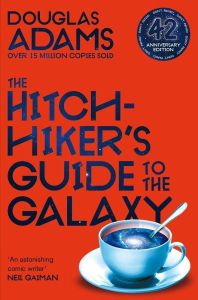
Back in early 2020, I purchased ‘The Hitchhiker’s Guide to the Galaxy’ book from Waterstones in Cardiff. The book was first published in 1979. I purchased the 42nd anniversary paperback edition of the book, which is quite fitting regarding the number 42. 😀
By 42nd anniversary, I mean, of course, the 42nd anniversary of ‘Hitchhiker’s’ as a series, not of the book itself. If this book had its own 42nd anniversary edition, it would have been printed in 2021. I’m not sure if any more editions of the book had been printed since then.
My original intention was to read the book as well as review the first series of ‘Hitchhiker’s’ called ‘Primary Phase’ sometime in 2020. But as plans go, they didn’t happen, as I was working on other projects back then. I don’t think the Covid-19 pandemic helped matters.
In the end, I reviewed ‘Primary Phase’ in 2022 and here I am sharing my review on the first ‘Hitchhiker’s’ book in 2026. This often happens when I purchase a book with the intention of reading it, as I initially planned to read the first ‘Back to the Future’ novelization in 2020.
I hope I’ll be able to check more versions of ‘Hitchhiker’s’, including its follow-ups through radio, TV, books and the 2005 film, and I hope to check them out sooner rather than later. It depends on what other items I’ve in mind in terms of reviewing, whether it’s TV, film or audio.
‘Hitchhiker’s’ as a franchise is unusual when you think about it. Don’t get me wrong, it’s very popular. Douglas Adams has achieved a worldwide phenomenon when he started doing the radio series before ‘Hitchhiker’s’ became something more in other mediums. 🙂
But it’s not a very straightforward franchise. I’m alluding to the fact in how the radio series, the books, the TV series and the 2005 film were produced and how their continuities are handled. This is particularly the case when some of them are handled by Douglas Adams. 😐
‘Primary Phase’ was released in 1978 whilst the first ‘Hitchhiker’s’ book was released in 1979. Now, from that, you would be easily led into thinking that the first ‘Hitchhiker’s’ book is essentially a novelization of ‘Primary Phase’. And it is. But it’s only up to a point. 😐
The first ‘Hitchhiker’s’ book isn’t a novelization of all six episodes of the first ‘Hitchhiker’s’ radio series, as I was expecting it to be. It’s actually a novelization of the first four episodes of the first ‘Hitchhiker’s’ radio series. It’s intriguing when you uncover that fact from reading the book.
I don’t think the first ‘Hitchhiker’s’ radio series was meant to be six episodes. I believe it was meant to be four episodes, but it got extended to six at some point. The fifth and sixth episodes were written by Douglas Adams and John Lloyd, one of his friends and colleagues.
I get the impression that Douglas Adams wasn’t happy with how the fifth and sixth episodes turned out. Or at least, he didn’t feel the inclusion of the Restaurant at the End of the Universe as well as ending up on prehistoric Earth weren’t utilised to their full value.
At least in the radio series. I don’t know how they’re included in the second ‘Hitchhiker’s’ book ‘The Restaurant at the End of the Universe’, as I’ve yet to read that. But I imagine more time is spent on those plot points in the second novel than for the first radio series.
The point being, the first ‘Hitchhiker’s’ book doesn’t end with Arthur Dent and Ford Prefect on prehistoric Earth. It ends with Arthur, Ford, Zaphod Beeblebrox, Trillian and Marvin escaping from Magrathea and heading off to the Restaurant at the End of the Universe. 🙂
One could be disappointed about the first ‘Hitchhiker’s’ book not being a note-for-note novelization of the first radio series. But frankly, never knowing what to expect from Douglas Adams and his writing, I shouldn’t be surprised by the first book’s presentation.
It just makes me more aware of the fact the continuities in the radio series and the book series don’t always match, especially when Douglas Adams tends to change and improve on things from what was in the radio series compared to what’s in the books and TV show.
It also made things more interesting when I read the preview for ‘The Restaurant of the End of the Universe’ book at the end of the first book, as the story doesn’t directly go into the fifth episode of the first series. You’d think that’d be the case in reading the second novel.
However, certain scenes from the second ‘Hitchhiker’s’ radio series are put in at the start of the second book before we resume what was in the fifth and sixth episodes of the first radio series. I’ll have to hear the second radio series and read the second book to be sure.
It makes the continuities of the radio series and the book series messy when trying to match them up and identify what’s similar and what’s different. Douglas Adams clearly changed things when writing radio and book versions of ‘Hitchhiker’s’ at the same time. 😐
I highly recommend checking out Dominic Noble’s video on ‘The confusing timeline of ‘The Hitchhiker’s Guide to the Galaxy’ adaptations’, as it provides more clarity on when the radio shows and novels were released and how often they criss-cross with each other.
It’s one of the reasons why I didn’t immediately check out the second radio series nor read the first book after immediately doing my review on ‘Primary Phase’ in 2022. I needed time to process the very confusing aspects of the continuities in the ‘Hitchhiker’s’ series.
Douglas Adams must have also been very busy when writing the first ‘Hitchhiker’s’ book to not novelize all six episodes and just novelized the first four. I say that as he was also working as ‘Doctor Who’s script editor in 1979 whilst writing the first ‘Hitchhiker’s’ book.
I know Douglas Adams’ work on ‘Doctor Who’ isn’t at the forefront when talking about his career, as it’s often ‘Hitchhiker’s’ that he’s well-remembered for. But I have to bring these points up in order to establish at what stage of his life Douglas Adams was doing the book.
As for the first ‘Hitchhiker’s’ book itself, it’s very well-written. I found it quite easy to get into book as I read it as well as heard it on audio via Audible. Having listened to the first radio series, it was easy to know what was coming up next in reading it chapter by chapter.
Granted, I had to listen to the first radio series again in order to be familiar with certain plot points I wasn’t very familiar with. This was mainly for the third and fourth episodes of ‘Primary Phase’ since I’ve listened to the first and second episodes more than the others.
But it was also to know when the book stopped being a novelization of the first radio series, as the fifth and sixth episodes aren’t included in the first book. It also helped me to recall the dialogue said by characters and how different they are in the book compared to radio.
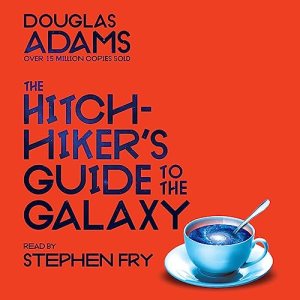
In terms of the audiobook which I listened to on Audible, the first ‘Hitchhiker’s’ book is read by Stephen Fry. A very fitting narrator, if I may so. Stephen has that intelligent reading voice that I’ve enjoyed hearing ever since I first saw him in the ‘Jeeves & Wooster’ series.
He’s also had an association with ‘Hitchhiker’s’ in various forms. He played Murray Bost Hanson in ‘Quandary Phase’, the fourth ‘Hitchhiker’s’ radio series, which I’ve yet to hear. And he voiced the Book in ‘The Hitchhiker’s Guide to the Galaxy’ 2005 film, which is great!
Don’t get me wrong, Peter Jones is the authentic voice for the Book in the original radio series. But when you have Stephen Fry as the voice of the Book in both the 2005 film and the audiobook for the first ‘Hitchhiker’s’ book, you’ve struck gold with a very refined voice.
Granted, I’ve yet to see the 2005 film by this point, but I’m positive Stephen Fry matches the tones of the Book when Peter Jones voiced him in the first radio series and the BBC TV series. 🙂 Hearing Stephen Fry read the first ‘Hitchhiker’s’ book was a joyful experience.
The story itself is divided into 35 chapters. Some are longer than others, some tend to be one page or half a page. I read the book at a very leisurely pace. It took me about a month to read the first ‘Hitchhiker’s’ book, as it allowed me to absorb each chapter satisfactorily.
Incidentally, the 42nd anniversary edition of the first ‘Hitchhiker’s’ book has a foreword by Russell T. Davies, ‘Doctor Who’s showrunner from 2005 to 2010 and current showrunner from 2023 onwards. It was fascinating to read what RTD had to say about ‘Hitchhiker’s’. 🙂
He clearly gives the book high praise, especially having readings of it in his school assemblies, I believe. I don’t think I would leave my copy of the first ‘Hitchhiker’s’ book on a bus to ‘spread the word’ as he puts, as I’d still like to keep my copy, thank you very much.
It’s difficult to know where to begin in terms of identifying what’s different from the radio version and the book version of ‘Hitchhiker’s’. Most of what you read in the book matches to what’s in the first four episodes of the first radio series, which is how I expect it. 😀
Mind you, certain things are omitted in the book from the radio series. One scene in particular is the scene featuring Lady Cynthia Fitzmelon, as played by Jo Kendall in the radio series. It’s not even in the BBC TV version of the first radio series either, interestingly.
Frankly, that scene didn’t really do much in terms of serving the plot of the radio series, and…I don’t think it’s a very funny scene anyway. Douglas Adams must have thought that as well considering he didn’t include it in the first ‘Hitchhiker’s’ book nor in the TV show.
A thing I’ve noticed from checking out the first radio series, the first book and the TV series of ‘Hitchhiker’s’ is how certain dialogue is changed in the book compared to what you hear in the radio show. 😐 I’m thinking in particular how certain scenes played out in the book.
For example, in the radio series, when Ford persuades Arthur to join him for a drink at the pub near his house as it’s to be demolished, Arthur is the one who gets to persuade the foreman Prosser with logic that they don’t need him whilst waiting to demolish his house.
In the book, it’s different, as it’s Ford who persuades Prosser with logic that they don’t need Arthur whilst waiting to demolish his house. In respect to the radio series, I feel the book version works better because why would Arthur try to persuade Prosser with logic? 😐
No disrespect to Arthur, but Ford is cleverer than him, considering he’s an alien. Arthur, by nature, is out of his depth when he finds himself in unusual situations after being rescued by Ford once the Vogons blow up his planet. It makes sense Ford persuades Prosser instead.
The TV series has Ford persuading Prosser with logic too and that’s taken from the book, not from the radio series. There’s even dialogue said by Prosser about him lying in the mud instead of Arthur in the TV series, which is taken from the first ‘Hitchhiker’s’ book itself. 🙂
Certain things from the radio series and the first book are adapted into the first TV series, which I’ve yet to do a review on. But it’s interesting how these changes were made in the book first and not in the TV series. Douglas Adams clearly found things weak in the radio series.
Another example is when Arthur and Ford are being tortured by the Vogon Captain reading his poetry to them. Instead of Ford saying that he ‘liked it’ as in the radio series, in the book, it’s Arthur who said that he liked the Vogon Captain’s poetry, which confuses Ford.
Once again, the TV series follows that same aspect of the storytelling from the book by having Arthur saying that he liked the Vogon Captain’s poetry instead of Ford compared to the radio series. And once again, it makes sense for Arthur to say it instead of Ford saying it.
In my opinion, and from my perspective, Arthur is attempting to find a way to please the Vogon Captain by saying that his poetry is good when in fact it isn’t. It makes sense for Arthur to do this rather than Ford, as he wants to avoid being thrown off the Vogon spaceship. 🙂
I’m sure it works fine with Ford saying he liked the Vogon captain’s poetry in radio, but it’s not effective when Arthur says it instead in the book and the TV series. This is clearly amended by Douglas Adams when he had more time to think about the story when writing it in prose.
Granted, it’s a plan that doesn’t get Arthur and Ford anywhere since the Vogon Captain was going to throw them off the spaceship anyway. But it makes sense for a human like Arthur to do that than Ford to do it as he’s an alien and he’d have more knowledge of Vogons than Arthur.
In reading the book, it was good to see what the text of the Vogon Captain’s poetry was like compared to hearing it in the radio series and the TV series. Quite frankly, I don’t really know what it is about the Vogon Captain’s poetry that causes Arthur and Ford such pain. 😐
From reading it as well as hearing it being read by Stephen Fry, the poetry’s a lot of nonsense. Granted, it would come from an alien culture that I don’t know anything about, but even then, I’d be lost as to what it’s about rather than finding it painful and scream-inducing.
Incidentally, this book introduces towels in ‘The Hitchhiker’s’ series for the first time. Towels become important in ‘The Hitchhiker’s’ series as well as amusing, since they’re hailed as being ‘about the most massively useful thing an interstellar hitchhiker can have’.
Apparently, according to my research, there’s an event called Towel Day, which is celebrated every year on the 25th of May as a tribute to Douglas Adams by his fans. Fan openly carry towels with them to demonstrate their appreciation for the books and the author. 🙂
This began in 2001, two weeks after Douglas Adams died on the 11th of May that year. It’s interesting what you can find out when uncovering more of ‘The Hitchhiker’s’ series. I wondered for a long time why towels kept being brought up in relation to Douglas Adams. 😀
There’s a chapter featured in the book that’s not in the radio series nor in the TV series where Zaphod Beeblebrox becomes President of the Galaxy and he steals the Heart of Gold spaceship with the Infinite Improbability Drive. Trillian is also with him in that chapter.
This chapter – identified as Chapter 4 – is featured between the destruction of the Earth by the Vogons and the first scene where Arthur and Ford find themselves aboard the Vogon spaceship. It’s an interesting scene to set up Zaphod and Trillian as characters in the story. 🙂
It contrasts to how they’re introduced in the radio series and the TV series where they’re introduced in the second episode and they’re piloting the Heart of Gold spaceship that rescues Arthur and Ford. I didn’t expect Zaphod and Trillian to be introduced quite early in the book.
Concerning Trillian as a character, she’s described in the book as being slim, darkish, with long waves of black hair, a full mouth, an odd little knob of a nose, and dark eyes. This is different compared to what she looks like in the TV series where she’s blonde and American.
It also contrasts to Susan Sheridan’s appearance where she’s arguably blonde and English. Granted, we don’t see Susan Sheridan as Trillian, since she played the role in the radio series. Yet the book’s description of Trillian is very unique compared to radio and TV.
There’s one scene in the radio series that’s not included in the book and that’s the scene where Zaphod puts his three hands on Trillian’s leg in the second episode. I’m glad that’s not in the book, as that would have made Zaphod very creepy in how he treats Trillian. 😐
The dialogue between Zaphod and Trillian where they talk about the ship’s improbability in rescuing Arthur and Ford is different in the book compared to what’s in the radio series. The book’s dialogue between Zaphod and Trillian also matches to what’s in the TV series.
The structure of the story in the book is quite at odds with the radio series, considering we started off on Earth before it gets blown up by the Vogons. Then we’re on the Vogons’ ship for a bit before we end up on the Heart of Gold spaceship before we get to Magrathea.
Then we have the business of the Ultimate Question and the Ultimate Answer to Life, the Universe and Everything in the scenes with Deep Thought. Then we have our heroes meeting the white mice before they escape Magrathea after running in with the police.
I wonder if Douglas Adams was trying to make the narrative of ‘Hitchhiker’s’ more contained when writing the first book without having the fifth and sixth episodes included. It really depends on how you look at it regarding Douglas Adams and narratives.
The mice featured in the book, including Frankie mouse and Benjy mouse, are very different in the book compared to the radio series. For one thing, they want to extract Arthur’s brain before acquiring the Ultimate Question to Life, the Universe and Everything.
This isn’t how they behaved in the radio series where they seemed to be quite friendly. Or at least, that’s the impression I got. It does make the mice more villainous when they’re claimed to control the experiments on humanity instead of it being the other way around.
There’s a new scene included in the book where Ford, Zaphod and Trillian survive being attacked on Magrathea and are being led to meet the mice underground. This happens at the same time Arthur is being led by Slartibartfast to meet the mice when underground.
The ending of the book also features a different fate for Marvin on Magrathea. In the first radio series, Marvin had to wait many years to meet up with Arthur, Ford, Zaphod and Trillian since they ended up at the Restaurant at the End of the Universe. Not the case in the book.
In the book, Marvin is waiting for them at the Heart of Gold spaceship and he’s lying down on the ground when Ford finds him. Apparently, Marvin became bored and he explained his view of the universe to the police officers’ spaceship, causing it to commit suicide. 😀
On a side-note, I’m surprised nobody reprogramed Marvin to have a new personality where he’s happier and less sulky. I mean, when Arthur tries to strike a conversation with Marvin, the android always finds a way to moan about something, which can be tiresome.
As said earlier, the book ends with our five heroes leaving the planet Magrathea and heading off for the Restaurant at the End of the Universe. Depending on how far they’ve got to travel, it’s a longer journey in the book compared to how they got to it in the radio series.
At the end of the book, there’s materials from the Douglas Adams archives to enjoy as well as preview containing the first two chapters of ‘The Restaurant at the End of the Universe’, the second book in ‘The Hitchhiker’s Guide to the Galaxy’ book series. I read the preview with the audiobook via Audible, read by Martin Freeman, who played Arthur Dent in the 2005 film.
‘The Hitchhiker’s Guide to the Galaxy’ book has been an enjoyable and engaging read and it’s been nice to listen to it via Audible with Stephen Fry reading the audiobook. It’s certainly been pretty fascinating to compare it to the radio series and find what’s different.
It’d be easy to say that it’s disappointing this book doesn’t cover everything in ‘Primary Phase’ and it’s basically a novelization of the first four episodes of the first radio series. But ‘The Hitchhiker’s’ series has a uniqueness to it when checking it out in radio and book forms.
The first ‘Hitchhiker’s’ book is well-written by Douglas Adams, and it manages to capture the wit and style that’s so easily enjoyed in the radio series as well as other mediums. I’m quite certain it’s only a matter of time before I check out some more ‘Hitchhiker’s’ content.
Sometimes, the writing of Douglas Adams can be an acquired taste, but it can also be very appealing, especially when exploring more of a franchise that initially began as a radio series before it became a worldwide phenomenon. Here’s to me checking out more soon. 🙂
Whilst I’m reviewing this book separately from the radio series, it doesn’t stop me from wanting to check out more of the radio series as well as the books. I’m just finding it pretty fascinating that I can review the radio series and the book series as separate continuities.
‘The Hitchhiker’s Guide to the Galaxy’ (Book) rating – 8/10
Go next to
|
|
| Return to The World of Douglas Adams | |
| Return to Comedy | |
| Return to Sci-Fi |
 Bradley's Basement
The distinctions between the original radio plays when I first heard it and the TV version which I saw first are of course quite notable. Some took me by complete surprise. Thank you, Tim, for your review.
LikeLiked by 2 people
Hi scifimike,
Glad you enjoyed my review on ‘The Hitchhiker’s Guide to the Galaxy’ book. It’s good to check out.
I don’t know when I’m going to review the TV version of ‘Hitchhiker’s’. I hoped to watch it via Britbox years ago, but it came off when combined with ITVX. I suppose I could check out the TV version via Dailymotion, but I’d have to consider whether to check it out without the DVD special features. I had the DVD once but then I gave it away, not thinking I’d see it again. I’ll work it eventually, but I’m wondering whether to review Secondary Phase of the radio series first as well as ‘The Restuarant at the End of the Universe’ book. We’ll see what happens.
Best wishes,
Tim 🙂
LikeLiked by 1 person
I think it might be worth your time. Douglas Adams had a notable habit of recycling his own ideas. Professor Chronotis from Shada ends up making an appearance or two in the Dirk Gently series (ignoring, for the moment, that the first book’s antagonist is from City of Death) and a few of Secondary Phase’s ideas end up in… I want to say the Restaurant at the End of the Universe novel?
LikeLiked by 2 people
Hi Wolfie,
Thanks for your recommendation. I have in mind to check out the first ‘Dirk Gently’ book next. I read that back in 2012 after checking out the ‘Shada’ novelization where I learnt that some ideas from that ‘Doctor Who’ story, including Chronotis, were in ‘Dirk Gently’. I hope to read it again with the audiobook read by Stephen Mangan, who played Dirk Gently in the short-lived BBC Four TV series.
Best wishes,
Tim 🙂
LikeLiked by 1 person