
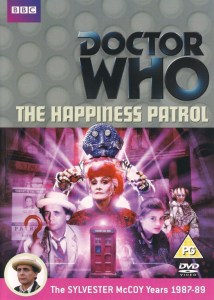
‘THE HAPPINESS PATROL’
Please feel free to comment on my review.
Helen A and the Kandyman with the Seventh Doctor and Ace


So, after the excitement that is ‘Remembrance of the Daleks’, we come to the second story of Season 25 of the classic ‘Doctor Who’ TV series. It’s ‘The Happiness Patrol’, a three-part story by Graeme Curry, who makes his only ‘Doctor Who’ contribution here. 😦
Well, unless you count ‘The Happiness Patrol’ Target novelization as his second contribution to ‘Doctor Who’. Plus, he had a cameo as one of the tourists at Windsor Castle in the next story ‘Silver Nemesis’, but that’s something to discuss another time. 🙂
Sadly, Graeme Curry died of a brain tumour in February 2019. He was 62 when he passed away. I shared my original review on ‘The Happiness Patrol’ in February 2018, a year before he died. It’s sad he didn’t write more than one ‘Doctor Who’ story in his career.
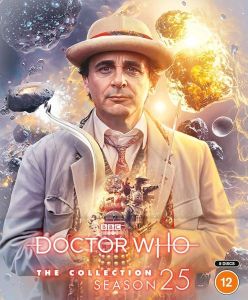
Like ‘Remembrance of the Daleks’, there are two versions of the story in the Season 25 Blu-ray box set. There’s the original three-part story on Disc 3 and there’s the Special Edition version of the story on Disc 4, containing an extended edit and new CGI effects.
The Special Edition version of ‘The Happiness Patrol’ is dedicated to the memory of Graeme Curry. This is fitting since Graeme Curry passed away in 2019 and it’s good a version of the story containing more scenes and new CGI effects is made to honour him.
With that said, even from watching the Special Edition version of the story, I can’t say ‘The Happiness Patrol’ won me over on Blu-ray compared to when I first saw it on DVD. Mainly because the political themes of this story were a struggle for me to get through. 😐
Now I’m not saying this to disrespect Graeme Curry’s abilities as a writer. I’m sure he was a competent writer when he wrote ‘The Happiness Patrol’ for TV. I hope to check out the Target novelization/audiobook sometime to explore more of this world he created. 🙂
But from viewing the TV story on its own, both in its original form on DVD and in its Special Edition form on Blu-ray, I have issues regarding the presentation and execution of ‘The Happiness Patrol’ as a ‘Doctor Who’ story. 😐 I’ll delve into this more in the review.
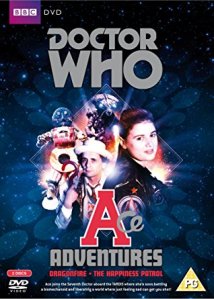
When I first saw ‘The Happiness Patrol’ on DVD, it was released in the ‘Ace Adventures’ DVD box set in May 2012. It contained ‘Dragonfire’ and ‘The Happiness Patrol’. I enjoyed ‘Dragonfire’ more than ‘The Happiness Patrol’, especially with it as Ace’s introduction. 🙂
As I’ve established, ‘The Happiness Patrol’ is a three-part story and was directed by Chris Clough. This was part of a block of six episodes in Season 25’s production. Three were dedicated to ‘The Happiness Patrol’ whilst three were dedicated to ‘Silver Nemesis’.
‘The Happiness Patrol’ was made in the studio whilst ‘Silver Nemesis’ was made on location. This was a pattern in the making of Sylvester McCoy’s three ‘Doctor Who’ seasons, since four TV stories got made from the fourteen episodes given to each season.
In Season 24, ‘Delta and the Bannermen’ was a three-parter made on location whilst ‘Dragonfire’ was a three-parter made in the studio. Chris Clough directed both stories in Season 24 and thus, he was invited to return to direct another two stories in Season 25.
As well as directing four stories in Sylvester McCoy’s era on TV, Chris Clough directed two segments of ‘The Trial of a Time Lord’ with Colin Baker, including ‘Terror of the Vervoids’ and ‘The Ultimate Foe’. Nowadays, Chris Clough is a producer than a director.
Anyway, as a story, what is ‘The Happiness Patrol’ about? Well, the story places on the planet Terra Alpha, which, according to the Doctor, happens to be an Earth colony. From what I’ve been able to gather in my research, the story takes place in the 24th century. 😐
Clearly the planet is not under the control of the United Federation of Planets from ‘Star Trek’, assuming that exists in the ‘Doctor Who’ universe at all. 😀 I say that since Terra Alpha is a world where it’s a crime to be unhappy. Everyone must smile all the time.
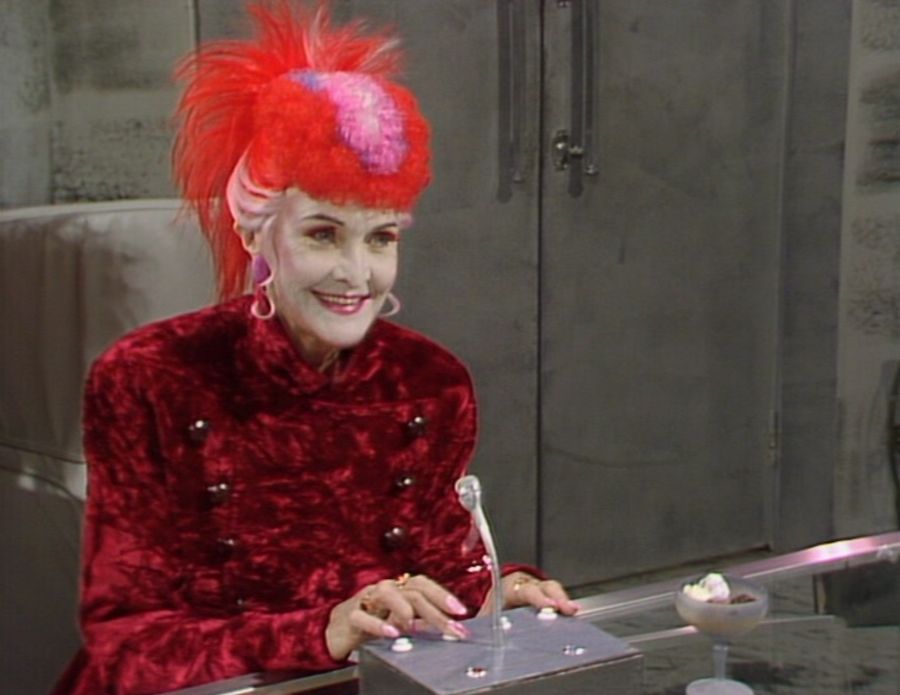
Helen A: And don’t forget, when you smile, I want to see those teeth.
Now, I can get behind that concept. A world where it’s forbidden to be sad. That can provide some interesting scenarios on what happens when you break the rule of being happy all the time. But I don’t think that’s reflected well in the story, which I’ll get to shortly.
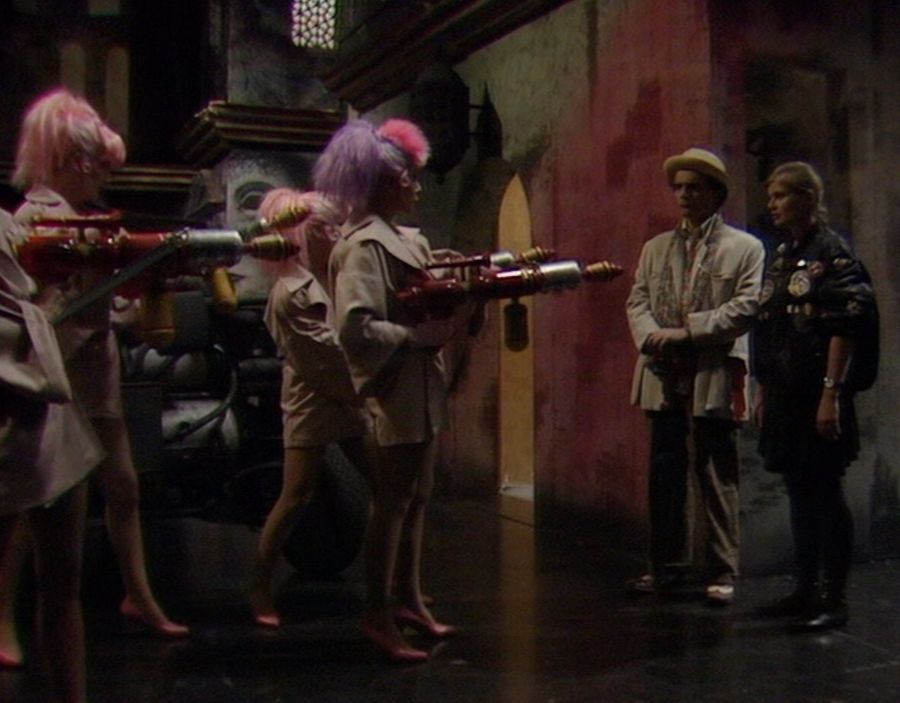
Anyway, the TARDIS ends up on the planet Terra Alpha and the Doctor and Ace step out to discover this oppressed society where sadness is against the law. The law is being enforced zealously by the brightly-uniformed Happiness Patrol who kill off the ‘killjoys’.
Terra Alpha is ruled by Helen A, who is aided by her…husband, I believe…Joseph C and her carnivorous pet, which looks like a space dog called a Stigorax, called Fifi. Can our heroes stop this ‘happy dictatorship’ going on and can they thwart the Kandyman? 😐
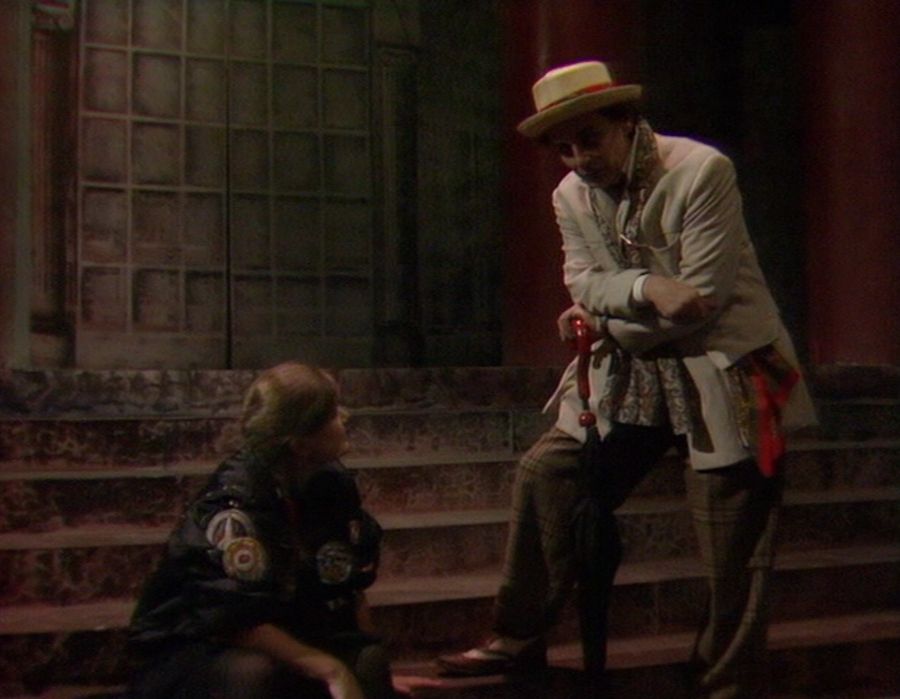
Now, in case I haven’t made myself clear, I’m not a fan of ‘The Happiness Patrol’ as a ‘Doctor Who’ story. Mainly because I found it dull and hard-going to watch. It should’ve been very compelling and exciting to watch. I hoped that it would be when I first saw it. 😦
But frankly, I didn’t find anything exciting about this ‘Doctor Who’ story. Like I said, the concept of ‘unhappiness is a crime on an alien planet’ is fine enough, but I couldn’t gain any emotional investment in the drama. It felt more plot-driven than character-based. 😐
Now, I’m sure many people will disagree with me and it has been interesting to read and hear other people’s viewpoints on what they make of the story, including what they liked and disliked. Even the ‘Behind the Sofa’ contributors’ thoughts were pretty fascinating. 🙂
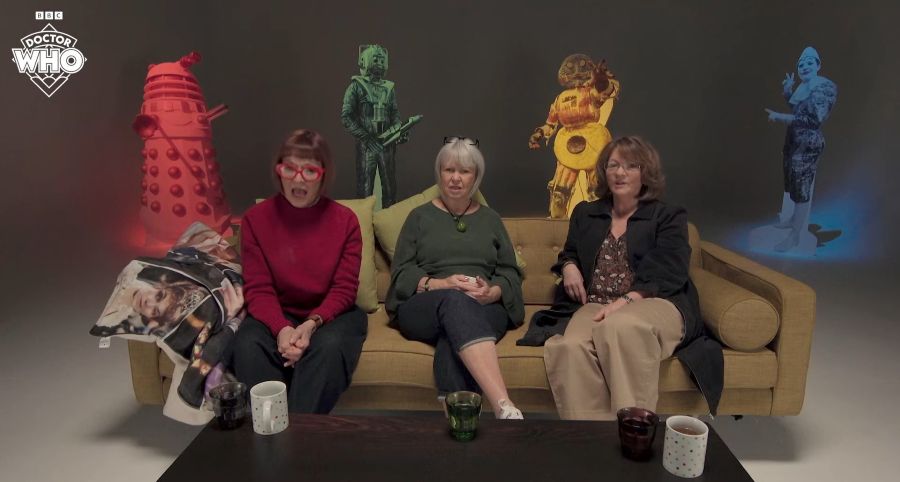
Janet Fielding, Wendy Padbury, Sarah Sutton, Bonnie Langford and Nicola Bryant shared what they thought of the story and how it didn’t work for them, which was a relief for me, compared to Sylvester McCoy, Sheila Hancock and Sophie Aldred who praised it highly.
Then again, those three have had more involvement with the making of the story and perhaps it connects to a cast member involved in the story more than the ones actually viewing the finished product. Mind you, I wonder if many ‘Doctor Who’ fans rate this story highly.
I mean, Janet Fielding has said that ‘The Happiness Patrol’ isn’t rated very highly by the ‘Doctor Who’ fans. I’m not sure if that’s accurate considering I’ve heard praise of the story from certain fans, but then, this ‘Doctor Who’ story doesn’t get talked about much.
What it comes down to is how the world of ‘The Happiness Patrol’ is set up. Apparently, this story was written as a parody of Thatcherism, which was happening strongly at the time with Margaret Thatcher as the UK’s Prime Minister. Helen A is meant to be Thatcher.
Now I appreciate the political messaging that’s going on in the story, as it’s meant to be reflective of what went on in the UK in the 1980s. It’s fascinating to see and maybe if this was made as a four-part story instead of a three-part story, I might appreciate it more. 🙂
But I do wonder, would many people get into the political atmosphere featured in this ‘Doctor Who’ story today. Unless you’re enthusiastic about politics and how the UK politically worked in the 1980s, I imagine many would find this story a struggle to watch.
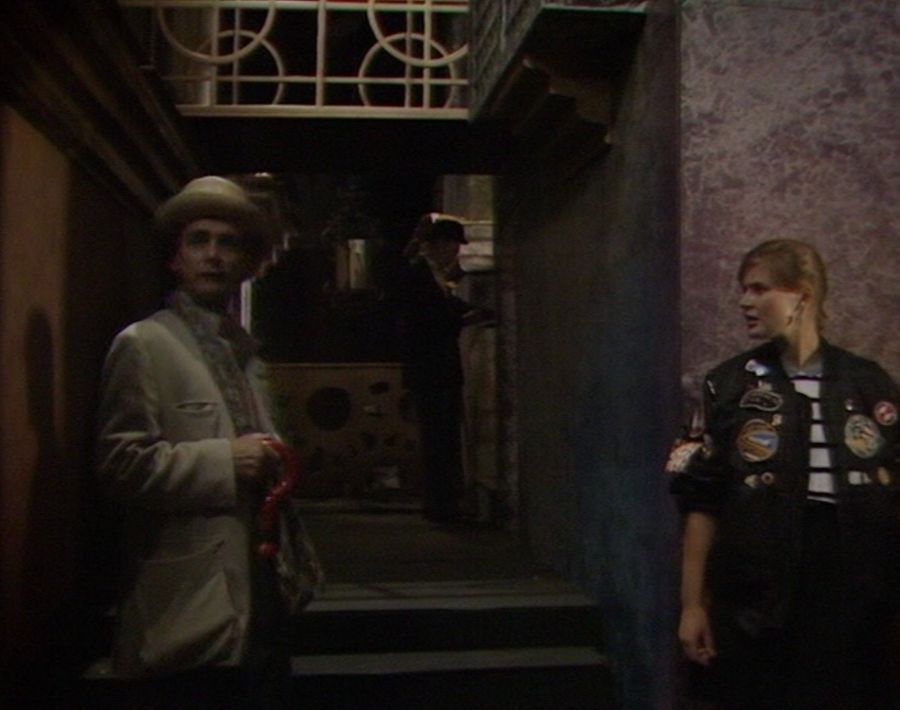
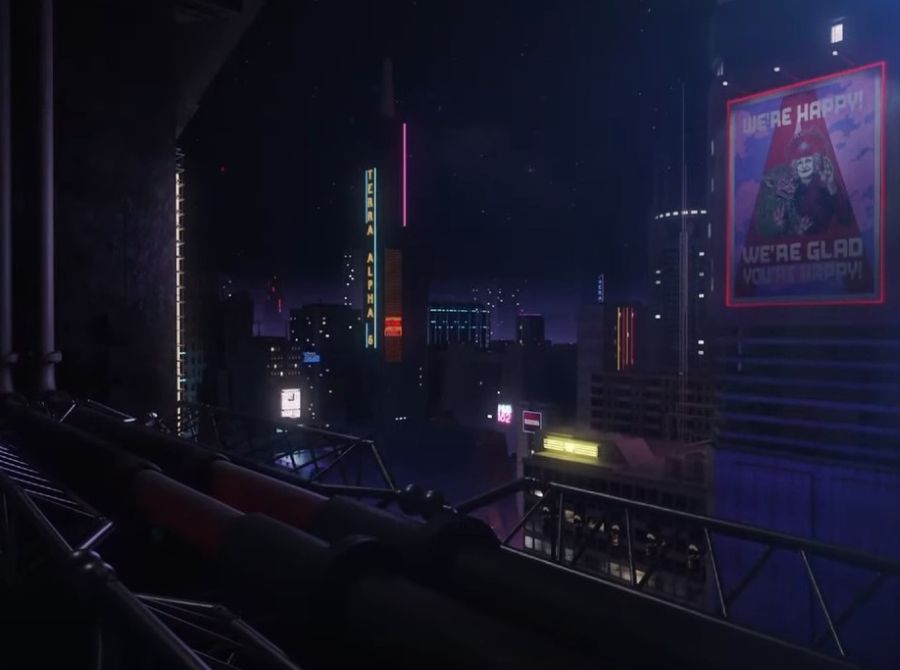
Something that gets me about this story is that it all takes place inside a city and it happens to be night all the time. Couldn’t we have some scenes set outside and perhaps in the daytime? Maybe show us a beach on Terra Alpha where people are happy.
I know this story was made inside a studio, but you can have exterior scenes in the studio as well as interior scenes. ‘The Keeper of Traken’ did exterior scenes in Traken’s gardens and ‘Kinda’ did exterior scenes on Deva-Loka. And both stores were done in the studio.
Granted, it might look unconvincing to have exterior scenes in the studio and perhaps it’d be better to go to Ealing Studios and have them on film like they did for ‘Planet of Evil’ and ‘The Creature From The Pit’. But the point is, there’s no variety on Terra Alpha.
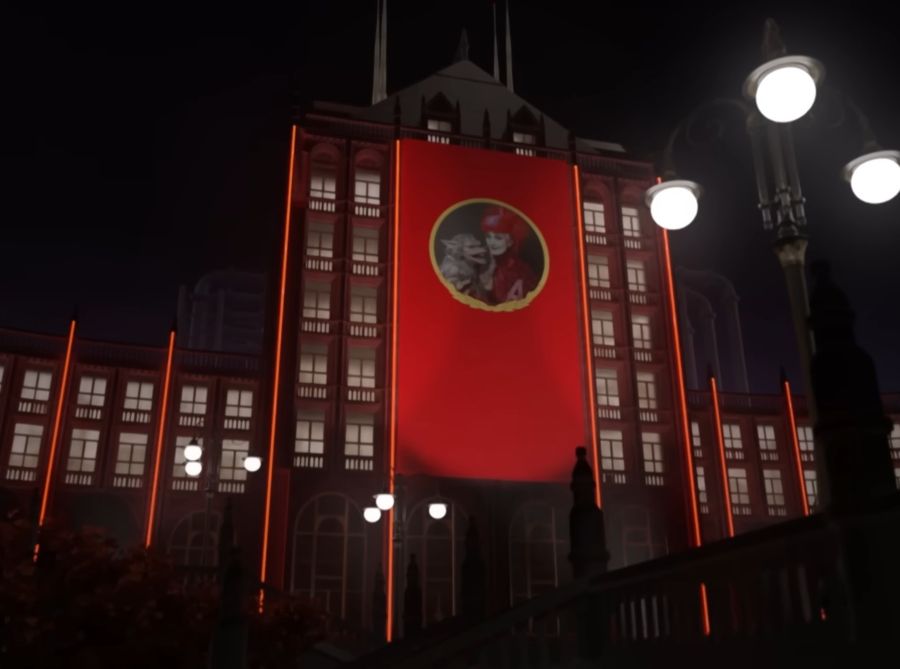
We don’t really get to know enough about the world of Terra Alpha to find it interesting. If Helen A and the Happiness Patrol wanted everyone to be happy, then maybe they should have provided resorts for tourists as well as locals to keep the ‘happiness’ going.
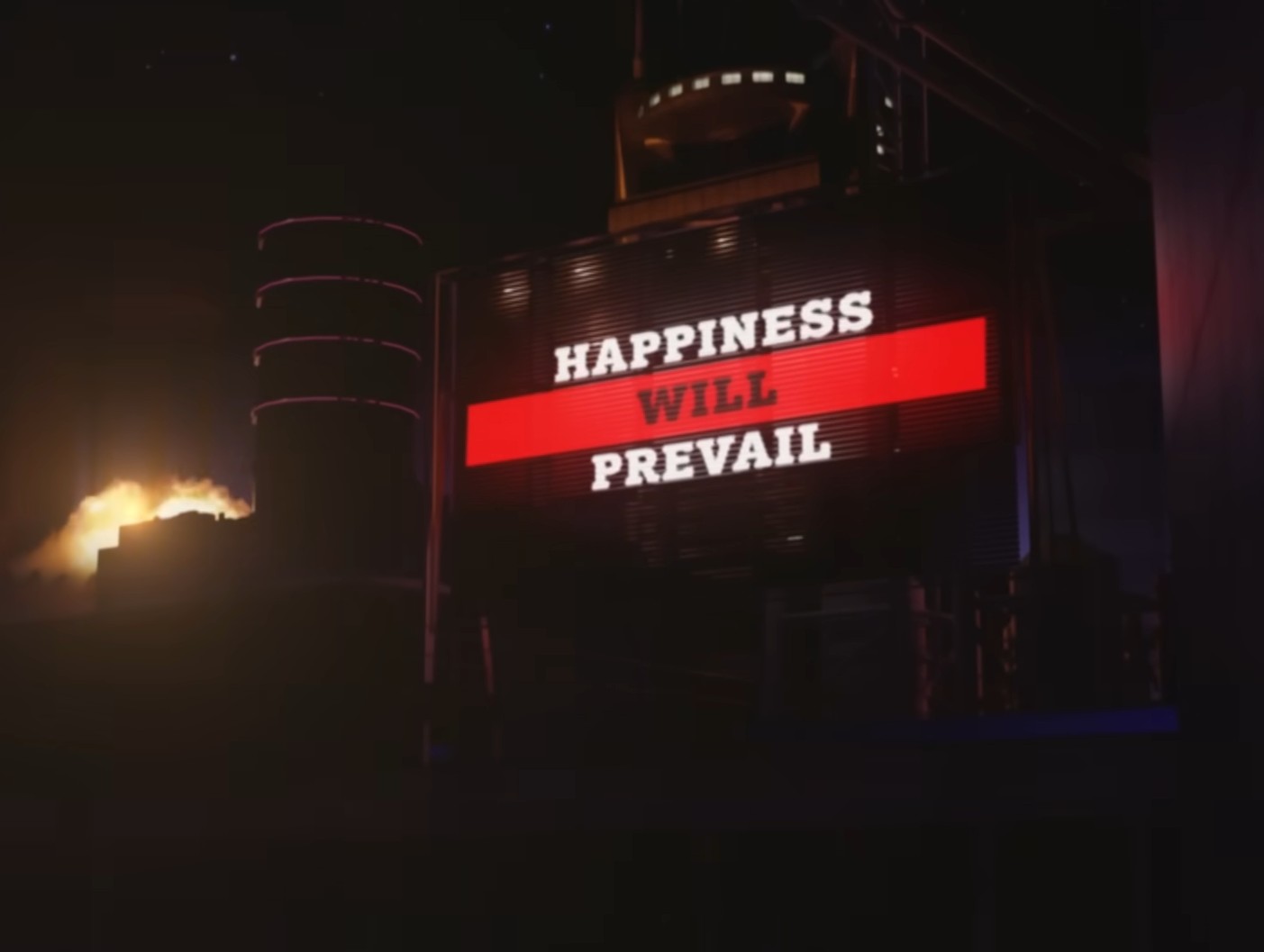
I’m just saying that if Helen A and her contemporaries wanted to keep the illusion that Terra Alpha is a happy place for people to go to and maintain that ‘unhappiness is a crime’, then they’d make every effort to ensure ‘happiness will prevail’, to coin a phrase.
Then again, that might be the point of the story. The point that Helen A and the Happiness Patrol are getting rather tired in their approach to maintaining happiness on Terra Alpha that they can’t think of any new ideas and are stubborn to accept new ones.
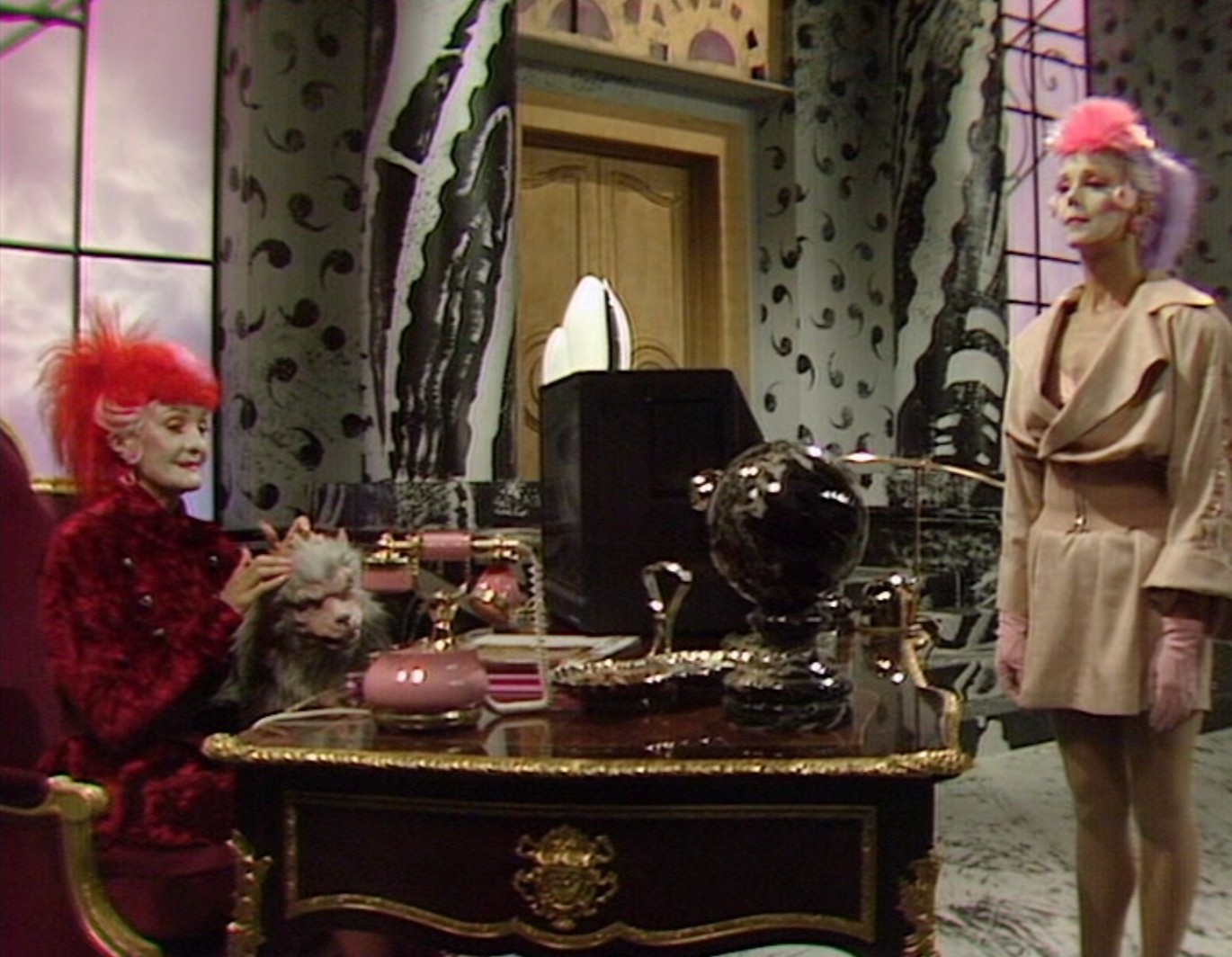
That this story is showcasing what the end of Helen A’s reign on Terra Alpha is all about with the protesters going against her philosophy and ideals for living on the planet. And that the Doctor and Ace have stepped in to help those oppressed under Helen A’s rule. 🙂
In the ‘Behind the Sofa’ item for this story, Wendy Padbury mistakenly called this story ‘The Happiness Control’ instead of ‘The Happiness Patrol’. Something that Janet Fielding and Sarah Sutton teased Wendy greatly before they watched the story. Poor Wendy. 😀
But on reflection, ‘The Happiness Control’ is a more fitting title compared to it being called ‘The Happiness Patrol’. Because it’s a story about Helen A and her minions trying to maintain control on Terra Alpha when it’s going wrong and it’s down to their stale approach to life.
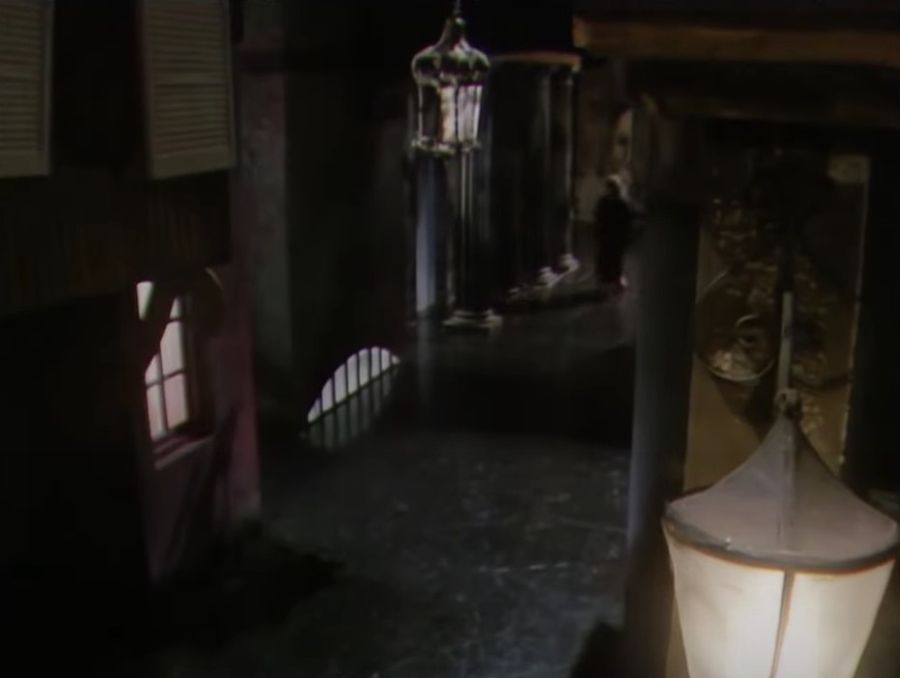
The story’s studio lighting let its down for me, especially when it you find that it’s all studio-bound and mostly set at night. I did wonder if we were underground for the most part, and I do wish there were more exterior scenes set in both the daytime and at night.
Why is it mostly night-time in the story? Granted, the Special Edition version of the story with its CGI effects help to make the story look more interesting compared to its original TV version, but surely it can’t have all taken place in a single night. Not really.
Had the story taken place within two days, it’d make sense and it wouldn’t be so dull and uninteresting. Even having the story finish on a note where a new day is about to begin and we see sunlight shining on everyone’s faces would have been very welcome.
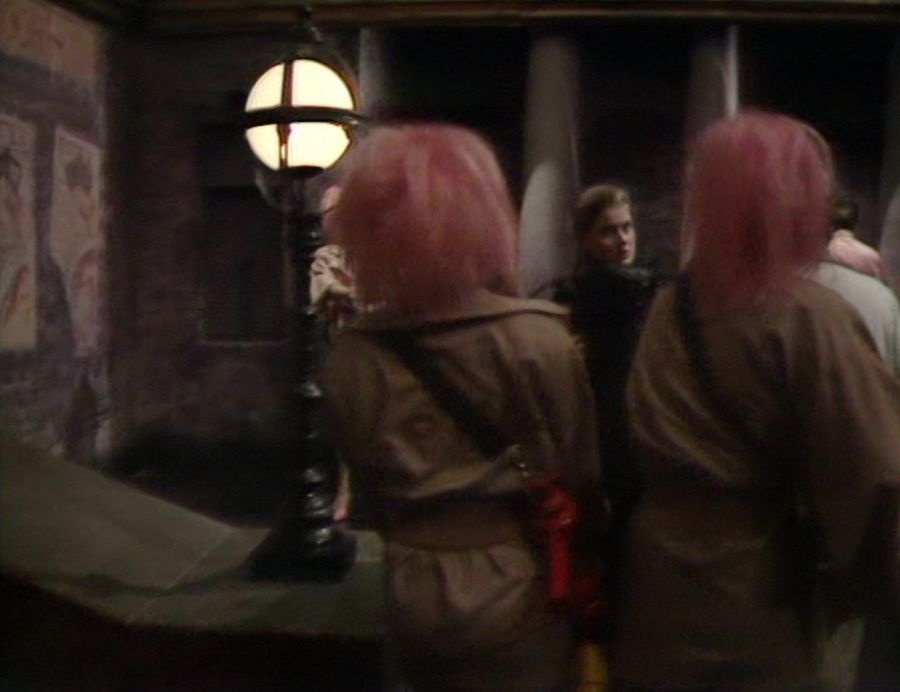
The set designs for the story aren’t that impressive. I mean, when we’re in the city and in places like the waiting zones, they’re all the same in looking drab and dismal. It’s a relief when we go to Helen A’s…palace (I think) where the sets seem bright and more intriguing.
With the waiting zones, they always seem to change in various places. I’m not sure how that works, as it’s not explained well enough, but couldn’t the waiting zones have been identified by number instead of saying that a waiting zone shifts from one place to another?
Another thing about the world set-up of ‘The Happiness Patrol’ that gets me is it’s rather silly. And I don’t mean it in a fun kind of way like you’d get with ‘The Horns of Nimon’, even if many don’t like that story. The world set-up doesn’t make sense, which makes it silly.
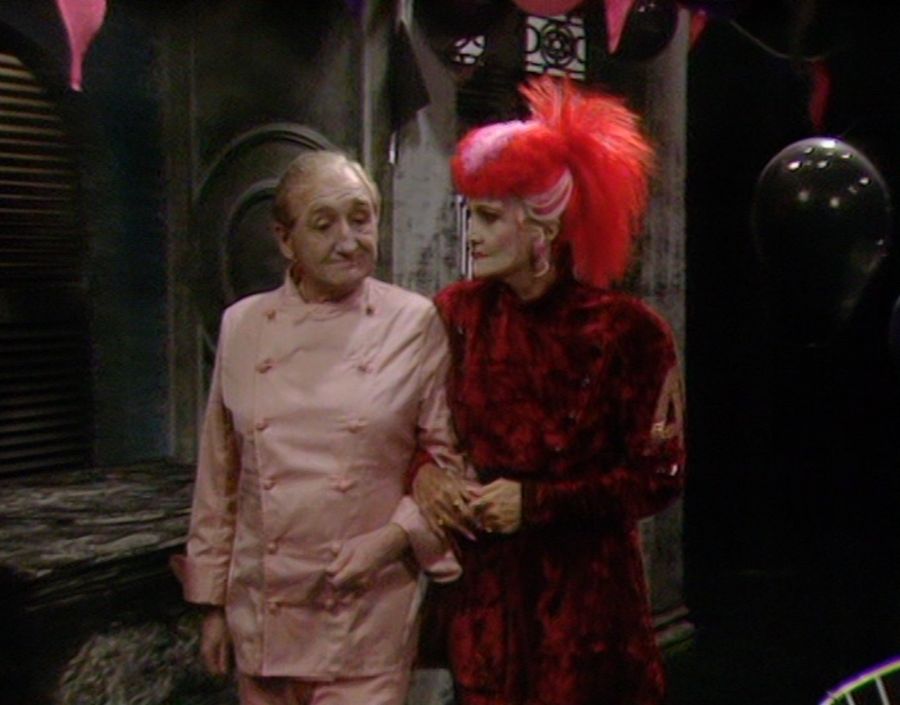
‘The Happiness Patrol’ could’ve easily been a comedic adventure. If this story was written like a BBC sitcom series such as ‘Keeping Up Appearances’ where Helen A was more like Hyacinth Bucket (sorry ‘Bouquet’), maybe I could engage with the plot more. 🙂
On a sidenote, I’m surprised Patricia Routledge wasn’t cast to play Helen A instead of Sheila Hancock. Not that I’m dissatisfied with Sheila Hancock’s performance as Helen A. She plays the character reasonably well, and made her seem like Margaret Thatcher.
But then, that’s kind of the issue. The story is written as a deliberate attack on the Thatcher government of the 1980s by writer Graeme Curry. It’s a fascinating approach, but again, I found it hard to invest myself with the tale and its characters to appreciate it.
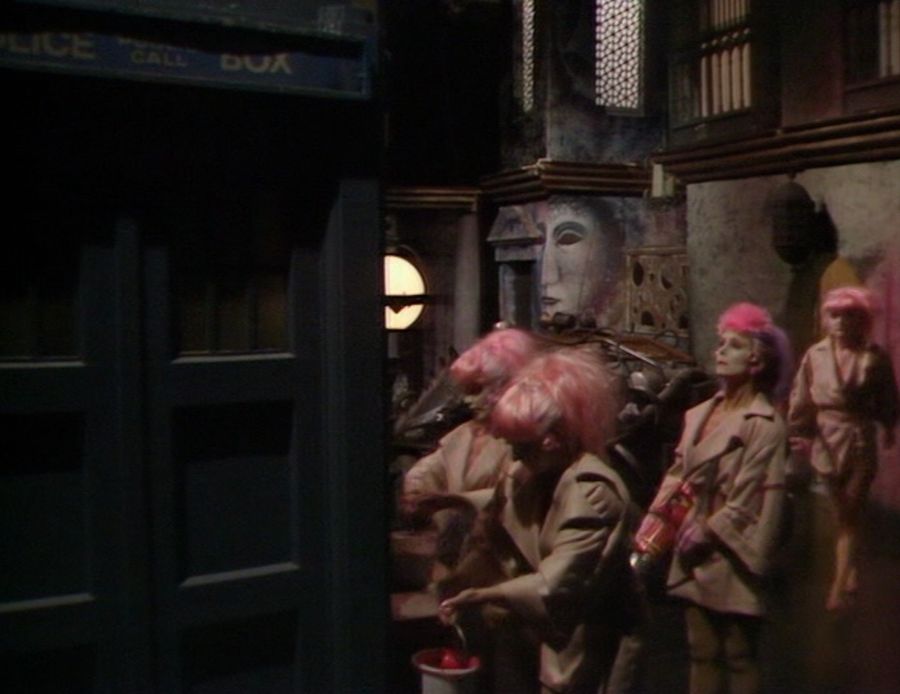
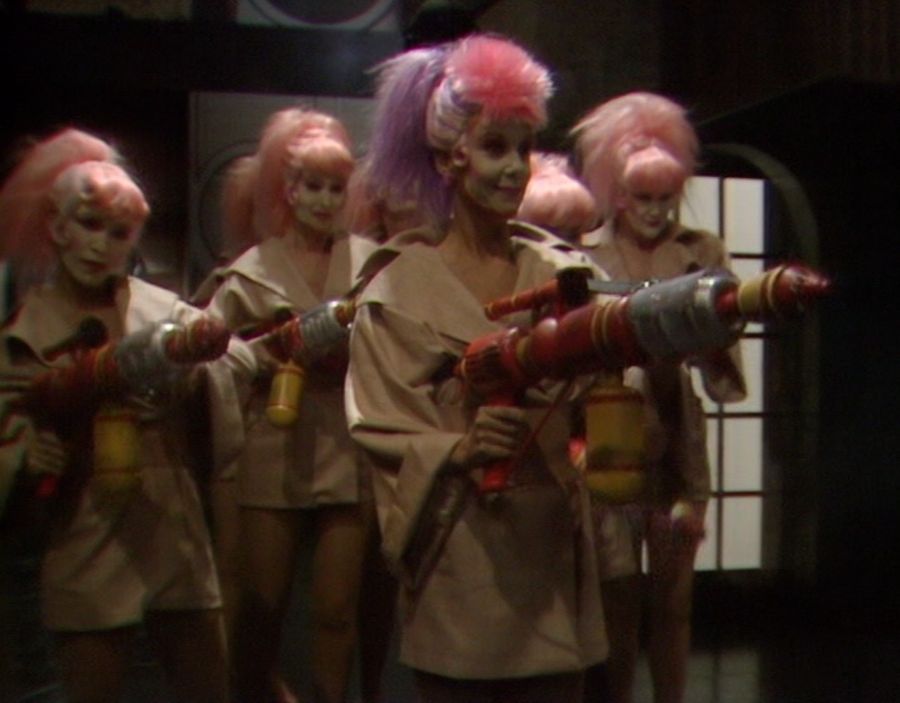
It’s not helped by the story’s cosmetic aspects, which make it silly and not in the fun kind of way. For example, the Happiness Patrol. They’re mostly girls wearing daft outfits and some have hair (or as it turns out, they wear wigs) that ranges from pink to purple. 😐
There are undercover agents in the Happiness Patrol that are male, but it’s mostly girls in the group. In fact, even when Happiness Patrol undercover agents like Silas P are wearing dark hats and dark coats, they usually tend to wear pink overalls underneath.
In fact, most of the male population I’ve seen in ‘The Happiness Patrol’ as well as the women, except Helen A who’s often wearing a red wig and in a red outfit, are in pink outfits. I don’t understand that. Why are people wearing pink for their hair and outfits? 😐
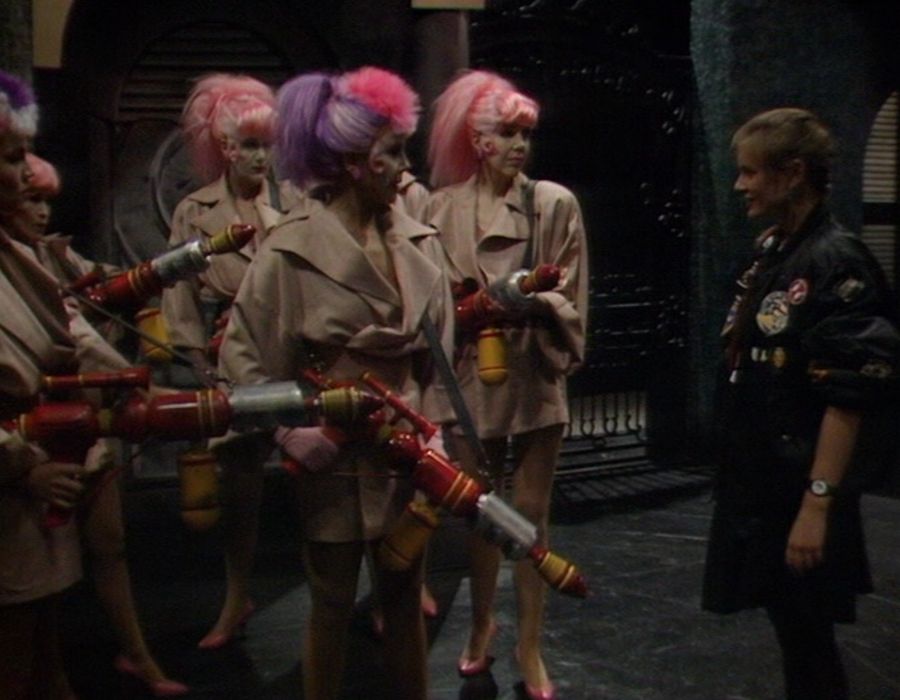
Granted, we live in a world where some people often dye their hair to be blue, green or purple to stand out more and be different from everyone. And that’s their choice. But why is it a thing on Terra Alpha? Why has it been decreed by Helen A for people to appear like that?
Is this an image that Helen A has enforced to give the appearance that everyone is happy? Is it what Helen A thinks men and women should look like by appearing in pink outfits and having pink or purple hairstyles and not show any dark and gloomy colours?
To be fair, that would make sense, as this happens to be a dictatorship where ‘unhappiness is a crime’. But it’s something that’s not really explained enough, if at all, in the story, and I wonder if it’s explained any better in the Target novelization/audiobook. 😐
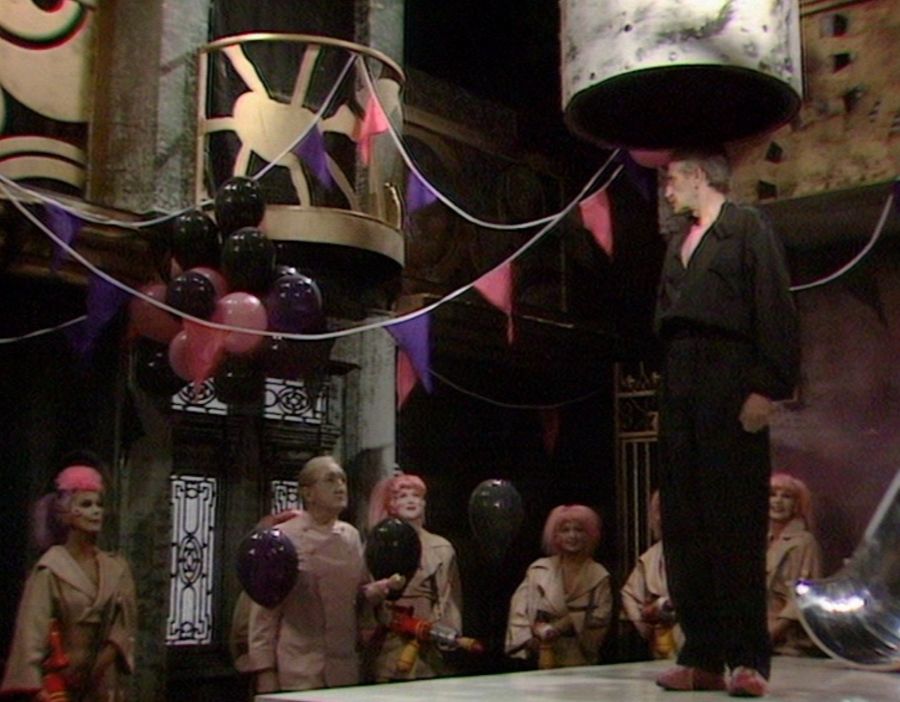
Seeing the Happiness Patrol as they are in their pink outfits and pink/purple hair did put me in mind of them being from the 1980s cartoon TV show ‘Jem and the Holograms’, which was shown at the same time. Not sure if Graeme Curry was inspired by that show.
Mind you, I’ve not seen ‘Jem and the Holograms’ myself, but would it be a surprise to anyone if that was the inspiration for the Happiness Patrol’s appearance? It’s so odd to see when watching the story and it makes you wonder why that approach was utilised. 😐
I know, I know, that stuff doesn’t matter in the grand scheme of things, as the story is about the Doctor and Ace trying to stop Helen A and her tyranny of imposing this forced happiness of hers onto a world that struggles to maintain the ‘happy’ appearance.
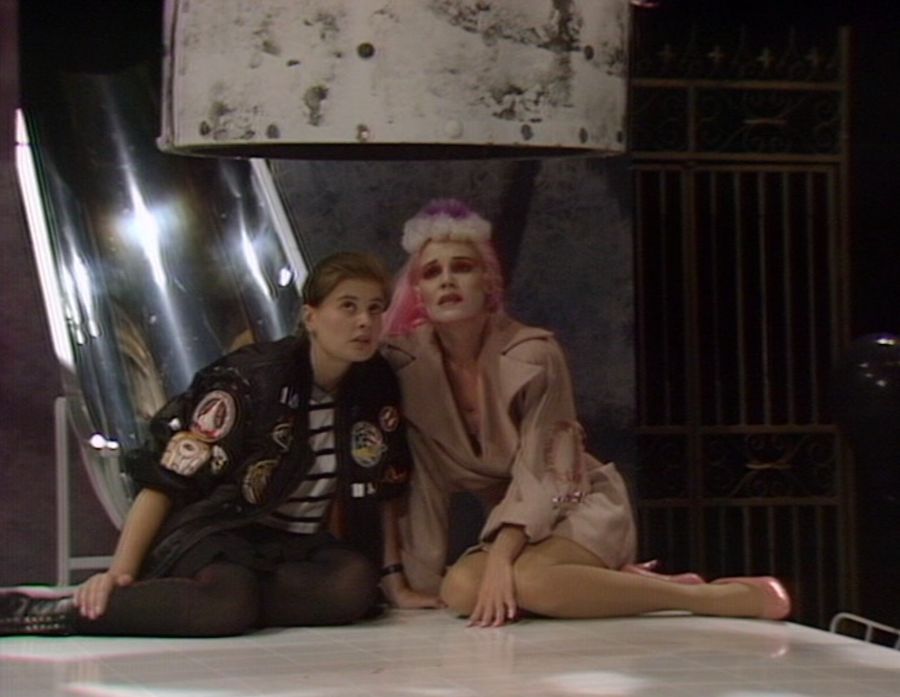
But since I find the story uninspiring and uninteresting, even from watching the Special Edition version of the story with its extra scenes and new CGI effects, it’s not hard for me to question everything else that’s going on in this story, including how the world is set up.
I mean, I put it to you. Would you be able to take the colourful characters of this story seriously in a political situation, especially when they have odd fashion, odd hairstyles and too much make-up on their faces? I don’t think I would if I was put in that situation.
And again, going back to most of the inhabitants of Terra Alpha having white make-up on their faces, why do they have white make-up on their faces? Are they meant to be clowns? Is it to make them appear flattering? I don’t think so, as it appears so overdone.
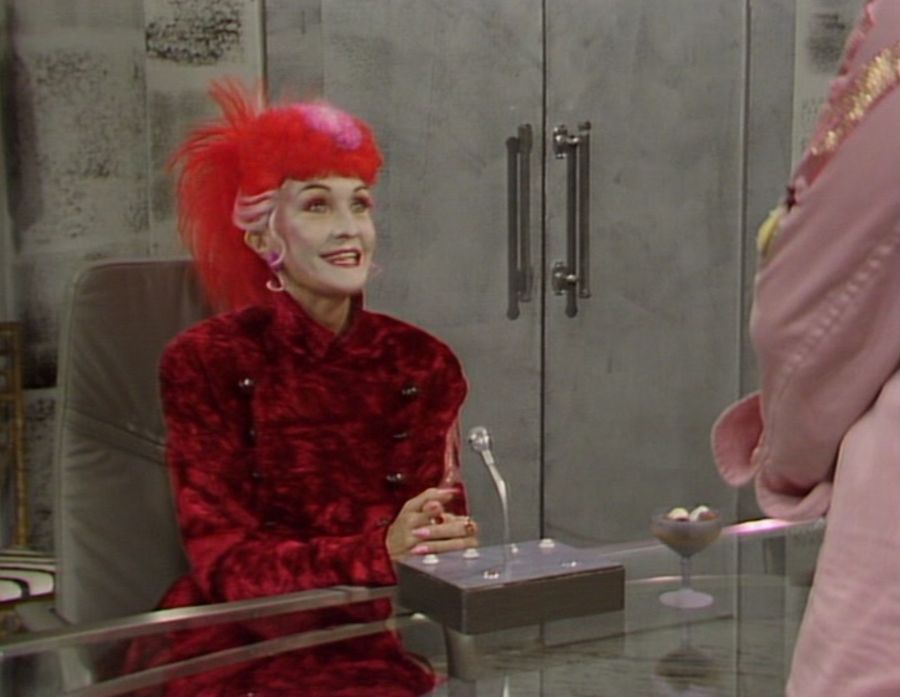
It doesn’t do Helen A any favours, especially when combining her make-up with her red clothes and red hairstyle. It makes her stiff as a character. Then again, that might be part of the whole Margaret Thatcher approach, but I wouldn’t like to make that comparison.
And that’s another thing that gets me about this story. ‘The Happiness Patrol’ being a direct attack on Thatcherism doesn’t really suit me. I’m not really a fan of ‘Doctor Who’ stories that get too political, especially when they’re having a political message to say. 😐
Usually, I prefer the ‘Doctor Who’ stories that have more escapism fantasy elements to them. ‘Remembrance of the Daleks’ and ‘Silver Nemesis’ do it well for me, especially when they have monsters that the Doctor and his friend Ace fight against in those stories.
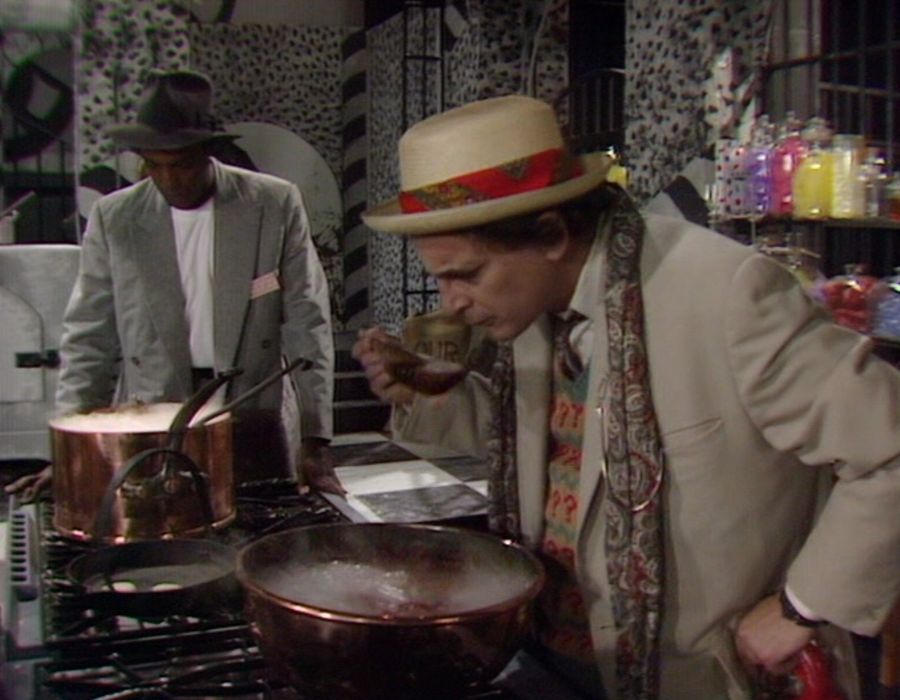
Combining a fantasy scenario with a real-life situation, especially political, is always going to be a risky business. If it’s subtle and you can read between the lines, I think it’d be okay. But if it’s obvious and you recognise it, the guarantee it’ll work isn’t always guaranteed.
In the Jon Pertwee era, there were ‘Doctor Who’ stories, particularly by Malcolm Hulke, that contained socio-political elements in them. But they didn’t get in the way of the story and at least Terrance Dicks was able to clarify elements that might be confusing.
The bottom line is that a political message should come last in the writer’s mind when doing a ‘Doctor Who’ story. I know politics is often a thing in terms of writing, but that shouldn’t be the main priority. The fictional/fantasy elements need to come first frankly.
It’s why I don’t think many fans take to the recent neo-Russell T. Davies/Ncuti Gatwa era of ‘Doctor Who’, because quite often, the political messaging comes to the fore more than the fantasy elements of a story. Some might disagree with that, but that’s what I think.
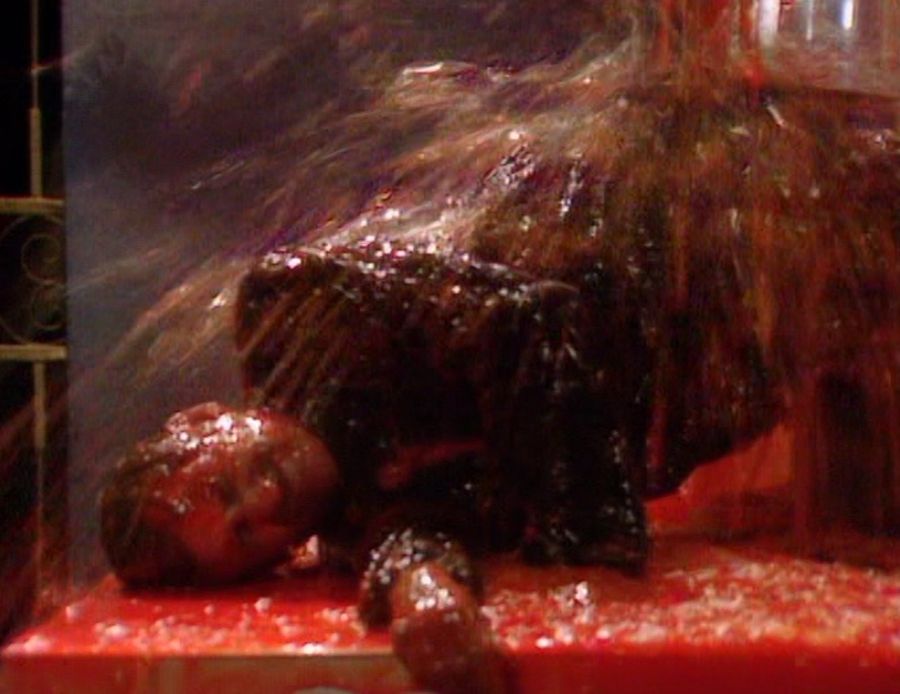
In watching ‘The Happiness Patrol’, I’m not getting the emotional investment for the victims of Helen A’s rule, because it’s not explored enough. Like a man getting killed by a strawberry Fondant Surprise. That scene would be effective if I knew who the poor man was.
He was executed because he displayed public grief. Now, wouldn’t it have been better to be shown what the man was grieving about? We’re just told that the man is guilty of showing a public display of grief. That’s it. We’re not shown what led up to his execution.
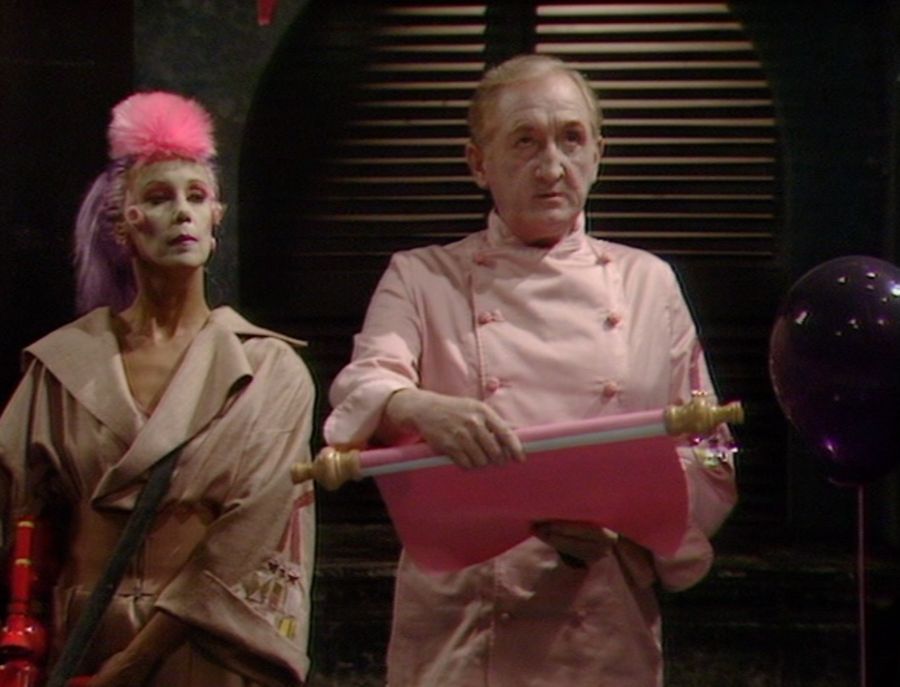
Joseph C: It says here that you have been found guilty of an ostentatious display of public grief? Oh dear, dear, dear.
This is an example of where the author needed to ‘show’ and not ‘tell’ what’s happening in the story. I don’t know if that’s made up for in the Target novelization, but I would have preferred seeing more victims suffering instead of being told why they’re called ‘killjoys’.
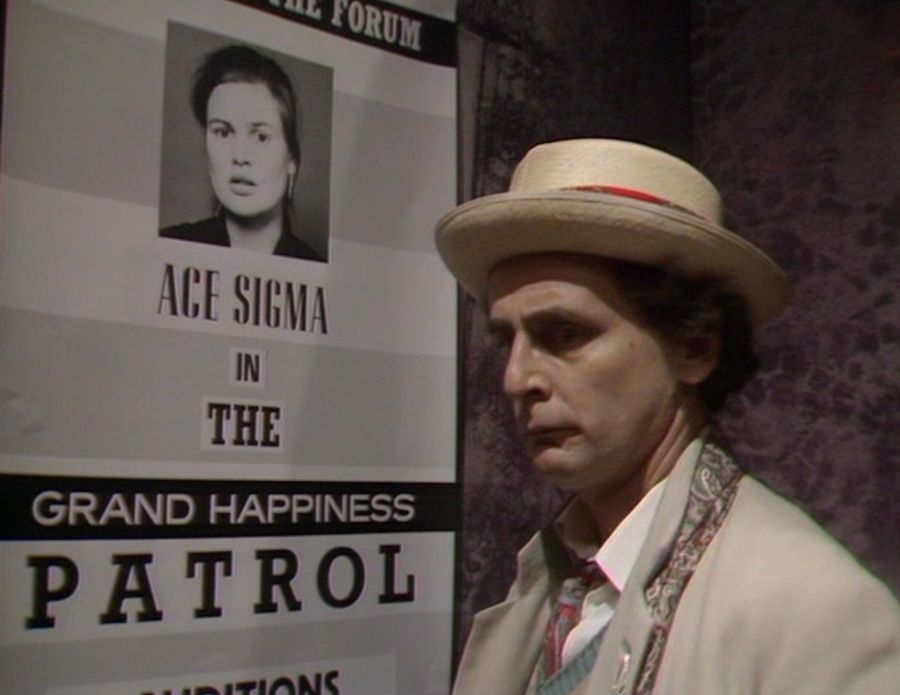
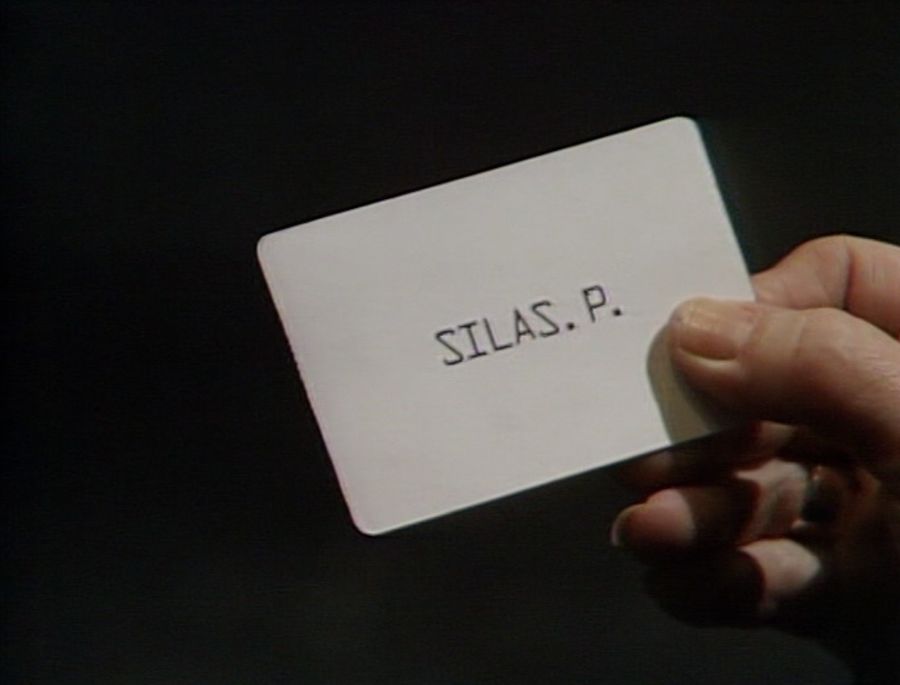
Incidentally, none of the guest characters are given proper surnames in the story. There’s Helen A, Joseph C, Daisy K, Gilbert M, Susan Q, Priscilla P, Silas P and Harold V. Those who are visitors to the planet are given the surname Sigma like Earl and Trevor. 😐
I don’t get the logic behind that, as it’s not really explained in the story. Why are the guest characters in ‘The Happiness Patrol’ mostly given initials as their surnames? Is it supposed to be something political? Something comedic? Perhaps both? I don’t get it.
One of the things that script editor Eric Saward said to writer Philip Martin when he wrote ‘Vengeance on Varos’ was that in order to create the world he invented, he had to know its ins and outs when depicting it on screen for the benefit of audiences watching.
Even in a three-part story, the ins and outs of an alien or futuristic society need to come across for an audience to process it. If it’s not explained well enough for audiences to understand how a fictional world works, then it’s going to be a struggle to enjoy the tale itself.
Now, if you think I’m being too harsh since I haven’t got into the monster aspects of the story yet, well, I have to tell you, I didn’t find the monsters featured in this story particularly inspiring. Even if they’d been designed and built with the best of intentions.
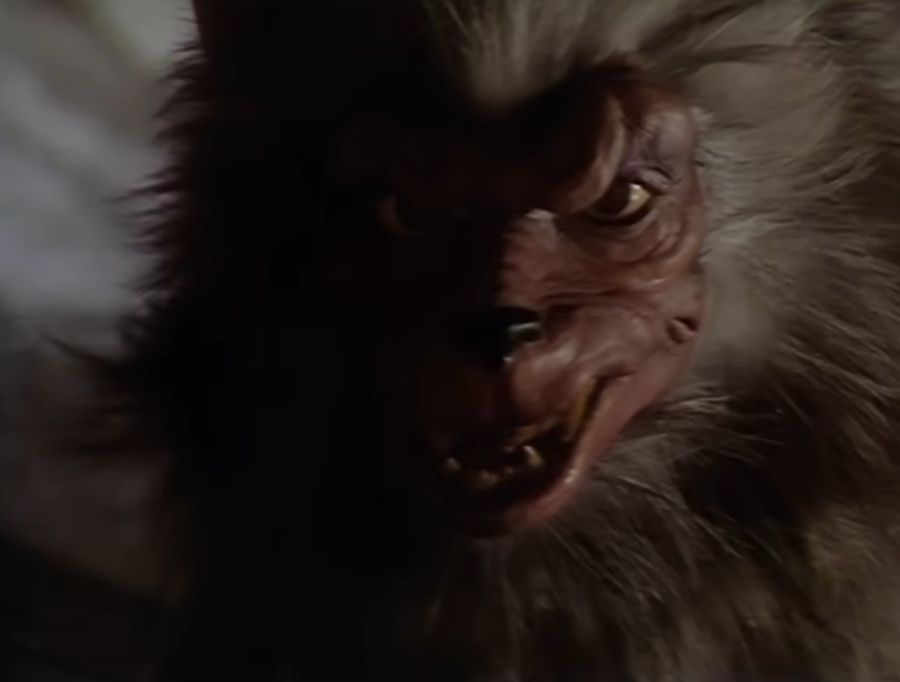
First, let’s talk about Fifi for a bit. Fifi is meant to be Helen A’s pet – like her owning her space dog. But frankly, I’m not quite sure why Helen A is so fond of Fifi. It might be because Fifi is vicious when going into pipes to sort out the Pipe People lurking in them.
But that’s kind of the problem with Fifi. She’s vicious. Not to an annoying extent like Krypto in the 2025 ‘Superman’ film, but she can be vicious in terms of appearance and mannerisms. I think there are times where Fifi is meant to be cute when Helen A holds her.
However, I’m not getting that, as surely Helen A would have got herself a pet that’s cuter than that. I’d rather have cuddly toy dogs like Cuddles, Puddles, Buggles, Snuggles and Fuggles to handle rather than have Fifi as a cuddly toy, especially since she doesn’t look happy. 😐
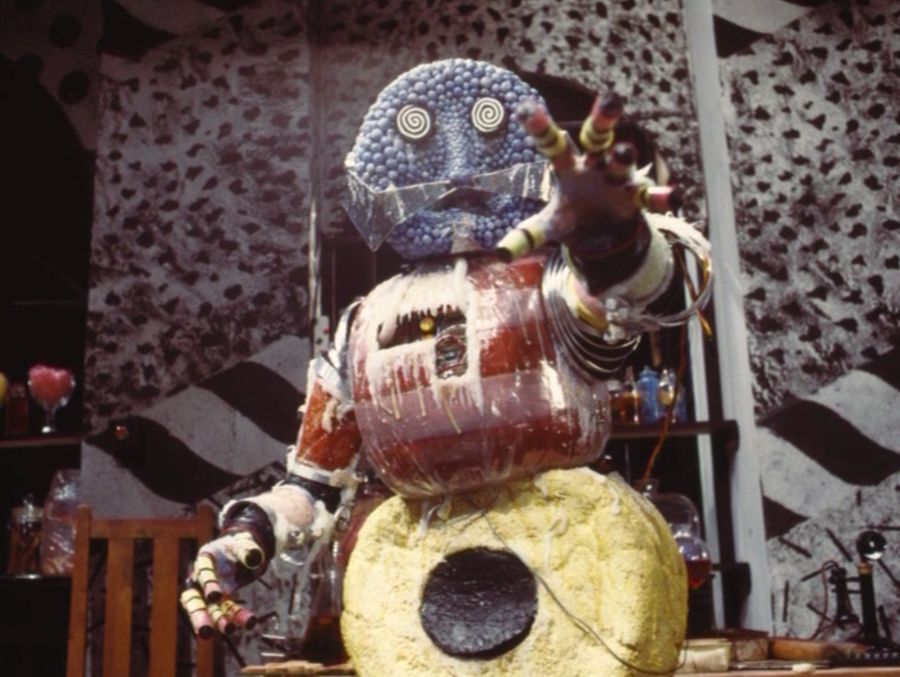
Another monster to talk about in this ‘Doctor Who’ story is the Kandyman. Yeah, I found it hilarious when watching the Kandyman for this first time. Mainly because the Kandyman is daft as a ‘Doctor Who’ monster, more in its presentation than in concept. 😦
Now, as I understand it, the Kandyman was originally going to be human in appearance and perhaps wear dark clothes and glasses instead of ending up looking like…well, Bertie Bassett, the Bassett’s sweet company’s mascot. That company makes liquorice allsorts.
Honestly, I would’ve been fine with the first concept instead of what we ended up with. Maybe it could’ve been like an evil Willy Wonka making chocolate and sweets to kill people, fitting with ‘The Candyman Song’ from ‘Willy Wonka & the Chocolate Factory’.
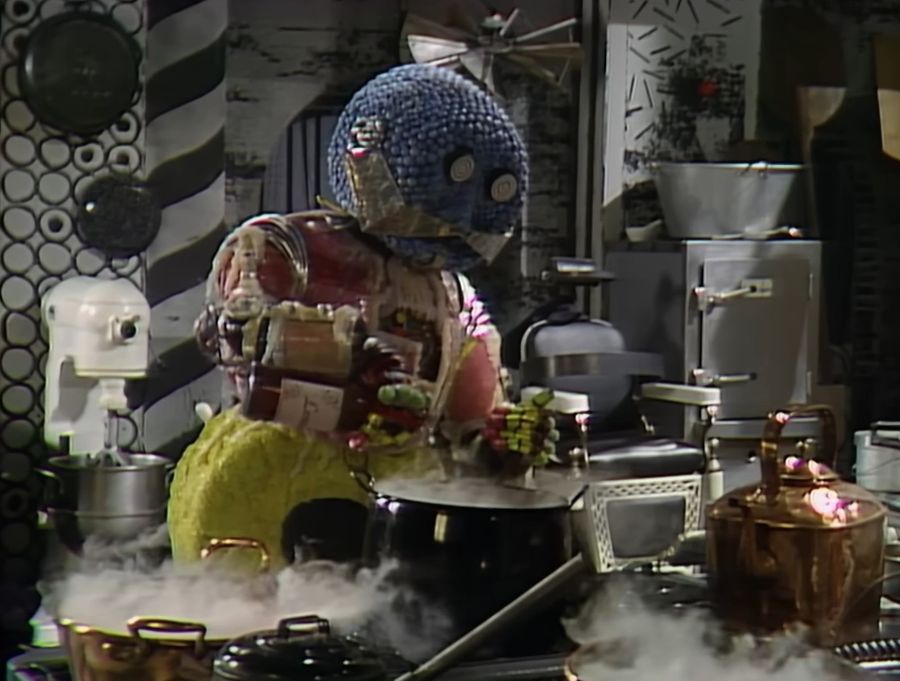
So, why did we end up with the Kandyman as he appeared in ‘The Happiness Patrol’ with a body made out of liquorice allsorts? In fact, why is the Kandy Man just made out of liquorice allsorts? Couldn’t they have added a bit of chocolate to him as well as sweets?
Heck, add jelly babies to the Kandyman? It’d make him more ridiculous than he appears in the TV story, but at least there’d be variety to him as a ‘Doctor Who’ monster with sweets that potentially kill people. Not everyone is a fan of liquorice allsorts, you know?
Apparently, the sweet company Bassett’s laid a compliant to the BBC over the similarity between the Kandyman in ‘The Happiness Patrol’ and their trademark character. Quite frankly, I find Bertie Bassett more cheerful-looking compared to the Kandyman in this. 😐
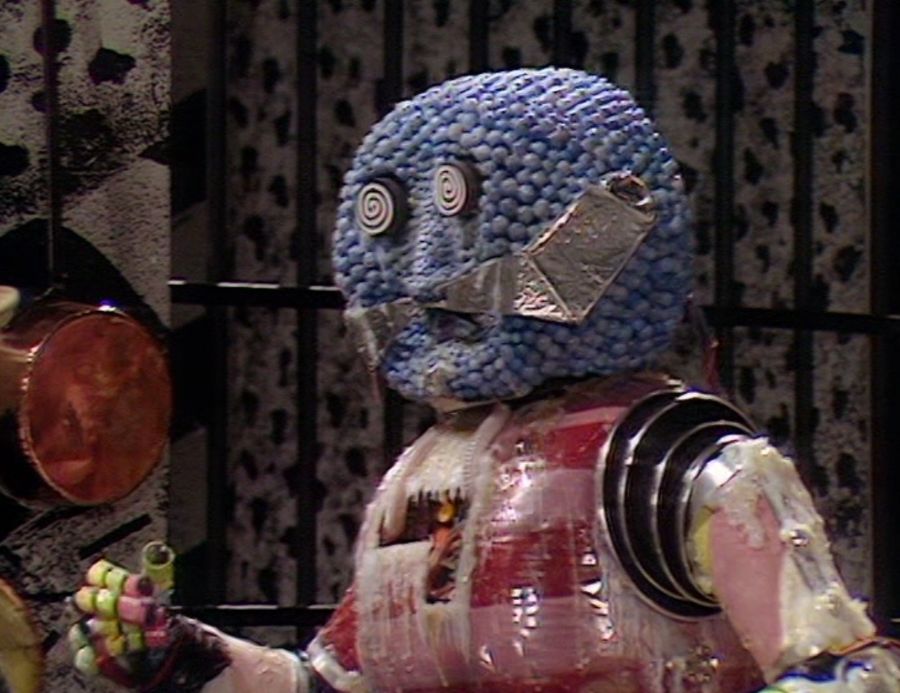
Regardless, the BBC agreed not to use the Kandyman again. Mind you, that hasn’t stopped Big Finish with including the Kandyman as a villain in the first ‘Ravenous’ box set with Paul McGann. Thankfully, Big Finish don’t have him appear like Bertie Bassett. 😀
A thing that gets me about the Kandyman is the fact that he’s always angry. Seriously, every time I hear him speak, he’s always shouting. I guess David John Pope who played the Kandyman got frustrated with being encased in the costume for long periods of time. 😀
David John Pope has also been in a TV episode of ‘Star Cops’ – the third episode called ‘Intelligent Listening For Beginners’ in case you were wondering. Regarding the Kandyman as a character, he’s not that great. In fact, I’d say he’s very one-dimensional.
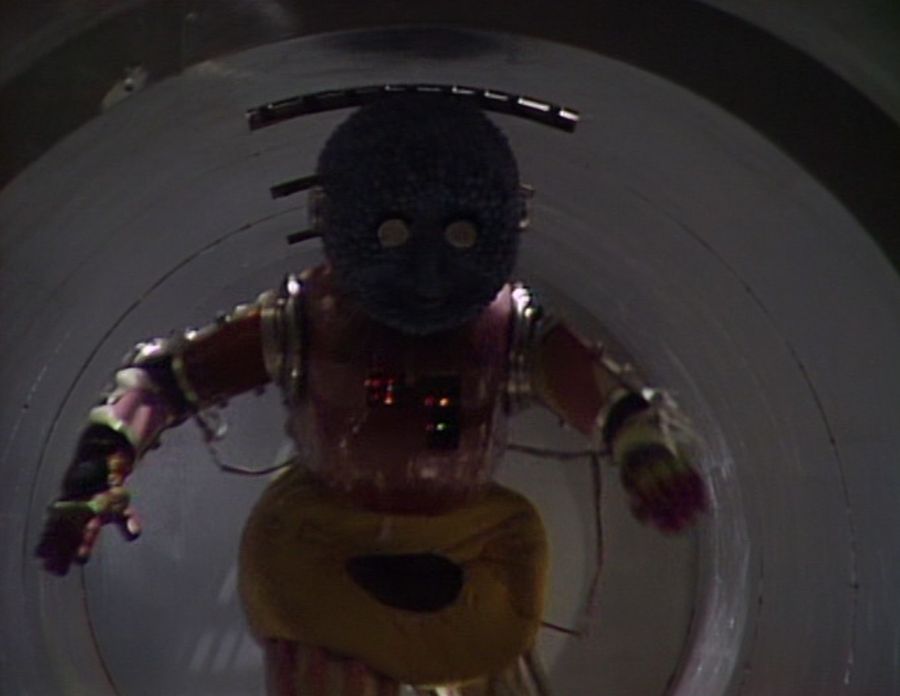
I mean, who is he? Where did he come from? How come he doesn’t look like everyone else that are human in appearance? Apparently, he was built by Gilbert M and gained a mind of his own, but that’s it. Why is he working for Helen A to kill people with sweets?
These questions are raised from my experience of the TV story in that I didn’t feel threatened by the Kandyman as a villain. I mean, would you really be threatened by someone who looked like liquorice allsorts and shouted a lot? It isn’t very inspiring for me.
So yeah, as you can tell, the Kandyman isn’t what I consider a great ‘Doctor Who’ monster in the TV series – both classic and new. I’d stick with knowing that Willy Wonka from ‘Willy Wonka & the Chocolate Factory’ is the real Candyman, especially since…
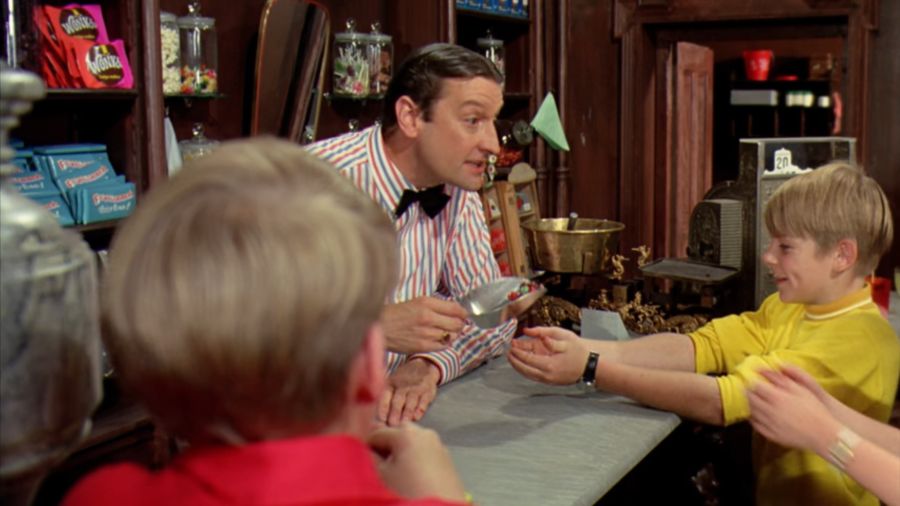
Bill: ♪ The Candyman can ’cause he mixes it with love and makes the world taste good. ♫
Also, there seems to be this obsession with sweets in Helen A’s world on Terra Alpha. I mean, is this what Helen A used to win people over as their ruler? By providing them sweets before it was decided to have people killed by sweets when they were unhappy?
Even if that was the case, it’s not encouraging, as I hate to break it to people, but sweets aren’t very good for you. It’s important to have a variety in terms of food and drink. You can’t rely on sweets all the time. It’d be pretty boring. Helen A should have known better.
Just to talk about the Pipe People for a bit. Apparently, these were the native inhabitants of Terra Alpha. Not that I’m expecting you to know that instantly from watching the TV story, since it’s never explained who they are, as we don’t get to know much about them.
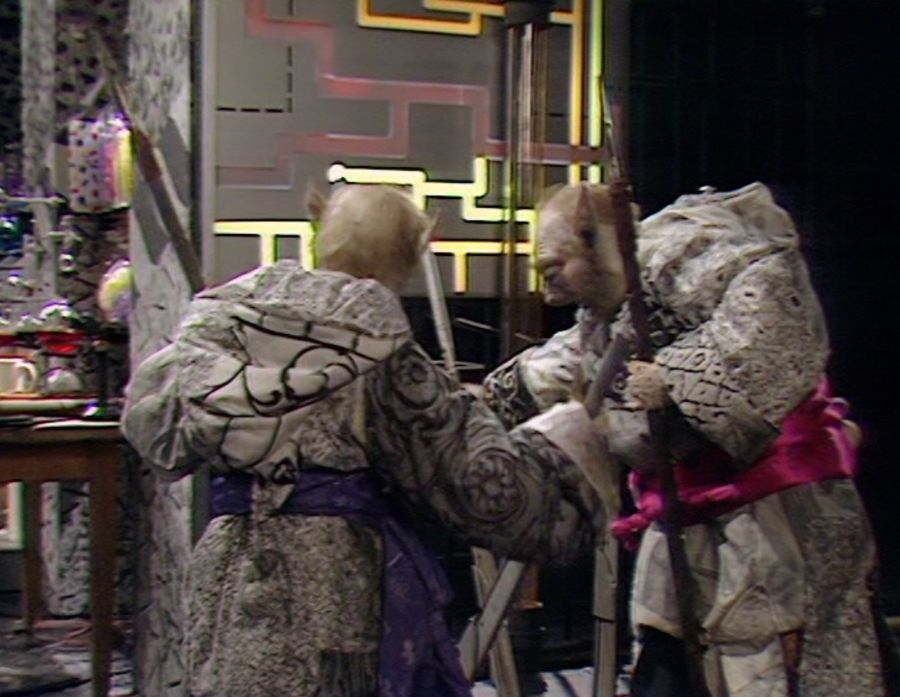
The Pipe People are rather pathetic in my opinion. They happen to be played by young boys wearing masks, and the masks are clearly unconvincing. Also, when seeing the Pipe People, you can’t understand a word they’re saying, which can be very frustrating.
I’d forgotten that the Pipe People were in this ‘Doctor Who’ story, as they’re so forgettable when you’re watching this ‘Doctor Who’ story. Had ‘The Happiness Patrol’ been a four-part story instead, perhaps the Pipe People would have provided a better impact. 😐
In fact, why are they called the Pipe People? Wouldn’t it have been better to call them Terra Alphans instead? It’d make sense. The Doctor doesn’t really get to have much interaction with the Terra Alphans when he, Ace and others are journeying in the pipes. 😐
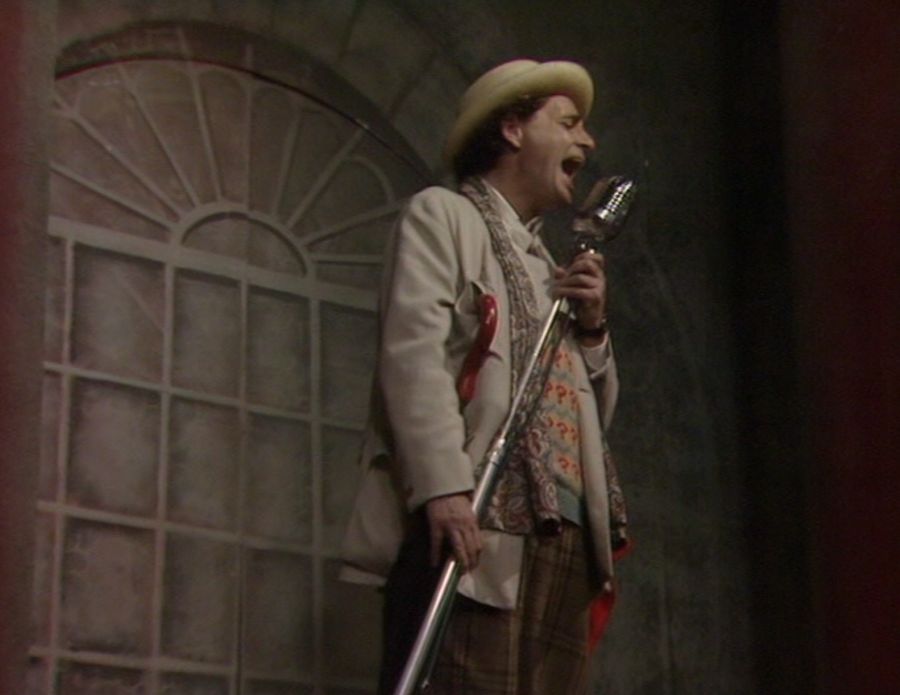
Sylvester McCoy delivers a good performance as the Seventh Doctor in this ‘Doctor Who’ adventure. I think ‘Remembrance of the Daleks’ showcases his Doctor better than what ‘The Happiness Patrol’ does to showcase him, but there are some good moments.
I enjoyed how the Doctor challenges Helen A and her regime on Terra Alpha and how he tries to find a way to disrupt the evil of “Happiness will Prevail”. On their first meeting, the Doctor makes it clear he’s not ‘happy’ with what Helen A is doing. This unsettles her.
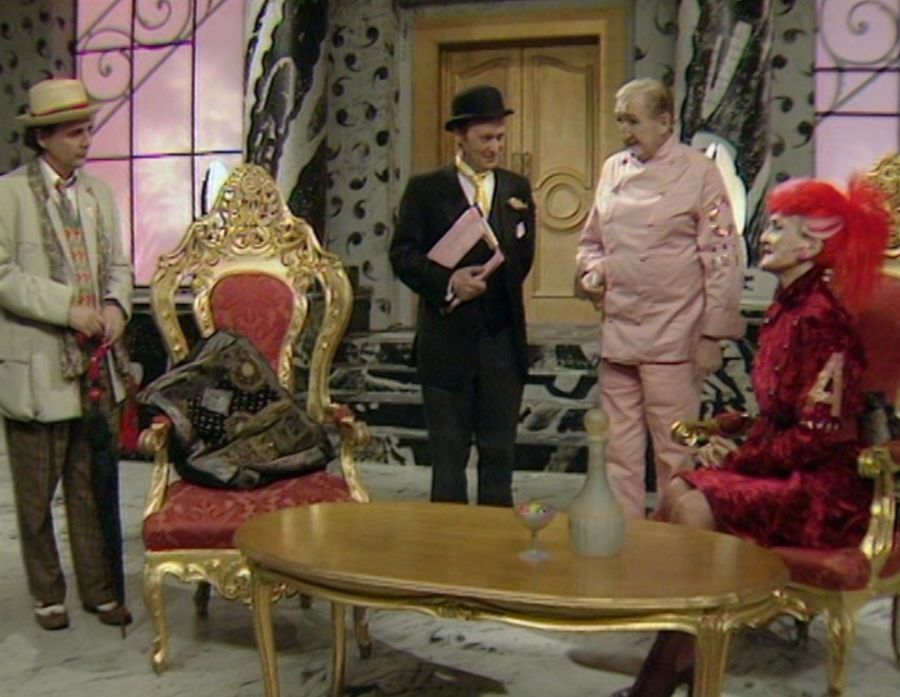
Helen A: I’m glad to see you again, Trevor. I don’t think I’ve had the pleasure.
Doctor: It’s no pleasure, I can assure you.
Helen A: How very kind.
Hmm, I wonder if Sheila Hancock got that “How very kind” line from working with John Le Mesurier in the 1964 film ‘The Moon-Spinners’. He said “Oh, how kind” quite often when playing Sergeant Wilson in ‘Dad’s Army’. I wouldn’t be surprised if that was the case.
There are moments where you get to see Sylvester McCoy’s Doctor being dark and manipulative in the TV series. This is a contrast to how he was in Season 24 where the stories were mostly comedic and he was being the clown instead of being mysterious. 🙂
The scene where the Doctor tempts one of two snipers to shoot him and look him in the eye whilst doing it was quite tense. It’s a scene that works well on its own compared to fitting in with the rest of the story. And it showcases Sylvester’s talents as an actor well.
I also liked the final scene between the Doctor and Helen A where he tells her that happiness is nothing without sadness. It’s a very defining moment in the story, well-performed between the two actors. This is something from the story that stood out well for me.
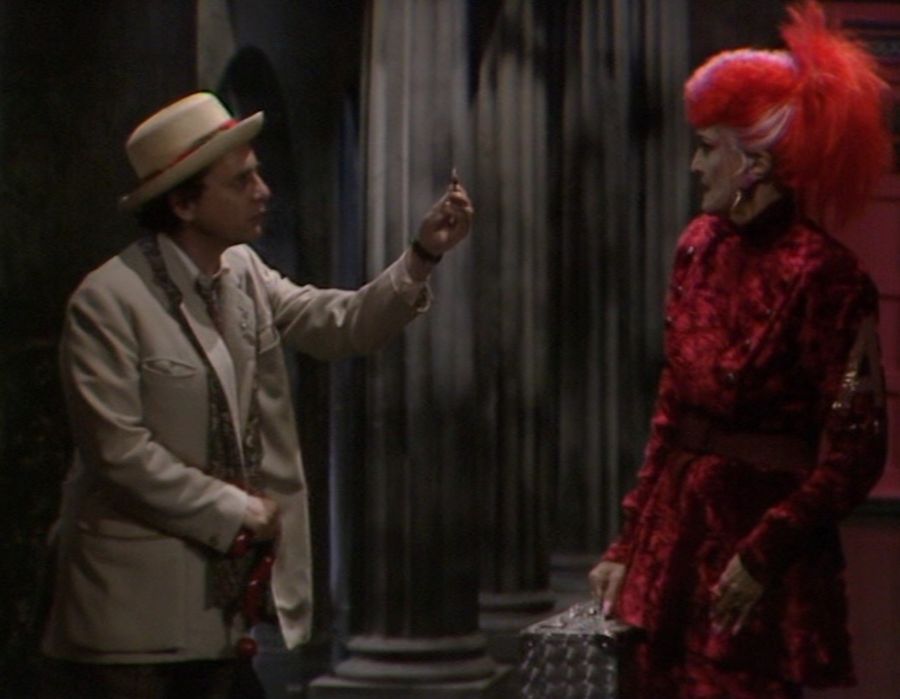
Doctor: Happiness is nothing unless it exists side by side with sadness. Two sides, one coin.
Now I’m not sure if he would have said that line differently by telling Helen A that “It’s okay to be sad sometimes” as that’s kind of important when living your life. But the way he said it in the story is fine and I wish that had been emphasised more thoroughly in the tale.
I enjoyed Sophie Aldred as Ace in this ‘Doctor Who’ adventure. I don’t think ‘The Happiness Patrol’ is a strong outing for Ace’s character, but I like those moments where she defies Helen A’s regime as well as the Happiness Patrol when visiting Terra Alpha. 🙂
She even gets to join in on the Doctor’s antics in ‘Part Three’ when he’s trying to make out that he and the ‘killjoys’ are happy to fool the Happiness Patrol and prevent being killed. Ace does get separated from the Doctor in the middle section of the adventure. 😐
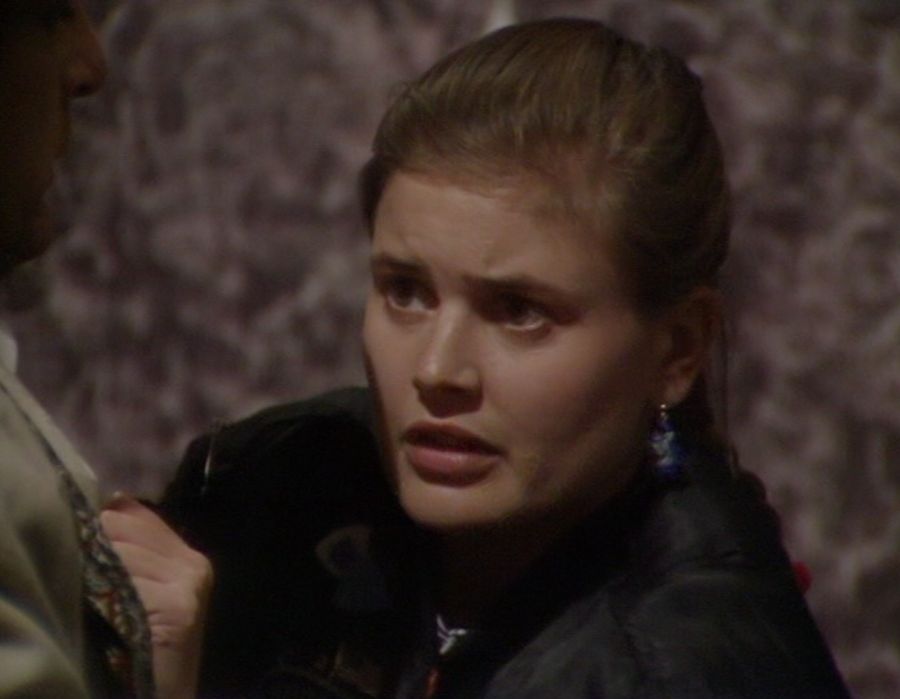
There’s a moment where Ace gets very angry with Priscilla P over her crude remarks about Harold V being killed off in ‘Part One’. She wants to fight back and make Priscilla P and the Happiness Patrol ‘very unhappy’ when they’re doing terrible things to certain people.
I like it that Ace gets to be friends with Susan Q, an unhappy member of the Happiness Patrol played by Lesley Dunlop, who was in ‘Frontios’ with Peter Davison, apparently. Sophie Aldred and Lesley Dunlop became very good friends after making this TV story. 🙂
Back when I did my original review on this story, I agreed with Sophie Aldred about her comments in the ‘Happiness Will Prevail’ making-of documentary that this story should have been shot in black-and-white, as it would have made the story far more interesting.
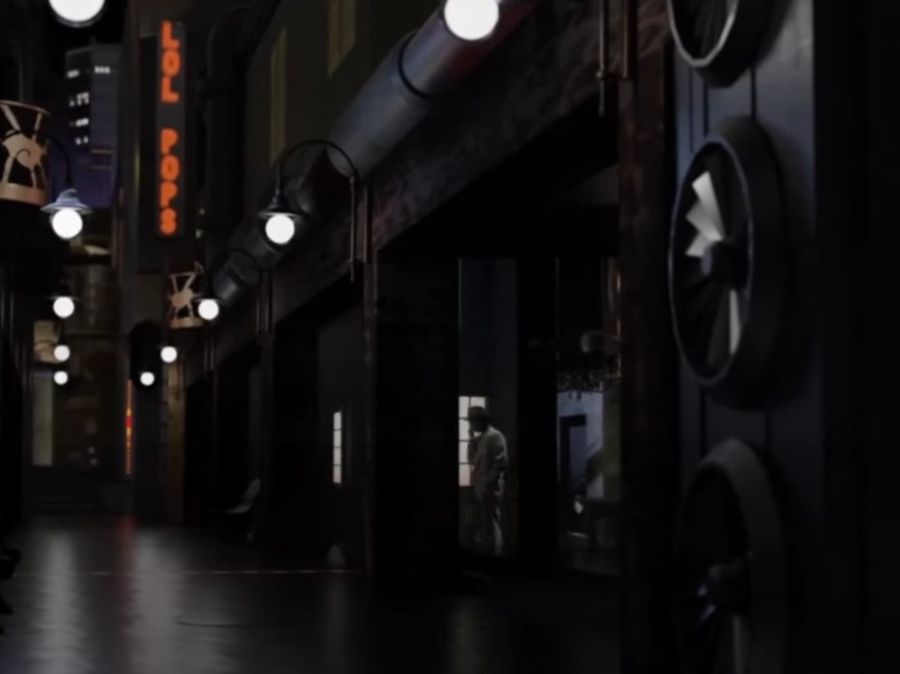
Whilst I still think that would be the case, it probably wouldn’t have been the best approach in making this story, since you’d take out a lot of the colours featured in ‘The Happiness Patrol’, including pink and purple. Although, frankly, wouldn’t that be better?
I mean, you can use your imagination as to what the Happiness Patrol looks like when seeing it in black-and-white. Plus, you wouldn’t be able to see the white make-up on people’s faces and using a film noir approach would make the story a little scarier, right?
Regarding the Happiness Patrol as characters, they’re not very good in sharing the ‘happiness’ as their group’s name would imply. I mean, all they’re doing is killing people off when they find someone unhappy. Isn’t that all against what their patrol is all about?
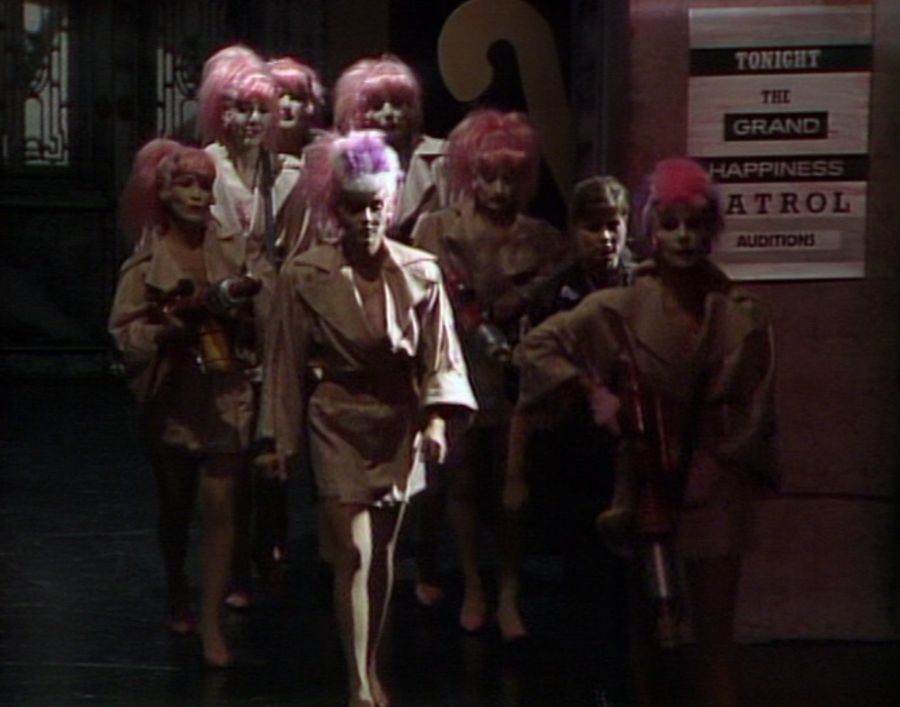
Are they called the Happiness Patrol because they’re happy to kill people off mercilessly? That’s sickening. Perhaps it’d be better if they enforced the ‘happiness’ by giving sweets to people that contained drugs to make them happy. That’d be far scarier.
Or perhaps they could pick people off one by one and take them to a brainwashing centre where they’re made to think and feel happy. Seeing the Happiness Patrol just killing unhappy people off in the streets isn’t interesting nor scary when I watch this story.
Even seeing the Happiness Patrol’s faces doesn’t convince me that they’re happy in what they do. When the Doctor, Ace, Susan Q and Earl Sigma show off their feigned happiness in ‘Part Three’, the Happiness Patrol members look very pouty and miserable.
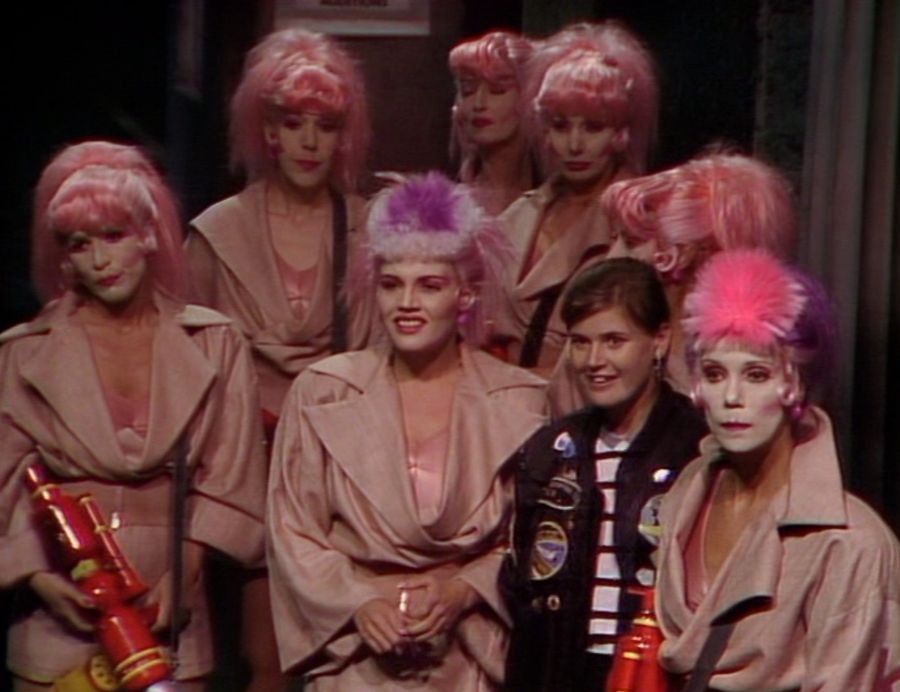
Like they’re unhappy that they can’t kill anyone because the people are showing how happy they are. It’d be amusing if they complained about this to Helen A and she’d be pointing the waving finger at them and say, “You shouldn’t be unhappy in the Happiness Patrol, dears.”
Georgina Hale guest stars as Daisy K, the leader of the Happiness Patrol, whilst Rachel Bell guest stars as Priscilla P who’s often in the prisons, oh, sorry, waiting zones on Terra Alpha. Daisy K and Priscilla P stand out here as the nastiest Happiness Patrol members.
Also, they’re the ones that speak more than the rest of the Happiness Patrol. The rest of the Happiness Patrol are played by Julie Lawrence, June Easther, Carole Mudie, Angie Alaimo, Heather Downham, Olwyn Atkinson and Selina Gilbert. They fared well in this tale. 😀
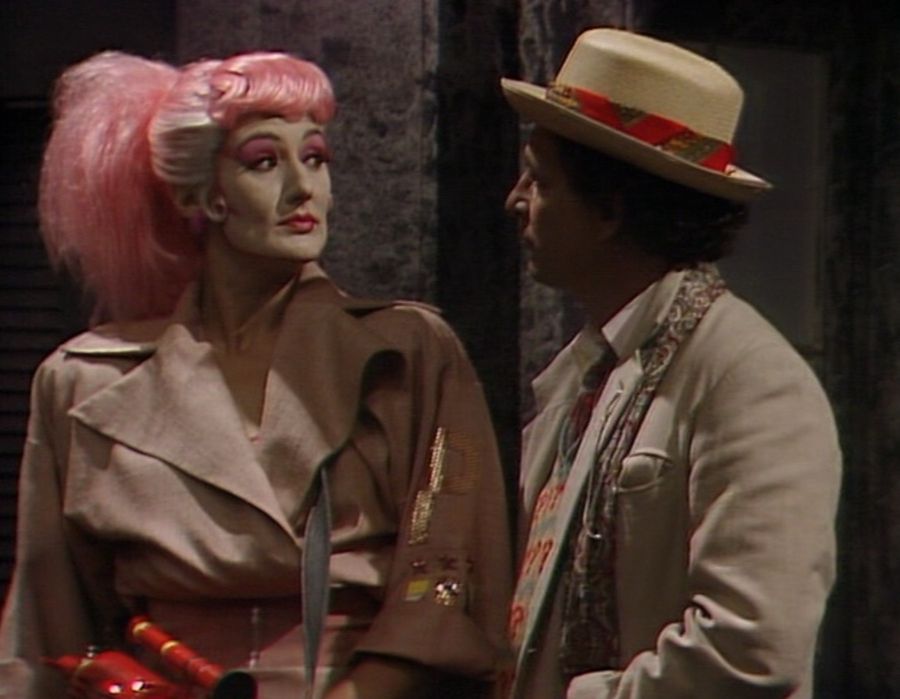
There’s not much to say about the Happiness Patrol as characters like Daisy K and Prisicilla P. They’re the same in terms of personality with being mean-spirited and ‘happy’ to work for Helen A. It was intriguing to see Daisy K and Priscilla P with their wigs off though.
The story’s guest cast also include Ronald Fraser as Joseph C, who’s Helen A’s husband. You could say he’s the Denis Thatcher of Helen A in much she’s the Margaret Thatcher on Terra Alpha. There’s not much to say about him, as he was few scenes in this tale.
It was quite a surprise to see him leaving Helen A behind on Terra Alpha when he and Gilbert M escaped in her shuttle. Not sure why he’d leave her apart from growing tired of his wife’s attitudes and methods, as their relationship doesn’t really get explored much.
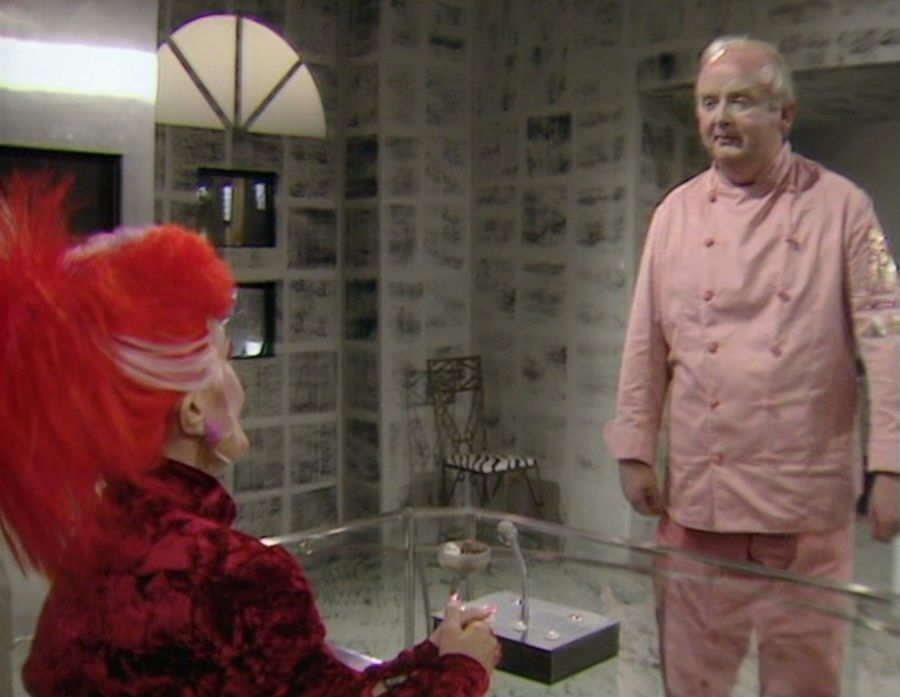
Harold Innocent guest stars as Gilbert M, who works in the Kandy Kitchen with the Kandyman by making sweets that kill people. After this ‘Doctor Who’ story, Harold Innocent went on to play Freeth in the audio story ‘The Paradise of Death’ with Jon Pertwee.
He also later played the Judge in ‘The Brittas Empire’ episode ‘The Trial’. As well as building the Kandyman, Gilbert M can be deliberately neglectful in being the Kandyman’s assistant, especially when the Doctor gets to freeze the Kandyman’s feet with lemonade. 😮
There’s Jonathan Burn as Silas P, who’s an undercover Happiness Patrol agent that only appears in ‘Part One’. He exposes Mary Healey as a killjoy to the Happiness Patrol and he gets killed off by the Happiness Patrol after failing to expose the Doctor to the Patrol.
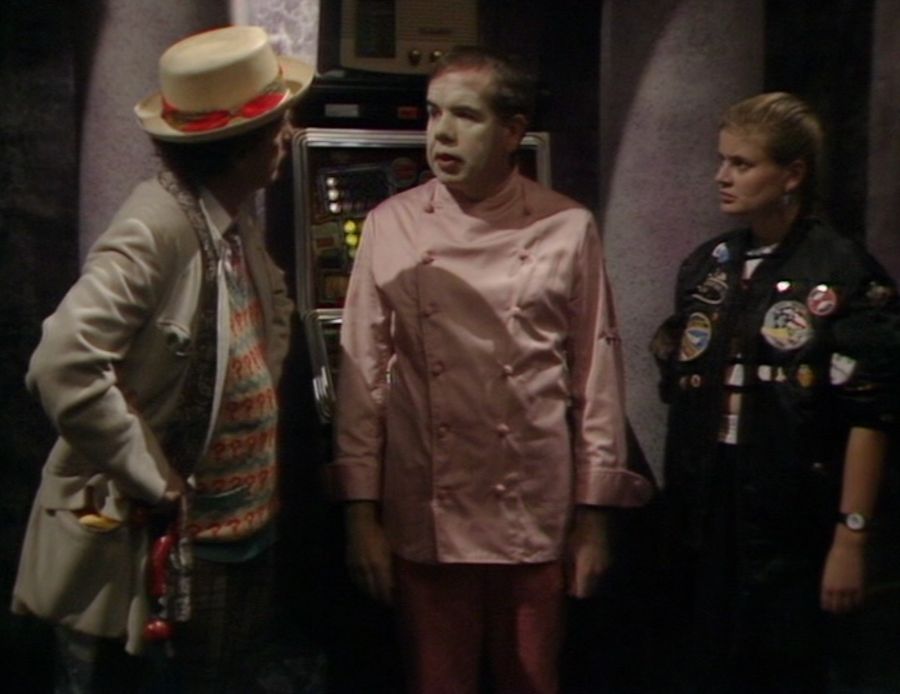
Tim Barker guest stars as Harold V, a killjoy who was once Helen A’s gag writer and was then called Harold F. Apparently, Tim Barker did two episodes of ‘Jeeves and Wooster’ and two episodes of ‘All Creatures Great and Small’ after this ‘Doctor Who’ TV story. 🙂
He’s also been in the first three episodes of the TV serial ‘Dark Season’ by Russell T. Davies. Unfortunately, Harold V gets electrocuted to death when playing a fruit machine in ‘Part One’ of the story. Yeah, not many of these characters survive to tell the tale. 😐
John Normington guest stars as Trevor Sigma, an official Galactic Censor that comes to inspect Terra Alpha. John Normington has been in ‘Doctor Who’ before, since he played Morgus in ‘The Caves of Androzani’ with Peter Davison. His voice is quite recognisable.
He later played Tom Flanagan in the ‘Torchwood’ episode ‘Ghost Machine’. Initially, I thought Trevor Sigma would be a bureaucratic villain, but thankfully he wasn’t. And he has a nice exchange with Sylvester’s Doctor when hearing Earl Sigma on his harmonica.
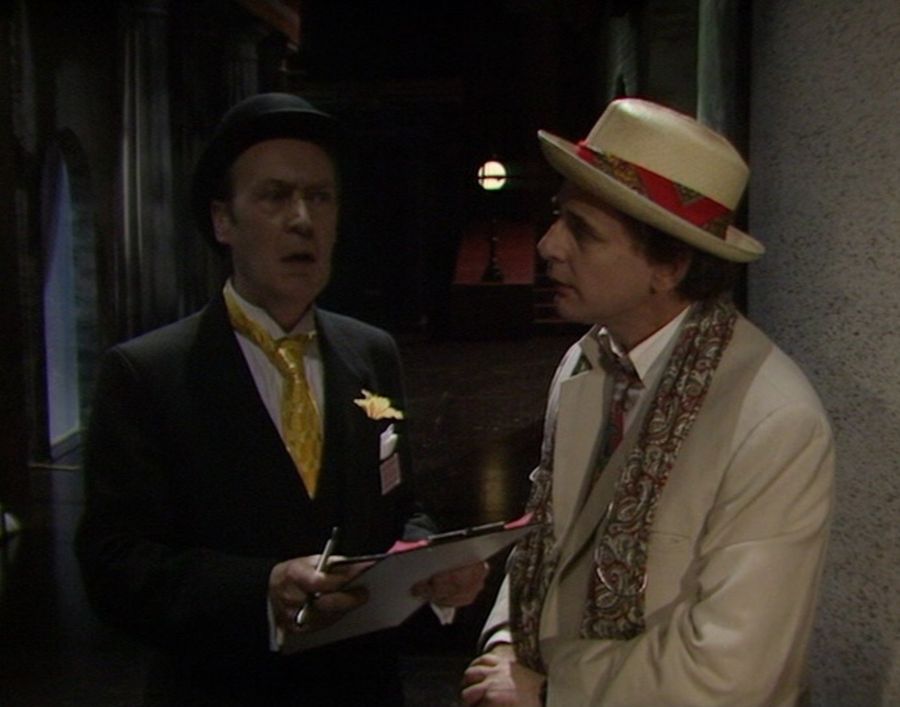
Trevor Sigma: That’s nice. It makes me feel sort of, er, sort of, er…
Doctor: Melancholy?
Trevor Sigma: Yes, that’s it. A pleasant melancholy.
Speaking of which, Richard D. Sharp guest stars as Earl Sigma, a blues player from the planet Earth who plays blue songs on Terra Alpha with his harmonica. Apparently, blues music is forbidden on Terra Alpha. I suppose Helen A isn’t a fan of blues herself.
The music featured in this ‘Doctor Who’ story is quite fascinating. Sometimes it ranges from melancholy music played by Earl Sigma on his harmonic to ‘lift music’ in the Terra Alphan streets, presumably composed by Dominic Glynn for the story’s incidental music.
There’s also Sylvester McCoy doing a rendition of ‘As Time Goes By’, a song sung in the 1942 film ‘Casablanca’ as well as the BBC sitcom series under the same name. I would have enjoyed the Doctor performing the song in full with Earl Sigma on his harmonica. 🙂
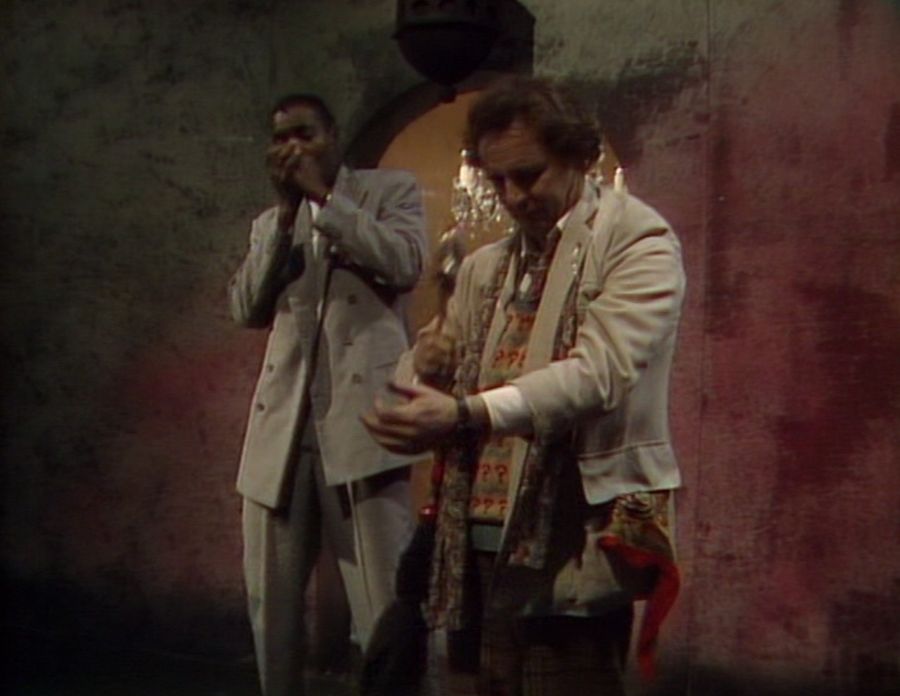
Oh, and Sylvester’s Doctor gets to play the spoons for a bit whilst Earl Sigma is on his harmonica in ‘Part Two’. Ace also gets to play with the Doctor’s spoons when she’s with Susan Q in ‘Part One’. It’s intriguing how the spoons keep popping up in ‘Doctor Who’. 😀
The cast also includes Tim Scott as the Forum Doorman, the Snipers played by Steve Swinscoe and Mark Carroll, two Pipe People including Philip Neve as Wences and Ryan Freedman as Wulfric, and there’s a Newscaster on Terra Alpha, voiced by Annie Hulley. 🙂
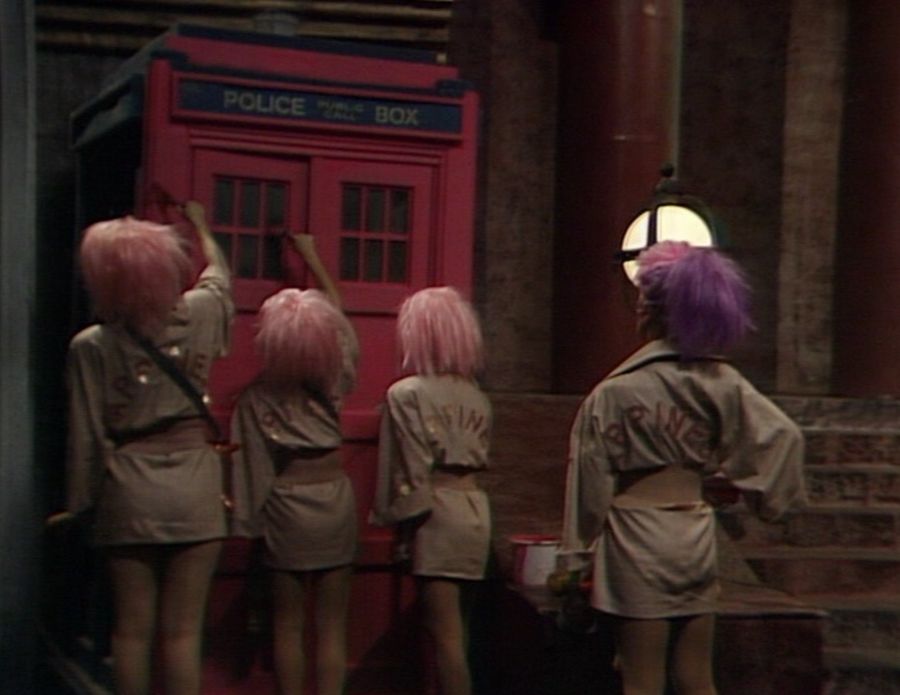
In the story, the TARDIS gets painted pink by the Happiness Patrol. Now I know Helen A and the Happiness Patrol are fans of Barbie. 😀 Not just of the Barbie doll and other merchandise, but also of the 2023 ‘Barbie’ film, which has Ncuti Gatwa appearing in it. 😀
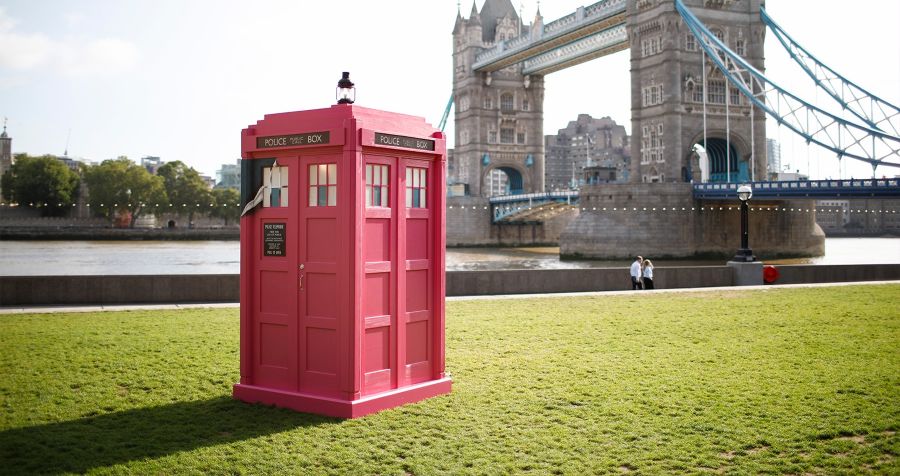
I’ll go one step further. In July 2023, the pink TARDIS resurfaced on the official ‘Doctor Who’ Facebook page. I assumed there was a link to ‘The Happiness Patrol’ somewhere in the 2023 photos of the pink TARDIS, but it was clearly promoting the new ‘Barbie’ film.
The story concludes with the Doctor getting to persuade Helen A to hear him that happiness cannot exist without sadness. Helen A refuses to listen to the Doctor until she sees her pet Fifi dying on a bench. She rushes over to Fifi and weeps bitterly indeed.
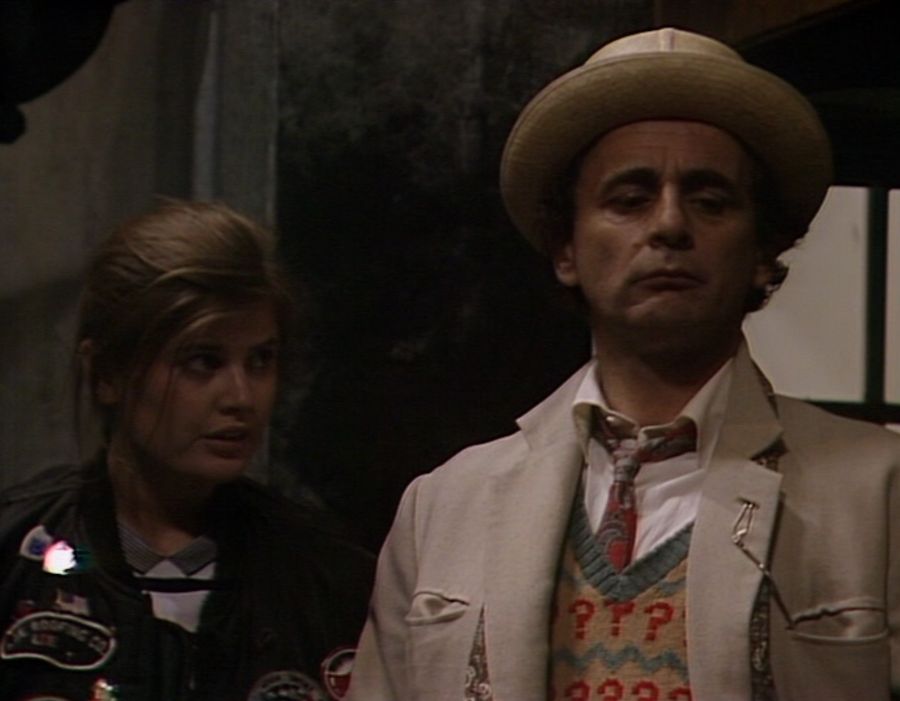
Ace: Shouldn’t we do something, Professor?
Doctor: ‘Tis done.
The TARDIS is repainted back to its natural blue, we see Daisy K and Priscilla P bicker each other with their wigs off and in white coats whilst repainting the TARDIS, and the Doctor and Ace bid farewell to Susan Q and Earl Sigma who are going to help repair Terra Alpha.
Before they leave Terra Alpha and the colony behind them, the Doctor says to a concerned Ace, “Happiness will prevail”. Even though that is a slogan used in Helen A’s regime, I’d like to think “Happiness will prevail”, even in the strenuous times we live in. 🙂
I highly recommend checking out the 1996 song ‘Happiness Is’ by Ray Connif. It’s a song I’ve listened to multiple times when my Nana was alive as well as through my Dad. The lyrics, ‘Different things to different people. That’s what happiness is!’ is very true indeed.
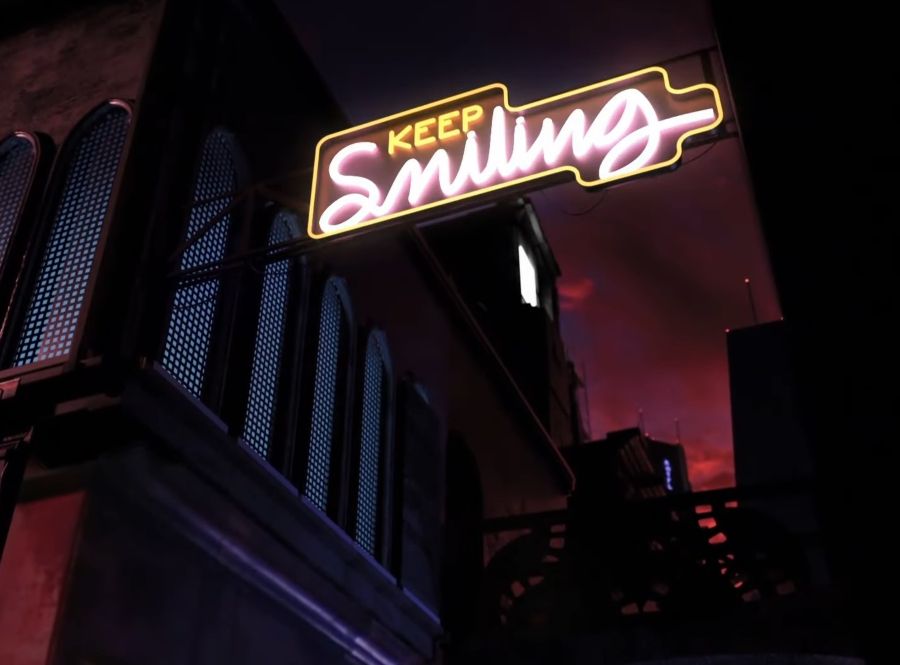
In the Special Edition version of ‘The Happiness Patrol’, there’s a sign with neon lighting that says, “Keep smiling” before it goes out. Whilst that’s an encouraging statement to end the story on, I’d rather go by a signed photo by someone special telling me the same thing. 🙂
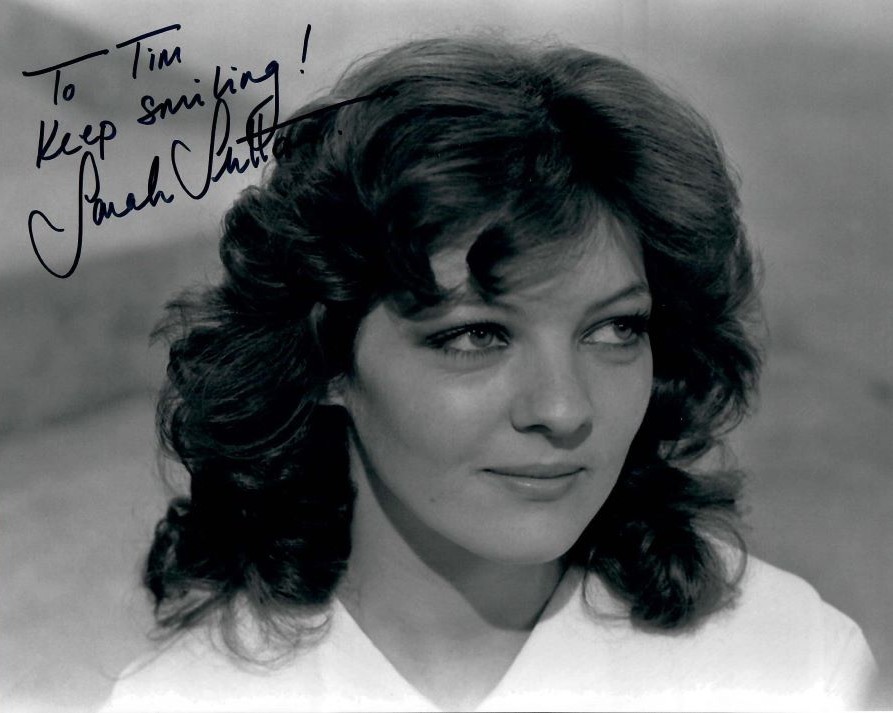
Tim Bradley’s photo of Nyssa in ‘Snakedance’ signed by Sarah Sutton with ‘Keep Smiling!’
Yeah, that makes me happier more than the closing shot of the Special Edition version of ‘The Happiness Patrol’. 😀
The original DVD special features were as follows. There was the making-of documentary called ‘Happiness Will Prevail’, featuring behind-the-scenes interviews with the cast and crew. There were deleted and extended scenes from the story to enjoy, and the ‘When Worlds Collide’ documentary which explores ‘Doctor Who’ and politics, featuring behind-the-scenes interviews with the cast and crew. There was a photo gallery of the story, a dual mono sound audio mix option for the story, an audio commentary with Sophie Aldred, writer Graeme Curry, director Chris Clough, script editor Andrew Cartmel and composer Dominic Glynn, moderated by Toby Hadoke, and an isolated music option by Dominic Glynn to enjoy. There was an info-text commentary option to enjoy, PDF materials including a ‘Radio Times Listings’ of the story, and a ‘coming soon’ trailer for ‘Death to the Daleks’, starring Jon Pertwee and Elisabeth Sladen.
On Disc 3 of the ‘Doctor Who – The Collection – Season 25’ Blu-ray, the original three-part 1988 TV version of the story, the ‘Happiness Will Prevail’ making-of documentary, the deleted and extended scenes, the ‘When Worlds Collide’ documentary, the dual mono sound audio mix option, the audio commentary and the isolated music option can be found on there. The photo gallery and the info-text commentary option have been updated for 2024 on the Blu-ray.
The new special features on Blu-ray include the ‘Behind the Sofa’ feature on ‘The Happiness Patrol’ with Sylvester McCoy (the Seventh Doctor), Sheila Hancock (Helen A) and Sophie Aldred (Ace) as well as Janet Fielding (Tegan), Wendy Padbury (Zoe) and Sarah Sutton (Nyssa) as well as Bonnie Langford (Mel) and Nicola Bryant (Peri). There’s a brand-new ‘Sophie Aldred: In Conversation’ interview conducted by Matthew Sweet, serving as a follow-up to the previous ‘Sophie Aldred: In Conversation’ interview included on Disc 7 of the Season 26 Blu-ray box set. There’s ‘Q&A: When Sophie Met Leslie’, an interview between Sophie Aldred and Leslie Dunlop. There’s the ‘Girls! Girls! Girls! – The Eighties’ discussion between Sarah Sutton, Janet Fielding and Sophie Aldred, who talk about the trials of playing a ‘Doctor Who’ companion in the 1980s (taken from the ‘Paradise Towers’ DVD). There’s a ‘Going Live’ item, a ‘Newsnight’ item and BBC trailers and continuity announcements of the story. There’s also a brand-new 5.1 surround sound audio mix option for the story to enjoy.
On the PDF front, as well as the ‘Radio Times Listings’ of ‘The Happiness Patrol’, there are production documents, three rehearsal scripts, transmission camera scripts for ‘Parts One and Three’, the studio floor plan, and visual effects design sketches.
On Disc 4 of the ‘Doctor Who – The Collection – Season 25’ Blu-ray, the new special features include the three-part Special Edition version of the story, featuring new CGI effects and some of the deleted and extended scenes from the story, and it can be seen in a dual mono sound audio mix option and a 5.1 surround sound audio mix option. There’s the ‘Chris Clough: In Conversation’ interview conducted by Matthew Sweet, an interview with visual effects designer Stephen Mansfield, and there’s some studio footage from the making of the story to enjoy.
As I’ve established, ‘The Happiness Patrol’ isn’t what I would consider one of my favourite ‘Doctor Who’ stories. I found it dull and uninspiring. Whilst I appreciate the story reflecting the 1980s and delivering a political message, I didn’t find it very exciting.
It’s a shame, as I would be behind the idea of a world where ‘unhappiness is a crime’ if I was emotionally invested with the characters featured in the story. There are missed opportunities to be found in this story, not really helped by its studio-bound limitations.
I don’t think I would last long on Alpha Terra if all that the Happiness Patrol did was killing off people one by one instead of trying to bring happiness to everyone. Mind you, I would laugh at the ridiculousness of the fashion and hairstyles found on that peculiar world.
When I saw the ‘Ace Adventures’ DVD box set containing ‘Dragonfire’ and ‘The Happiness Patrol’, I found it an enjoyable collection of ‘Doctor Who’ stories. It wasn’t the greatest, but I like how Ace was introduced as a ‘Doctor Who’ companion in ‘Dragonfire’.
‘The Happiness Patrol’ was a let-down for me, but it was intriguing to see how the 1980s was reflected in a political fashion, especially with it being an attack on Thatcherism. It’s not a story that I would’ve come up with personally, but I appreciate it being made. 🙂
I’m not sure if I would appreciate ‘The Happiness Patrol’ more if I read and listened to the Target novelization/audiobook by Graeme Curry, but it’s something for me to consider and I hope I will get to check out the story in novelization/audiobook sometime soon.
At least Sylvester McCoy as the Seventh Doctor and Sophie Aldred as Ace proved to be a highlight for me in this adventure. It was also great fun to see the reactions of the ‘Behind the Sofa’ contributors, including Sarah Sutton’s, when they viewed this TV story.
As part of the 25th anniversary season of ‘Doctor Who’, I can’t say it’s a match on ‘Remembrance of the Daleks’ and frankly, I don’t think 25th anniversary celebration ever came into the writing of it. Thankfully, that would be made up for in the next TV installment.
‘The Happiness Patrol’ rating – 5/10
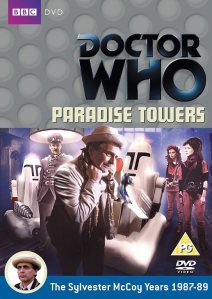
‘GIRLS! GIRLS! GIRLS! – THE EIGHTIES’
Please feel free to comment on my review.
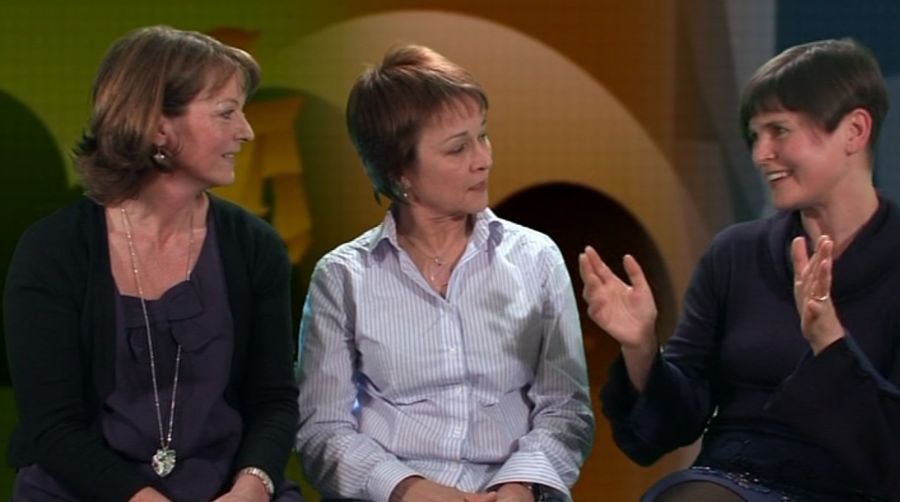
This special feature was originally released on the ‘Paradise Towers’ DVD back in July 2011. Now it’s available on Disc 3 of the Season 25 Blu-ray box set containing the original three-part TV version of ‘The Happiness Patrol’. I’m so pleased that it’s found its new home.
‘Girls! Girls! Girls! – The Eighties’ was the highlight for me when checking out the ‘Paradise Towers’ DVD. It’s a discussion between Sarah Sutton, Janet Fielding and Sophie Aldred (Ace) about the trials and tribulations of being a ‘Doctor Who’ companion in the 1980s. 🙂
At that point in 2011, I’d seen Sarah Sutton three times at conventions with the latest one being the ‘London Film & Comic Con’ in July 2011. I’d also just met Sophie Aldred at that event and was soon about to see both at ‘Regenerations 2011’ in September 2011.
I hadn’t met Janet Fielding at all by that stage, and it was interesting to see the various hairstyles Janet and Sophie had in that discussion compared to how I see them nowadays at conventions. Sarah hasn’t changed a lot since doing the discussion, which is amazing.
Sarah is my favourite ‘Doctor Who’ companion, so it was thrill to see her in this discussion on the ‘Paradise Towers’ DVD chatting to Janet and Sophie. It was fascinating to see the trio sharing about how challenging it was playing a ‘Doctor Who’ companion on 1980s TV.
It was lovely to see Sophie Aldred moderate the discussion between Janet and Sarah, especially since she played Ace in the late 1980s whereas Janet and Sarah played their characters in the early 1980s. The trio seem to get on very well with each other here. 🙂
Janet Fielding is quite dominant throughout the discussion, especially when sharing her frustrations about playing Tegan in ‘Doctor Who’ and how women were treated on TV compared to years later. Her insight about female roles on 1980s TV was very fascinating.
Sarah is lovely and quietly spoken throughout the discussion. I’m very pleased that Sarah doesn’t regret doing ‘Doctor Who’ when she played Nyssa in the 1980s, especially when it concerns her personal life with meeting her husband and everything, which is very nice.
The topics discussed in the discission include talking about remembering the first time they worked on the TV show. It was intriguing how Sophie and Janet shared about coming from the theatre to work on TV and finding it frustrating that they weren’t given very much direction.
Sarah of course has worked in TV since she was young and she was tutored on how to act in front of the camera. It was funny when Sophie and Janet recalled their first day of working in ‘Doctor Who’ compared to Sarah who can’t seem to recall her first day much.
The trio discuss whether their characters reflected the 1980s era of ‘Doctor Who’ or not. Sarah doesn’t seem to think so, since Nyssa is of an aristocratic background and is more old-fashioned. Janet doesn’t seem to think Tegan’s character reflected the 1980s either.
Janet shares how she’s always wanted to play Lucy from the Peanuts series featuring Charlie Brown and Snoopy, and Tegan was her chance to be ‘Lucy in space’. It’s brought up that Janet objected to Tegan’s image in terms of costumes when it affects her character.
The dress sense of 1980s ‘Doctor Who’ companions is talked about. It’s fascinating how Sophie’s dress sense as Ace is an improvement over what Sarah and Janet had to put up with when they tended to stay in the same costumes with some being quite unflattering.
The white tube top that Tegan wore in Season 20 is brought up as well as Nyssa’s ‘Snakedance’ outfit. Attitude and approach in ‘Doctor Who’ is discussed and it was enlightening to hear Sophie share how she was told to shave her armpits in the TV show.
I like how Sarah, Janet and Sophie talk about what happened to them when moving on from ‘Doctor Who’. Sarah is content with how things turned out for her, Janet shares her frustrations on leaving ‘Doctor Who’ and Sophie shares how she got on to be a TV presenter after the series.
Incidentally, Peter Purves, who plays Steven in ‘Doctor Who’, introduced the ‘Girls! Girls! Girls – The Eighties’ discussion at the beginning. I greatly enjoyed ‘Girls! Girls! Girls! – The Eighties’ and it’s very clear that Sarah, Janet and Sophie enjoyed doing the discussion too.
‘Girls! Girls! Girls! – The Eighties’ – 10/10
| The previous story
For the Seventh Doctor was
For Ace
|
The next story
For the Seventh Doctor is For Ace is |
| Return to The Seventh Doctor’s Timeline | |
| Return to Ace’s Timeline | |
| Return to The Doctors’ Timelines Index | |
| Return to The Companions’ Timelines Index | |
| Return to Doctor Who Timelines | |
| Return to Doctor Who | |
| Return to Sci-Fi |
 Bradley's Basement
I wouldn’t have lasted 5 minutes on this planet being a somewhat grumpy git lol, it’s a ok watch, again studio bound doesn’t do it any favours & the actings a little hammy, Sylvester McCoy & Sophie Aldred do well but the Kandyman i mean what the hell was that?
LikeLiked by 3 people
No, I don’t suppose you would. 😀 I don’t think I would either. Although I would laugh at the ridiculousness of the fashion and hair style of the Happiness Patrol and Helen A if I were on that planet.
I found this story rather hard-going and dull to watch. I don’t know if I’d appreciate it more if I read/listened to the novelization/audiobook of ‘The Happiness Patrol’ by Graeme Curry. It’s something to consider in the future.
Glad you enjoyed Sylvester McCoy and Sophie Aldred in this one and glad you agree with me on my thoughts about the Kandyman. And Big Finish are bringing him back in the first ‘Ravenous’ box set with the Eighth Doctor?! What are they thinking?!
Thanks for your comments, Simon.
Tim. 🙂
LikeLiked by 1 person
Yeah I’m perplexed at Big Finish bringing back the Kandyman but no doubt they’ll make a better effort than this story did.
LikeLiked by 2 people
Black-and-white would have lost all the candy colors of the imposed happiness. The TARDIS being painted over “happy pink” was symbolic of the whole tyranny. Had to have that color
LikeLiked by 3 people
Hi Edward,
Thanks for sharing your thoughts about the story having colour instead of black-and-white.
Tim 🙂
LikeLiked by 1 person
Hello again, Now, I actually watched this in black and white on original transmission. I also made an audio recording so I could listen to it again not having access to a video recorder at the time. It’s a great listen and the book version is enjoyable too.
I thoroughly enjoyed the story, I guess because I wasn’t distracted by the garish colour scheme. Boy was I shocked to see the colour version! Though, Delta was truly frightening, that poor bright green baby.
I could appreciate what the story was getting at. How any autocratic ruler takes all the joy and colour out of the people they’re ruling.
For me, the characters are well-drawn and believable. The Kandyman is not the most subtle piece of Dr Who design and it didn’t help that they escaped from his clutches very easily, The voice is brilliant, particularly on audio.
What didn’t work for me were the pipe people, you couldn’t understand them! And the ridiculous go carts. While The Happiness Patrol is far from perfect, there are little flashes of genius. Helen A finally showing she did care about something, Earl Sigma changing his tune when he spots a patrol and that confrontation with the two guards is McCoy at his best. The beauty of Dr Who is that if surreal political satire is not your cup of tea, there’s always Cybermen, Nazis and a giant meteorite next week!
Take care, Tony.
LikeLiked by 2 people
Hi Tony,
Thanks for sharing your thoughts and insight on ‘The Happiness Patrol’. Glad you enjoyed this story. Interesting you saw this story in black and white instead of colour on its original transmission. I’m sure it must have been pretty scary for you when you first saw it in black and white. Thanks for sharing your memories of recording the audio when watching the story on TV.
I’m hoping to re-examine and update my thoughts on ‘The Happiness Patrol’ when it comes to the Season 25 Blu-ray box set release. I’m sure I’ll be checking out ‘The Happiness Patrol’ novelization/audiobook by Graeme Curry, read by Rula Lenska, when it comes to revisiting this ‘Doctor Who’ story.
I know I sound harsh in my review for this story, but hopefully I can extend more on my thoughts and justify why ‘The Happiness Patrol’ wasn’t really for me. Hopefully, I’ll have more positive things to say in my re-watch of the story on Blu-ray compared to my original DVD review. ‘Remembrance of the Daleks’ and ‘Silver Nemesis’ are certainly winners for me out of Season 25 than ‘The Happiness Patrol’ and ‘The Greatest Show In The Galaxy’. 🙂
Many thanks for your comments.
Tim 🙂
LikeLiked by 1 person
“The Happiness Patrol” is the ultimate adult faerie tale in some ways, isn’t it? Helen A and her Happiness Patrol are a walking, talking personification of the phrase: “You’d be prettier if only you smiled more.”
Her regime on Terra Alpha isn’t about genuine happiness. No, it’s all about the appearance of happiness. Joy without love. Uniforms and uniformity. It’s another form of fascism like Ratcliffe and the Daleks, but cloaked in painted smiles and fake sincerity.
The moral of the story: “It’s alright to be sad sometimes,” is the kind of messaging that children’s programming thirty-years on excels at. The kind of storytelling that they get lauded for. In that respect, “The Happiness Patrol” is pretty avant-garde and genuinely so.
The only thing that lets the serial down, for me, is the studio lighting. The sets desperately want to be German expressionist (a la ‘The Cabinet of Dr Caligari’ or ‘Metropolis’), but they’re often so unsympathetically lit. Odd, really, as Don Babbage who did studio lighting here also gave us “Four to Doomsday”, “The Caves of Androzani” and “Mindwarp”. I’m tempted to lay that problem at director Chris Clough’s feet, as unfortunately, quite a few of his stories have an — sadly there’s no other word for it — superficiality to the production values (see “Silver Nemesis” vs. Andrew Morgan’s more solid “Remembrance of the Daleks”).
LikeLiked by 2 people
Hi Wolfie,
Thanks for sharing your thoughts on ‘The Happiness Patrol’. Thanks for highlighting what you like and dislike about it.
Again, I stress, I appreciate the political message and morals featured throughout this story. I like how you mention that the society by Helen A is it’s putting on the appearance of happiness and that the Doctor’s message of “It’s alright to be sad sometimes” is important (I’m sure he said it differently in the TV story but that’s basically the gist of it). If this story was a bit like the BBC sitcom series ‘Keeping Up Appearances’ and Helen A was like Hyacinth Bucket, maybe I could get into what the story more. I agree, the studio lighting lets it down, especially when it’s all studio-bound and seems to be underground for the most part. 😐 I wish there were more exterior scenes and perhaps if the story was filmed on location and it became a four-parter instead of a three-parter, it’d be very engaging. I just couldn’t find the emotional investment that I wanted this story to give me and the good-hearted humour isn’t present a lot of the time. Then again, this is a political satire and that’s probably why I couldn’t engage with it. Also, the Kandyman being angry a lot of the time wasn’t something I was taken with. 😐
Again, I look forward to readdressing my thoughts on ‘The Happiness Patrol’ when it comes to an updated review on the story based on a Season 25 Blu-ray release. Also, I hope to check out Graeme Curry’s novelization of the story soon.
Many thanks for your comments.
Tim 🙂
LikeLiked by 1 person
No worries, Tim. Not every story is going to be for everyone, that’s just life. I get the sense from your reviews that you’re always trying to be even-handed. It’s why I enjoy reading them (and feel comfortable commenting on them).
I’m still interested in that “Time-Flight” novelisation, by the way. As flights of fancy go, I’d be open to having my mind pleasantly changed with a fondly considered adaptation.
LikeLiked by 2 people
Thanks Wolfie,
I’m pleased you enjoy how I handle my reviews. I greatly enjoy reading your comments and thoughts whenever you share them on the ‘Doctor Who’ stories I’ve reviewed.
Oh, my own ‘Time-Flight’ novelization would be an enjoyable and interesting challenge. I’ll have to revisit the TV story of course as well as the original Target novelization by Peter Grimwade to make notes and see what could be done differently if I novelized the story. I’m not sure if I mentioned this before, but I would start off with a prologue featuring the Fifth Doctor, Nyssa and Tegan in the aftermath of ‘Earthshock’ before getting into the main story proper from Chapter 1 onwards. It’s something to consider and I hope to embark on the idea with great enthuasism.
Many thanks,
Tim 🙂
LikeLiked by 1 person
The Happiness Patrol is a classic example of how extravagant forms of Dr. Who storytelling can be mixed with a most serious message. Hence Sylvester’s two great scenes with making a young man realize that he doesn’t really want to be killer, a scene that many youths in the world should see to hopefully end gun violence, and his final confrontation with Helen A. As with any such dystopian way of life, all its conditioned beauties to keep the people in line are inevitably overcome by those who can remember what most naturally matters. As for Kandyman, his realism in representing a behind-the-scenes authority who does the dirty work can be visible despite how over-the-top they made him in physique. The lesson to be learned is that happiness may prevail so long as we don’t feel obliged to pay too high a price. Thank you, Tim, for your review.
LikeLiked by 2 people
Hi scifimike,
Thanks for sharing your thoughts on ‘The Happiness Patrol’. I admit, this is a ‘Doctor Who’ story that I don’t check out very often compared to other ‘Doctor Who’ stories and it’s interesting to read some of the positive comments from others about what this story is trying to say compared to how I viewed it with not so much of a positive feeling. I look forward to revisiting this story when the time comes, especially when checking it out on a potential Season 25 Blu-ray box set. Whether my thoughts will change from my initial review in revisiting the story on either Britbox or Blu-ray, I don’t know. It should be an interesting experience. 😀
Many thanks for your comments.
Tim 🙂
LikeLiked by 1 person
With regards to Girls! Girls! Girls!, I’m actually surprised thinking about how many companions actually reflect the eras in which they’re produced.
There’s a lot of implicit subtext, of course.
In the early 1960s, Ian Chesterton represented the programme’s shift to science-fiction, while Barbara Wright represented its shift to historical drama. In the late ’60s, Zoe Heriot was a companion built for the fascinations of the Space Age.
Jo Grant’s hippy attitude was pure early ’70s and a nod to the programme’s ’60s roots. Leela of the Sevateem was an admix of past and future, with a name that was taken straight from the headlines (Chris Boucher named her after Leila Khalid).
Peri Brown’s background was an appeal to American markets in the same way that Tegan was for Australian audiences.
But, if we’re looking at the make-up of companions directly… A reflection of the times?
From what little characterisation we glean, Dodo Chaplet was a ’60s audience surrogate through and through. ‘Fab gear,’ and all. Her replacements, Ben Jackson and Polly Wright were moddish 60s as they came. A new Ian and Barbara for a younger, hipper generation.
That said, companions also evolved with external attitudes. Ian and Barbara both acclimatised to 60s freedoms quite well as the programme went on (By recognising, via Vicki, they were getting out-of-date: ‘Get with it, Barbara. Get with it. Styles change, styles change…’). Jamie McCrimmon became to the Second Doctor as Illya Kuryakin did to Napoleon Solo, Spock did to Jim Kirk, and Artie Gordon did to Jim West. Enduring companions were remoulded slightly as times changed.
In concept, Peri Brown feels quite 1980s. The American girl with attitude. At least, on paper. It’s tricky to properly evaluate because her role was shaped a great deal by her character’s passivity in The Caves of Androzani, not the plucky intrepid girl we saw in Planet of Fire. She would fare a great deal better in other mediums than on television in that regard. That said, her level of agency is on par with the expectations of 1985. Things have regressed somewhat — machismo is at its height — and women do often get left behind at this time in television.
I would say, though, that Ace is probably the ’80s companion. A reflection of blue-collar British disenfranchisement with an anarchic streak. The punk fighting the establishment wrongs of the era. Racism, fascism and ‘Victorian values’. She burns down Gabriel Chase because of anti-Pakistani violence against a friend. She’s very current and the programme is unapologetic about that.
The companions of this ’80s era, however, are definitely subservient to the Doctor’s role. Not partnered with him. Contrast how Lalla Ward’s Romana is broadly characterised in her final season (under Williams) vs. how she was broadly characterised in her first (under JNT). There is a definite feeling that companions can’t lead the plot more thoroughly than the Doctor.
That rule is broken from time to time in stories like Frontios or Planet of Fire, but it’s not as commonplace in the 1980s as other eras. At least, to begin with.
LikeLiked by 2 people
Hi Wolfie,
Thanks for sharing your thoughts on how the ‘Doctor Who’ companions reflect certain eras in the 1960s, 1970s and 1980s. I do find the ‘Doctor Who’ companions of the 1980s fascinating, especially when you try to chronicle and interpret how their character journeys are developed compared to say how companions in the new TV series like Rose Tyler and Donna Noble are handled. There’s not much emphasis in how companions are progressed in their character journeys in the 1980s compared to later eras in the new TV show. It’s why I enjoy checking out the Big Finish audios that provide opportunities for 1980s companions to be developed, particularly in stories like ‘Psychodrome’ and ‘Prisoners of Fate’ (both by Jonathan Morris), compared to how they were handled on TV. It makes me wish the Big Finish stories were in TV form instead of audio form, and I wish the tension and drama in certain Big Finish stories is reflected in how TV is done today without it needing to be overly stylish and flashy in terms of visual presentation.
Best wishes,
Tim 🙂
LikeLiked by 1 person
Hallo, Tim!
We have to remember that serialised storytelling for characterisation didn’t really happen on television until the 1990s. Before then, it was very rare to have such a deliberate sense of progression and, particularly, evolution in how characters evolved.
The introduction of the video cassette and the VCR really did change how stories were told over the ’90s. We went from the surprise acknowledgement of other stories in Star Trek: The Next Generation to the full-blown serialisation of series such as Babylon 5.
Ironically, though, something like Psychodrome is actually a reflection of storytelling that existed on Doctor Who since its inception. A story set in a strange and unknowable environment that directly reflects on the individual nature of each character? That’s The Edge of Destruction from 1964.
For all the historical complaint about the 1980s being ‘too focused on continuity,’ there wasn’t actually an awful lot devoted to character. Not outside of companions like Vislor Turlough or, if things had panned out, Ace. It was far more about events, than people.
The Sixth Doctor thrived in the narrative atmosphere created during the 1990s and embraced in the 2000s. A Doctor whose characterisation deliberately evolved and shifted over a protracted period of storytelling? Absolutely. Perfect. It became so intrinsic, in fact, that you can pick where a Sixth Doctor story is placed as much on gruffness as the current companion accompanying him.
Companions are where it truly shone, though. Peri Brown’s characterisation with the Fifth Doctor is a remarkable contrast to that with the Sixth Doctor. We actually get to see her mature, grow into her own person, and become as independent as the Doctor himselves.
Contrast her with, say, Mel Bush. By comparison, her character is broadly static, but she gets to breathe in that space. In one story alone, The Juggernauts, we get a far better sense of who she is as a person than the entirety of Season 24 combined. There is a genuine effort to see these characters readily explored and understood.
It makes perfect sense that Janet Fielding and Matthew Waterhouse were so reluctant to return to their roles. If they’d been the same as on television… I don’t think their times at Big Finish would have been long at all.
Adric’s insecurities are beautifully fleshed out, but it’s Tegan who has the best turnaround by… Well, essentially getting to bite back at the Doctor. She doesn’t get to do that on television much at all. Their back and forth makes those stories count, and endeared me to the character much more than on television. I think she was only as strong a presence as she was from Fielding’s force of personality.
The companions in Big Finish aren’t the Doctor’s ‘assistants’, they are their friends. There’s a life and an energy beyond what the plot needs from them that particular week. And given the medium, if they didn’t have that depth of dialogue and characterisation — the results would be lethal. There’s nothing visual to grip onto in lieu of that.
And that might be why ’60s Doctor Who still holds up as well as it does. It doesn’t have the luxury of spectacle. It must rely on the strength of its characters to persist. Attitudes change, blind-spots are addressed, but I think it’s all too easy, today, to get lost in the gloss.
Remember, Doctor Who is still supposed to be about people. You can only rely on an amusement park gimmick for so long before it runs out of power.
Which…. Actually, The Happiness Patrol is a great metaphor for. You can only distract with bad jokes, soulless music, and a bag of sweets for so long before people ask for something of substance.
When the carousel stops and you haven’t gone anywhere… You either had the best conversation of your life with the other punters or you’ve just realised the horse’s smile is painted crooked on the plastic.
LikeLiked by 2 people
Hi Wolfie,
Thanks for sharing your extra thoughts. There does seem to be this endless cycle of praising a TV show or film series that we love checking out before we criticise it at a certain point before praising it again. ‘Doctor Who’ has certainly been subject to that as much as ‘Star Wars’ and ‘Star Trek’. There’s always a pull to keep coming back to a TV show like ‘Doctor Who’ to check it out, even if it’s not in a good place.
It’s very easy to criticise ‘Doctor Who’, especially when it’s been hyped up a lot and it’s lost in the glossy spectacle it tries to present itself. But I always enjoy checking out ‘Doctor Who’ to see what the characters are up to, even if some of the stories don’t live up to my expectations.
Whilst stories like ‘The Happiness Patrol’ aren’t exactly my cup of tea, it’s always nice to witness certain character moments that I enjoy from seeing the stories, including from the Seventh Doctor, Ace and certain guest characters. It’s also good to check out other people’s reactions to certain stories whether it’s from reading certain well-balanced reviews, seeing video reactions on YouTube and seeing how ‘Doctor Who’ actors react to certain stories in ‘Behind the Sofa’ items on Blu-ray, which I enjoy. It sort-of strengthens your experience of a story compared to viewing it for the first time. It’s also fascinating to hear from actors how they’ve found the experience of playing their characters, particularly in the ‘Girls! Girls! Girls’ discussion featuring Sarah, Janet and Sophie.
I’m sure when I get down to doing my in-depth reviews on Series 14 and 15 of ‘Doctor Who’ with Ncuti Gatwa, I’ll have more to share compared to how I shared my initial reactions to the episodes back in 2024 and 2025. It’s something I’m looking forward to with enthusiasm and perhaps a little trepidation, especially when it comes to compiling my thoughts in an analytical and evaluative manner. 😀
Many thanks and Best wishes,
Tim 🙂
LikeLiked by 1 person
As the old saying goes: Praise comes easily in good weather. Criticism, likewise in bad.
As of 2025, Doctor Who definitely seems to be in trouble. The worst trouble it’s probably seen since its television cancellation by the BBC in 1989.
A lot of long-term series are sitting in silence in the current worldwide political unrest. Just like them, we don’t know when Doctor Who will return, if it will, and the problems — just like in 1989 — are beyond the programme’s control. I’m finding myself more and more drawn to the storytelling of the Wilderness Years and there’s probably a good reason for that…
Doctor Who will find ways to survive, but I don’t think television will necessarily be it. Technically, we haven’t had televised Doctor Who since the Thirteenth Doctor and the shift to streaming after the Disney acquisition. The programme has already ceased to be what it was for over 50 years — knowing how unstable even that was — and we’ve seen an almost exact repetition of history in what happened with the 1996 Paul McGann television film. An American co-production that doesn’t seem to have quite panned out (again). We’re a bit lucky this time, actually. We got a few series with Ncuti Gatwa’s Fifteenth Doctor, rather than the one-off pilot with the Eighth Doctor.
But Doctor Who will likely have more life now in that Wilderness, than in any fairytale ivory tower. I think we will have to cast our eye out that way. Otherwise, we might be waiting a jolly long time for not a great deal…
LikeLiked by 2 people
Hi Wolfie,
Many thanks for sharing your thoughts. I was chatting to Sarah Sutton in Farnborough recently about the fact that people will be tuning more to the Big Finish audios now that the future of the TV series is in question and she agreed with me. I’m sure I’ll be doing more ‘Doctor Who’ reviews on my blog, including the Series 14 and 15 reviews and updating my reviews on ‘The Savages’, Season 7 and 13, which I’m looking forward to, as well as Big Finish audios featuring the Fifth, Ninth and Thirteenth Doctor.
The BBC claims there is a future going to happen for the Doctor once the BBC/Disney deal is concluded, but I’ll hold back on sharing any thoughts on that until I see some evidence of that ever happening. Hopefully, the rumours of missing ‘Doctor Who’ episodes returning to the BBC Archives will come true, and there’ll be something to look forward to with the 62nd anniversary coming up as well as ‘The War Between the Land and the Sea’ spin-off series.
Best wishes,
Tim 🙂
LikeLiked by 1 person