
‘IMAGE OF THE FENDAHL’
Please feel free to comment on my review.
The Fendahl with the Fourth Doctor and Leela


It’s time to check out the third story in Season 15 of the classic ‘Doctor Who’ TV series called ‘Image of the Fendahl’. This is considered one of the creepiest and chilling stories ever made in the history of ‘Doctor Who’ and it’s the third story of Graham Williams’ tenure as the producer of the classic TV show.
At this point, ‘Doctor Who’ was still going through a transitionary phase from the end of Phillip Hinchcliffe’s time as producer of the TV show to Graham William’s beginnings as the producer. Certain gothic horror elements had to be attended to first before Graham Williams could really make his mark.
In a sense, he had done so in ‘The Invisible Enemy’ with the introduction of K-9. But K-9 doesn’t appear much in ‘Image of the Fendahl’ and it’s clear that the story was written before he was ever being considered to be a regular character in the TV series. Thus, it’s just the Fourth Doctor and Leela in this.
The story was commissioned by Robert Holmes, who was the script editor at the time and on his way out. ‘Image of the Fendahl’ is by Chris Boucher, a writer who had contributed to ‘Doctor Who’ before in the previous season – Season 14. This included the stories ‘The Face of Evil’ and ‘The Robots of Death’.
Both stories introduced Leela as the new ‘Doctor Who’ companion. It’s fitting Chris Boucher wrote another Leela story, and this is the third and final one he did for the TV series. After ‘Doctor Who’, Chris Boucher went on to script-edit the TV series ‘Blake’s 7’ and he created the short-lived ‘Star Cops’.
Whilst Robert Holmes is credited as the sole script editor on ‘Image of the Fendahl’, the story was also script-edited by a newcomer to the TV series – Anthony Read. Anthony Read was a former script editor and producer for the BBC, as he worked on TV shows like ‘The Troubleshooters’ and ‘The Lotus Eaters’.
Anthony Read’s involvement on ‘Image of the Fendahl’ isn’t as pronounced compared to what he worked on for the rest of Season 15, and it’s clear that it’s more Robert Holmes’ handling on the scripts than Anthony Read’s. I imagine that he pitched in to amend and tweak certain lines on the final scripts.
It can be argued that ‘Image of the Fendahl’ is the last gothic horror adventure to be featured in Tom Baker’s era of the TV show. This is especially with changes in the air regarding the transition from Philip Hinchcliffe’s gothic horror atmosphere to the light-hearted aspects of Graham Williams’ tenure. 🙂
Mind you, the following season – Season 16 – had a story that contained gothic horror elements in it, which was ‘The Stones of Blood’ by David Fisher. Although, the gothic horror aspects featured in that story are tamer compared to what’s in ‘Image of the Fendahl’, especially with grisly stuff occurring. 😐
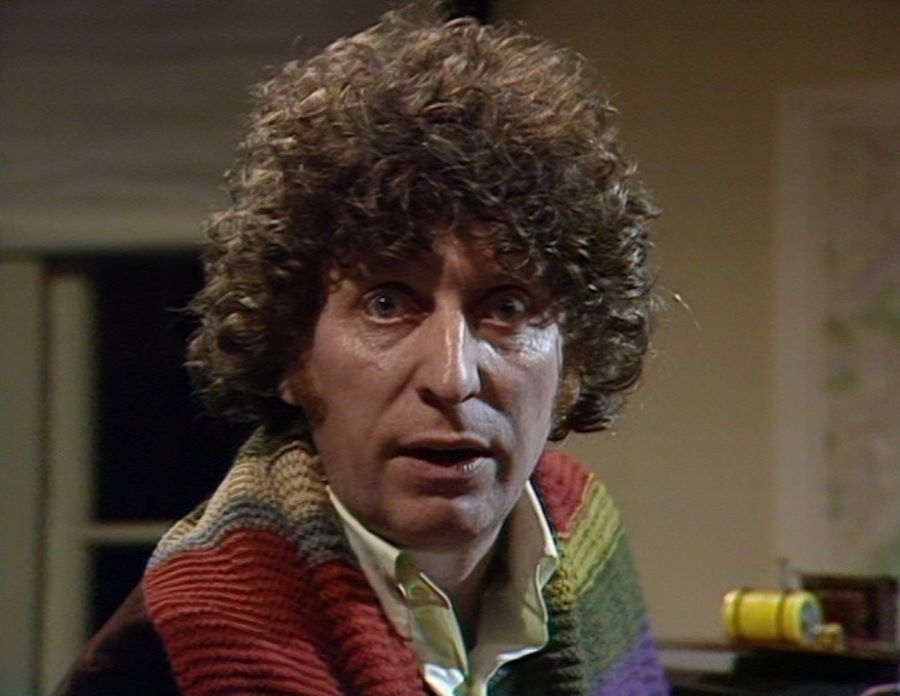
I believe Tom Baker prefers the earlier part of his ‘Doctor Who’ tenure under Philip Hinchcliffe as opposed to the part under Graham Williams. He’s still in his element though, especially since this was the third TV adventure to be presented in Tom Baker’s fourth season as the Fourth Doctor on BBC TV.
It’s clear that plans were made to make the show more light-hearted and less violent. Mind you, that doesn’t stop ‘Image of the Fendahl’ from having some violent moments, as witnessed by Colin Baker, Sarah Sutton and Janet Fielding when they watched this adventure through the ‘Behind the Sofa’ item.
It’s ironic considering Robert Holmes was keen to incorporate gothic horror elements in Chris Boucher’s scripts for ‘Image of the Fendahl’ before he went on to write a light-hearted story in ‘The Sun Makers’ next, as script-edited by Anthony Read. It’s very commendable in the grand scheme of things.
It’s evidence that writers like Robert Holmes can do a variety of writing styles from doing gothic horror to light-hearted. It’s evident in the Patrick Troughton and Jon Pertwee-era stories he wrote, but then the gruesome side of his writing was often toned down before and after his tenure as the script editor.
An example is when Robert Holmes originally included a line said by Irongron in ‘The Time Warrior’ about someone’s wife ‘crunching’ on someone’s eyeballs, which was vetoed by Terrance Dicks in the script-editing. I digress, but it’s pretty intriguing to reflect this in the transitionary phase of Season 15.
Anyway, the point is, this is where Robert Holmes’ time as ‘Doctor Who’s script editor comes to an end before he handed the reins over to Anthony Read, who took over for the rest of Season 15 and the whole of Season 16. Thankfully, Robert Holmes returned to write more stories of the classic TV series.
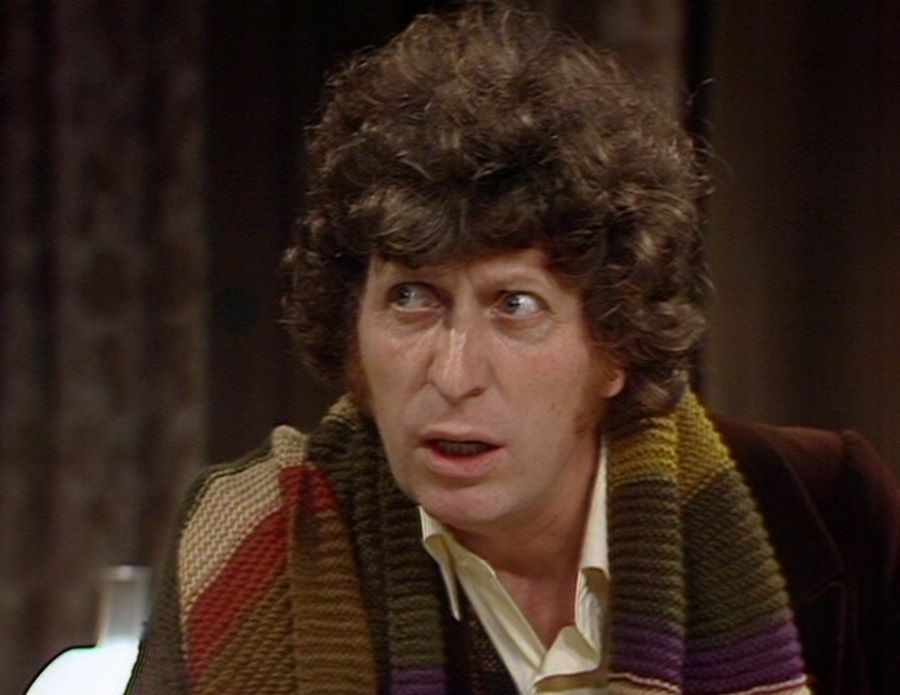
Whilst ‘Image of the Fendahl’ is a creepy and chilling ‘Doctor Who’ story to sit through, I can’t say I fully understand it. Even from revisiting the story on Blu-ray, I’m still not sure what’s going on. You might have to rewatch ‘Image of the Fendahl’ more than once to get a clear idea of what’s happening.
Or you could check out the ‘Image of the Fendahl’ novelization and/or audiobook by Terrance Dicks, read by Louise Jameson. Despite that, the story is quite disturbing when you watch it. Mind you, it tended to be rather slow-paced in places, particularly in the first half containing the first two episodes.
This is down to the fact that things were being set up in introducing the characters, the situation and the environment our heroes are in. This is a trend of Chris Boucher’s writing, which I’ve noticed, especially as it took a while for him to introduce all the characters featured in the ‘Star Cops’ TV series.
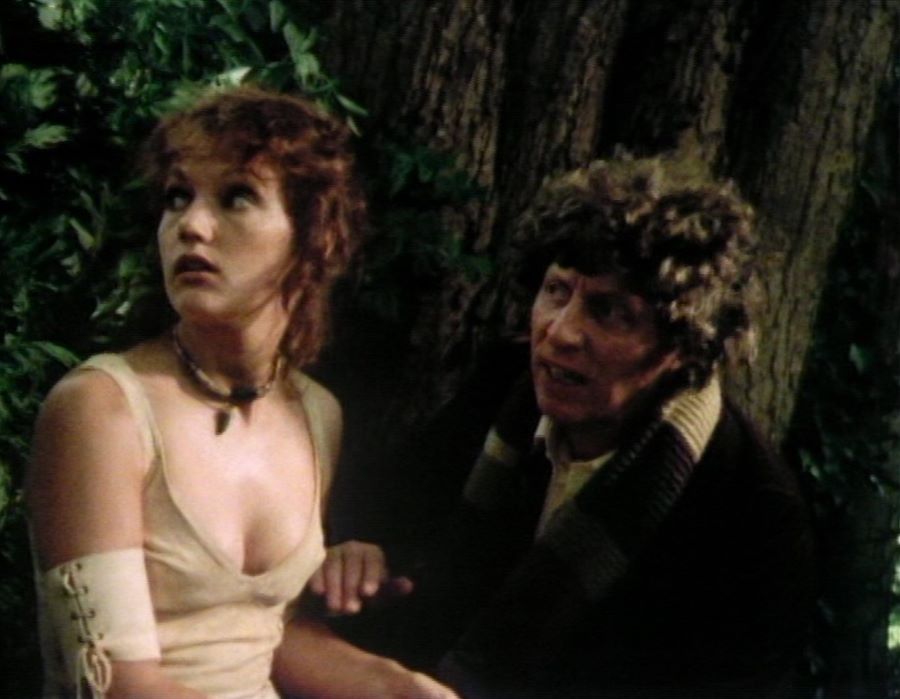
Thankfully, as the story progressed, things became more interesting in ‘Parts Three and Four’. This is especially when the Doctor and Leela are more involved and they’re interacting with the guest characters compared to how things were very slow in them being involved in the story’s actual events.
The adventure proved to be exciting and worthy of entertainment because of that from watching the story’s last two episodes. I do wonder if more incidental music should have been provided by Dudley Simpson, since most scenes included in ‘Parts One and Two’ are devoid of any music cues being played.
There are issues in terms of story structure and character development when watching ‘Image of the Fendahl’, but I enjoyed how things were unveiled. This is especially as the Fourth Doctor and Leela solved the mystery step-by-step. When it comes to their part to play in the story, I become interested. 😀
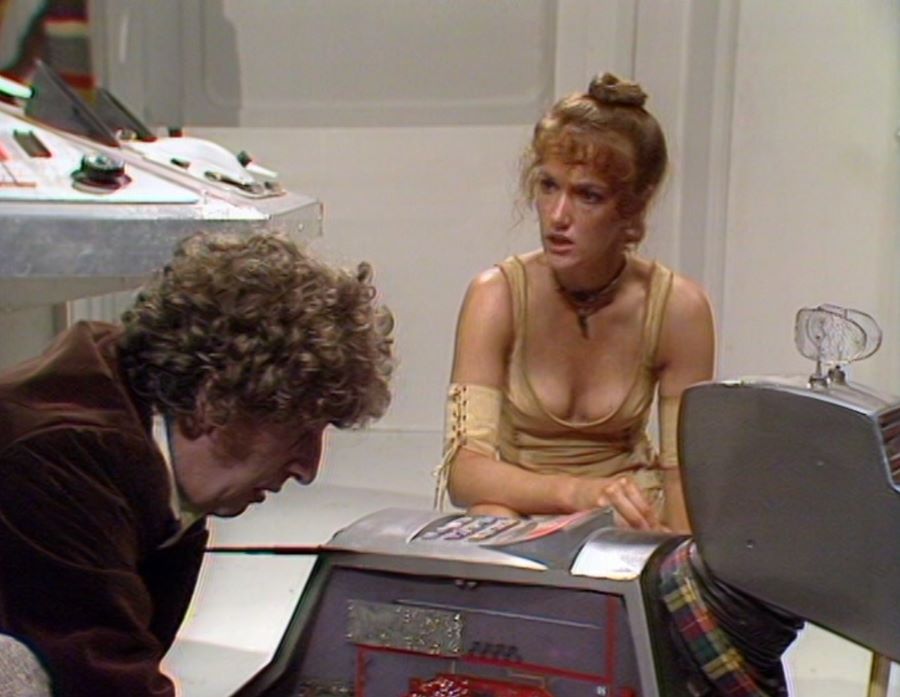
In the story, the TARDIS detects a sonic time scan. The Doctor and Leela trace it back to Earth in the present day. Initially I assumed the story was taking place in October 1977, since it would match to the transmission date of ‘Part One’. I also assumed that it happened earlier due to the TV story’s filming.
The story was filmed in August 1977. But another account has come to light that the story takes place in July 1977. If anyone can confirm this detail, that’d be great. It’s a minor nitpick on my part and besides, as long as the story takes place in 1977 as one would guess to be the case, I’m okay with that.
As the Doctor and Leela try to locate the sonic time scan on planet Earth, elsewhere, there are four scientists working at Fetch Priory in a place called Fetchborough. I’ve checked and Fetchborough is actually a fictional place. The story was filmed in East End in Hampshire, which I find very intriguing. 🙂
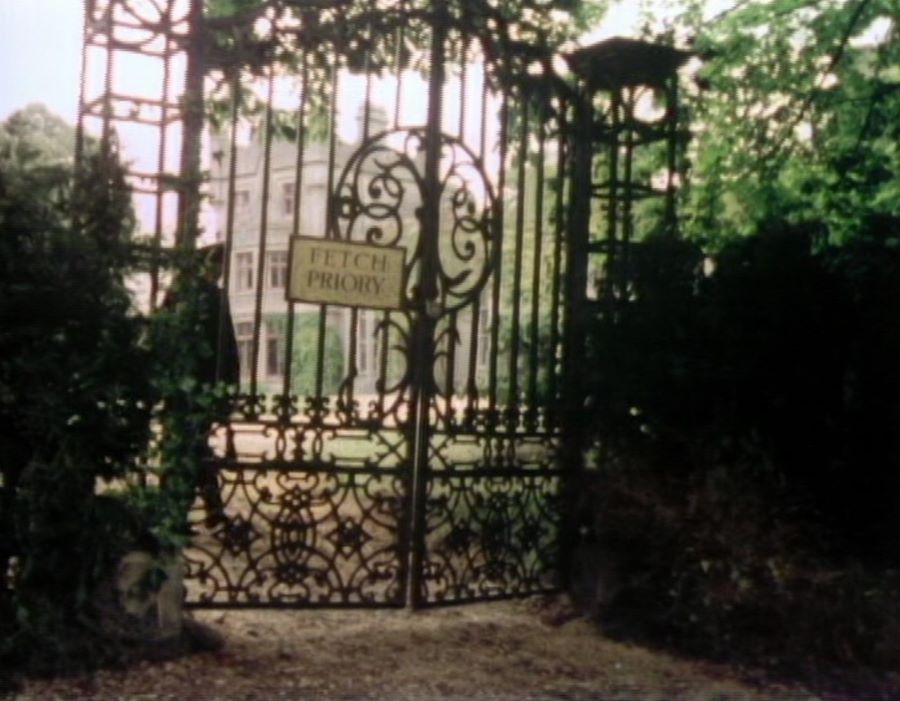
The location for Fetch Priory happens to be Stargrove Manor. Interestingly, according to my research, the place was used before as a filming location for ‘Pyramids of Mars’ in Season 13. Obviously, the interior scenes of Fetch Priory were filmed in a BBC studio as opposed to actual Stargrove Manor itself.
The four scientists, including Denis Lill as Dr. Fendelman, Scott Fredericks as Max Stael, Wanda Ventham as Thea Ransome and Edward Arthur as Adam Colby, are studying a human skull that came from a volcano and happens to be twelve million years old. 😐 Something that Adam is sceptical about.
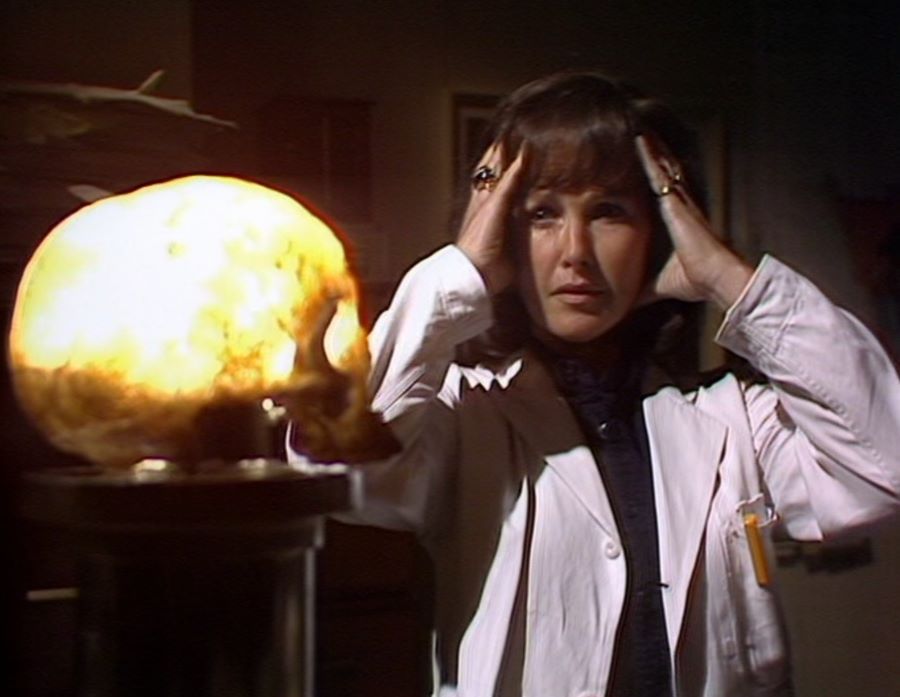
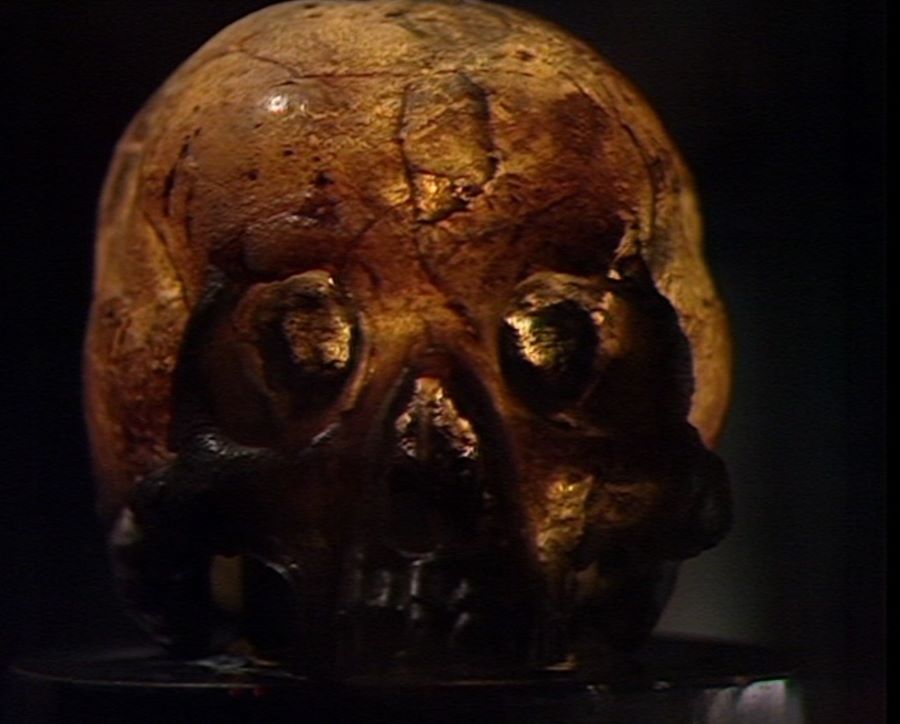
As experiments are conducted on the skull, something strange occurs. The skull glows brightly in the dark and it appears to be taking control of the scientist of Thea Ransome through her mind. Once the Doctor and Leela discover the skull, it transpires it’s the key to a nightmare from the Time Lord’s past.
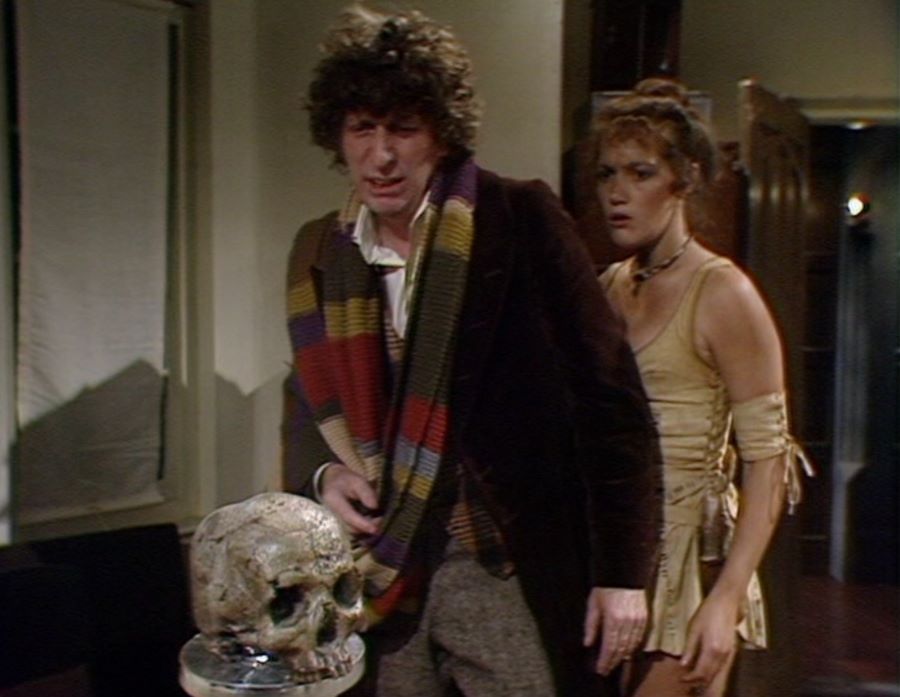
The Doctor claims to Leela that it’s the Fendahl, which ‘grows and exists by death’. Or rather, ‘it absorbs the full spectrum of energy’ – ‘what some people call a life force or a soul’ – as ‘it eats life itself’. Once the discovery is made, the Doctor and Leela do all they can to stop the Fendahl at all costs.
By that, I mean, before the Fendahl takes control of the Earth and homes in on everyone’s fears. I must admit, I found the aspect of the Time Lord’s involvement not fully explored enough. I mean, it’s stated the Fendahl via the skull is connected to the Time Lords in some way, but it isn’t shown how. 😦
It’s said rather than presented, which is probably why it didn’t stand out for me quite much whilst watching the story. There are also supernatural elements woven into the story, particularly in the cultist element, which seems to be formed by one of the scientists, Max Stael, who knows of the Fendahl. 😐
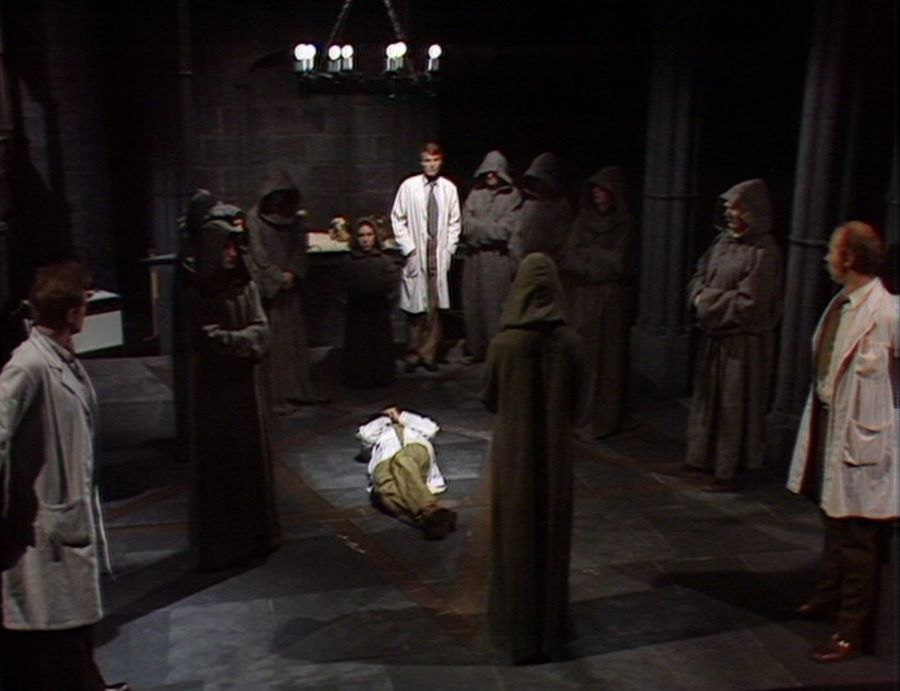
Yes! A cult with members in dark hooded robes is in this story. They conduct a ceremonial ritual to bring the Fendahl to life. I don’t fully understand the rituals and religious beliefs featured in this story, but it was very fascinating and intriguing to watch, especially in the story’s characters and atmosphere.
Incidentally, ‘Image of the Fendahl’ was directed by George Spenton-Foster. This is his first ‘Doctor Who’ story, as he would go on to direct ‘The Ribos Operation’, the first story of ‘The Key to Time’ season – Season 16 – of the classic TV series. He directed episodes of ‘Blake’s 7’ after ‘Doctor Who’. 🙂
Despite the ‘slow-paceyness’ of the story in the first two episodes, George Spenton-Foster does a good job in terms of directing his first ‘Doctor Who’ story for the classic TV series. Arguably, I prefer ‘The Ribos Operation’ more than ‘Image of the Fendahl’, but he handles the horrors aspects of this story well. 🙂
I’ve had the DVD cover of ‘Image of the Fendahl’ signed by two people so far. I’ve had it signed by Louise Jameson, who plays Leela in the ‘Doctor Who’ TV series and the Big Finish audios. And I’ve had it signed by Derek Martin, who plays David Mitchell, the chief leader of Dr. Fendelman’s security team.
Louise signed my DVD cover of ‘Image of the Fendahl’ at the ‘Regenerations 2011’ convention in Swansea in September 2011. I believe that might have been the first time I saw Louise Jameson at a convention. I know I saw her at more conventions since then, but…my, my! Time flies really fast, right?
When Derek Martin signed my DVD cover of ‘Image of the Fendahl’, it was at the ‘Time Warp’ convention in Weston-super-Mare in July 2014. I had a nice encounter with Derek Martin then, and he said “Hello, boss!” to me when I met him. I’ve never been called that before, and it was flattering.
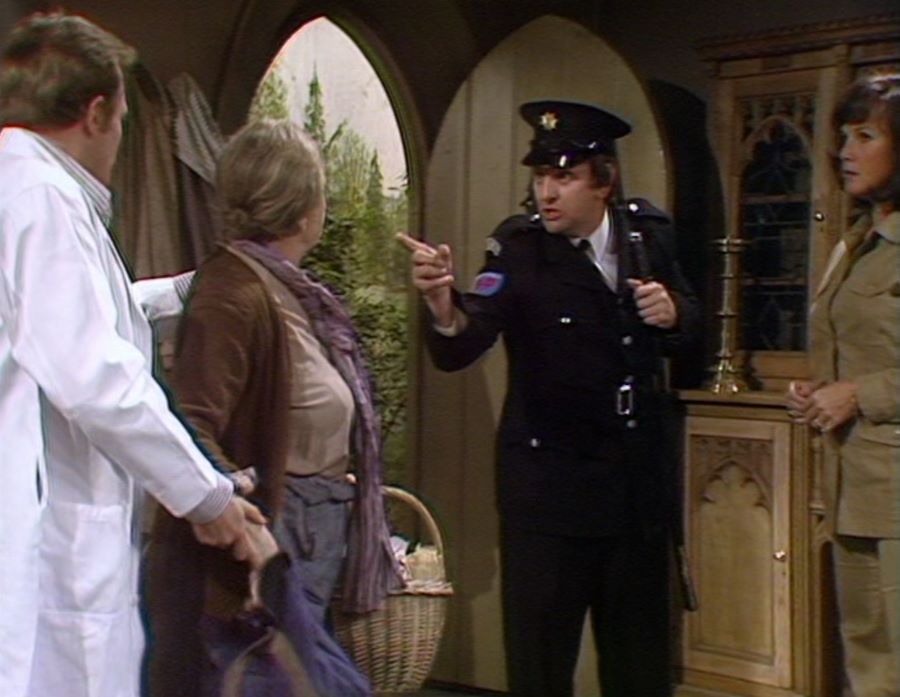
Derek Martin is well-known for playing Charlie Slater in the BBC soap opera ‘EastEnders’ from 2000 to 2011 and had brief appearances in 2013 and 2016. He’s also been in ‘Doctor Who’ before ‘Image of the Fendahl’ came along, albeit they were quite small roles compared to the one he plays in this story.
According to Katy Manning in the ‘Behind the Sofa’ item for ‘Image of the Fendahl’, Derek Martin was a stuntman in the HAVOC team during Jon Pertwee’s era. I’m pleased that Katy recognised and recalled Derek Martin whilst viewing ‘Image of the Fendahl’ with Matthew Waterhouse on ‘Behind the Sofa’. 🙂
The other ‘Doctor Who’ stories he’s been in with minor uncredited roles include ‘The Romans’, ‘The Massacre of St. Batholomew’s Eve’, ‘The Highlanders’, ‘The Web of Fear’, ‘The Ambassadors of Death’, ‘Inferno’, ‘The Mind of Evil’ and ‘The Claws of Axos’. Quite a record before he did ‘Image of the Fendahl’.
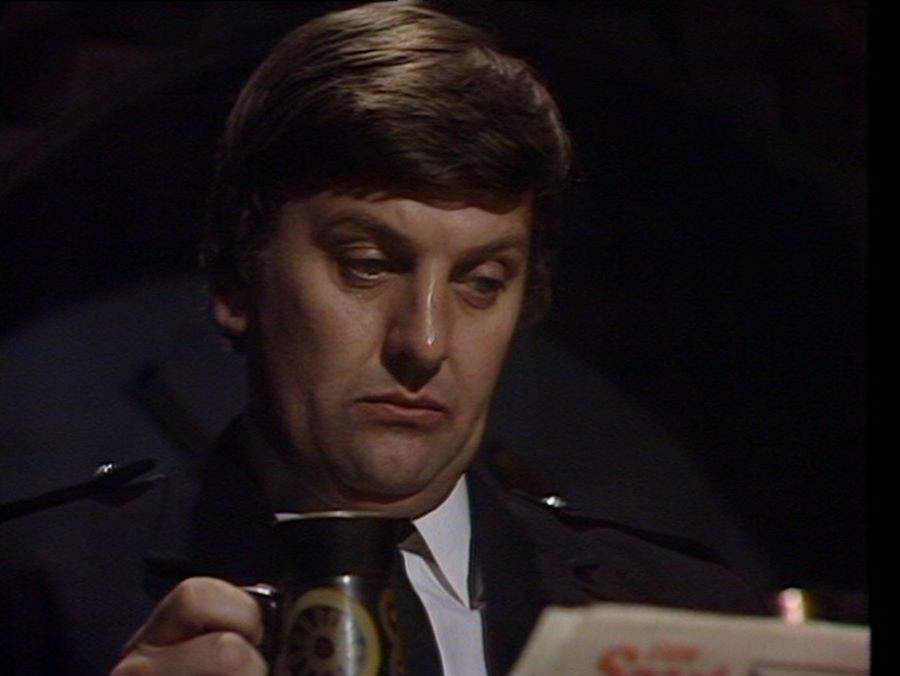
Arguably, Derek Martin’s role in ‘Image of the Fendahl’ is quite small, considering he appears in ‘Part One’ and gets killed off in ‘Part Two’. I’m astonished he didn’t last for very long. You would think being the leader of a security force, as summoned by Fendelman, he’d be very good at his job at all times. 😦
Going back to Louise Jameson, over the years, I’ve enjoyed chatting to her at conventions, especially during signings and mingling with her and other guests away from the signing table. It’s also clear how much Louise puts into her performances as Leela in many of the stories she’s done on TV and on audio.
That’s impressive when you think about it. Mind you, I’ve discovered there’s a difference in terms of approach regarding how Leela’s character is developed in the classic TV series, particularly in the transition phase between Philip Hinchcliffe’s era as producer to Graham Williams, which is intriguing.
When Leela began in ‘Doctor Who’ in Season 14, she was supposed to have this journey where the Doctor taught her to be less savage. A sort-of Professor Higgins and Eliza Doolittle-styled relationship from ‘My Fair Lady’, which is something I appreciate, and I would have liked to have seen it to its fullest.
Unfortunately, when Leela appeared in Graham Williams’ first season as producer of ‘Doctor Who’, the Professor Higgins/Eliza Doolittle styled relationship isn’t so evident. This is emphasised in ‘Image of the Fendahl’, especially since her character isn’t standout and strong as one would like her to be. 😐
I believe Katy Manning and Matthew Waterhouse raised this issue when they watched ‘Image of the Fendahl’ in the ‘Behind the Sofa’ item. Despite that, Louise does a tremendous job playing Leela in the TV series, especially in ‘Image of the Fendahl’, and it’s intriguing how her character happens to be savage.
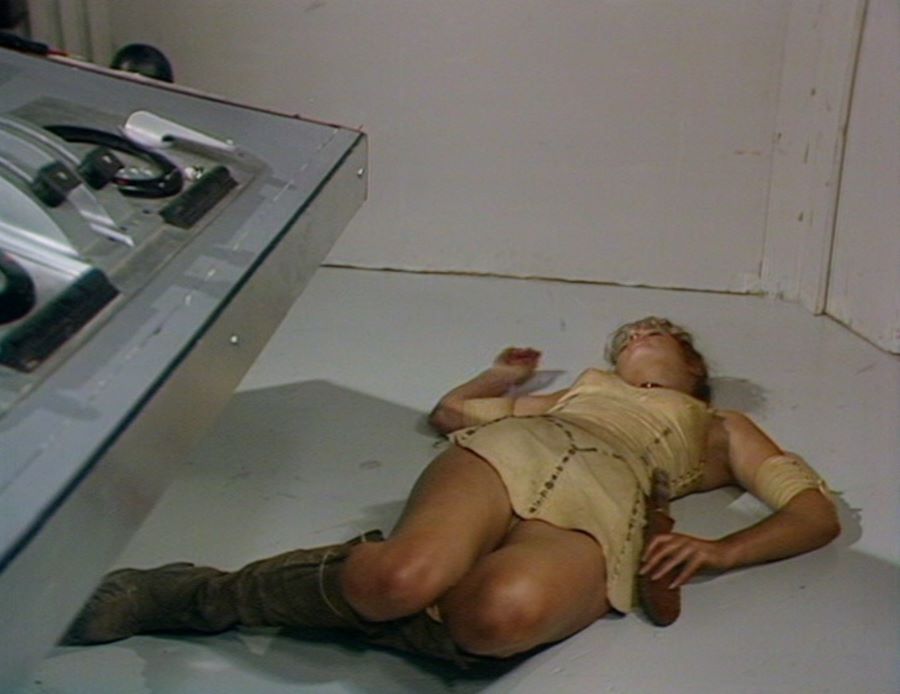
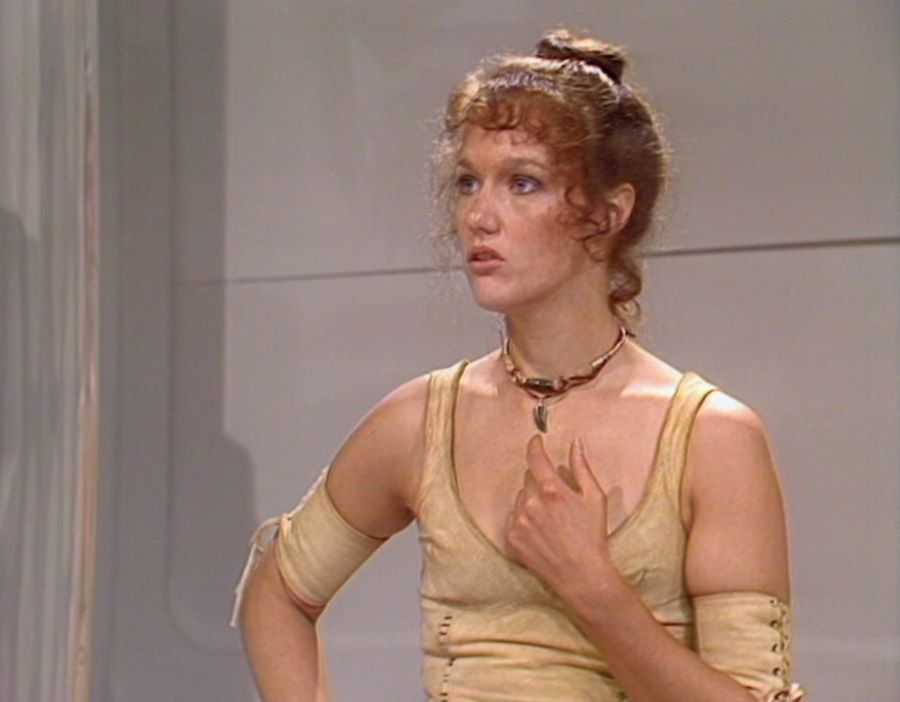
Despite being quite underused, Leela does have some nice moments throughout this story. Interestingly, Leela wears a new costume that still has her scantily-dressed. The costume is more yellow or beige compared to the brown leather-like outfit she wore when introduced in Season 14. 😀
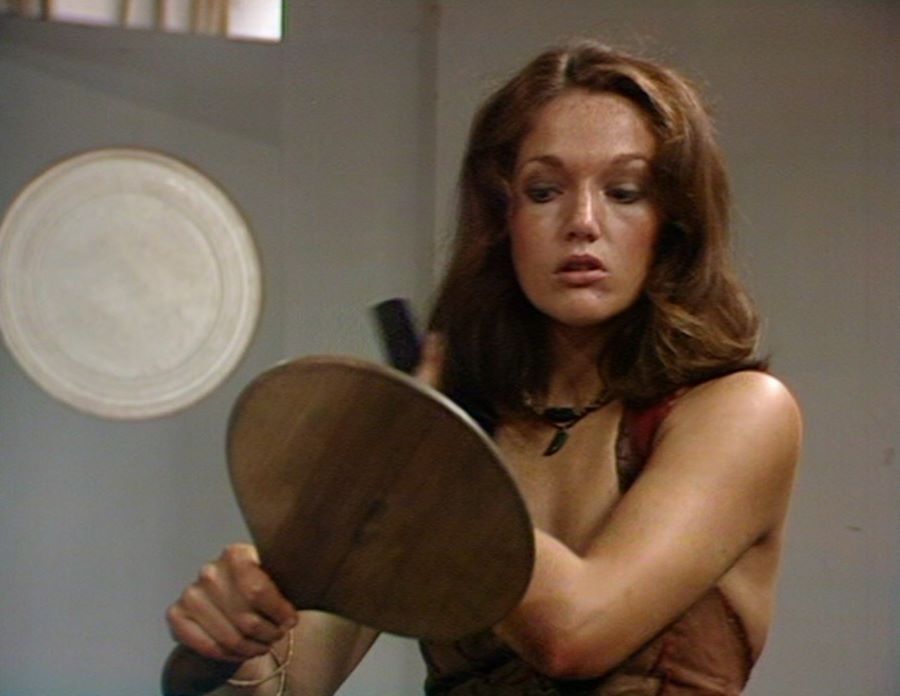
Leela also has a new hairstyle in this story, particularly when she has her hair put into a bun, which I found quite unusual whilst watching the story. Apparently, Louise had her hair cut too short by her hairdresser before production on the story began. This is the reason why she had her hair put in a bun.
Graham Williams didn’t like it once he saw Louise as Leela with her hair in a bun, but once he saw what she looked like with the hair down, he went along with the ‘hair in a bun’ thing. At least Leela’s hair is back to almost proper length by the time the story came to an end and she’s in her original outfit.
I liked the moments where Leela was referring to K-9 as ‘he’ and ‘him’ compared to the Doctor who called K-9 ‘it’ in ‘Part One’. Leela is overjoyed when the Doctor ends up calling K-9 ‘him’ instead of ‘it’. I suppose the Doctor decided he had grown to appreciate K-9 more as a pet than a computer just then.
Leela gets to save the Doctor from a skull burning his hand in ‘Part Three’ when kicking a chair from underneath him. I found it funny when the Doctor collapsed on top of her, and Leela called him ‘heavy’. Apparently, Tom Baker was ‘heavy’, according to Louise Jameson in the ‘Behind the Sofa’ item.
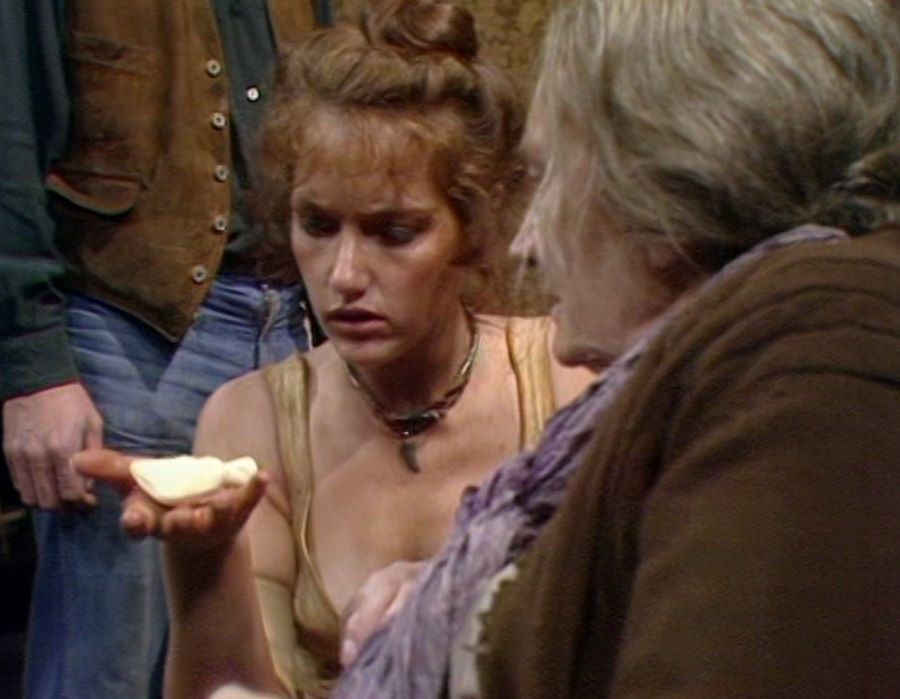
I liked the connection that Leela had to old Martha Tyler, especially when she was given a charm for protection by her. It was interesting to hear from Louise Jameson that Leela respected the elderly, which I appreciate. I imagine Leela respected many old members in the Sevateem tribe when she was young.
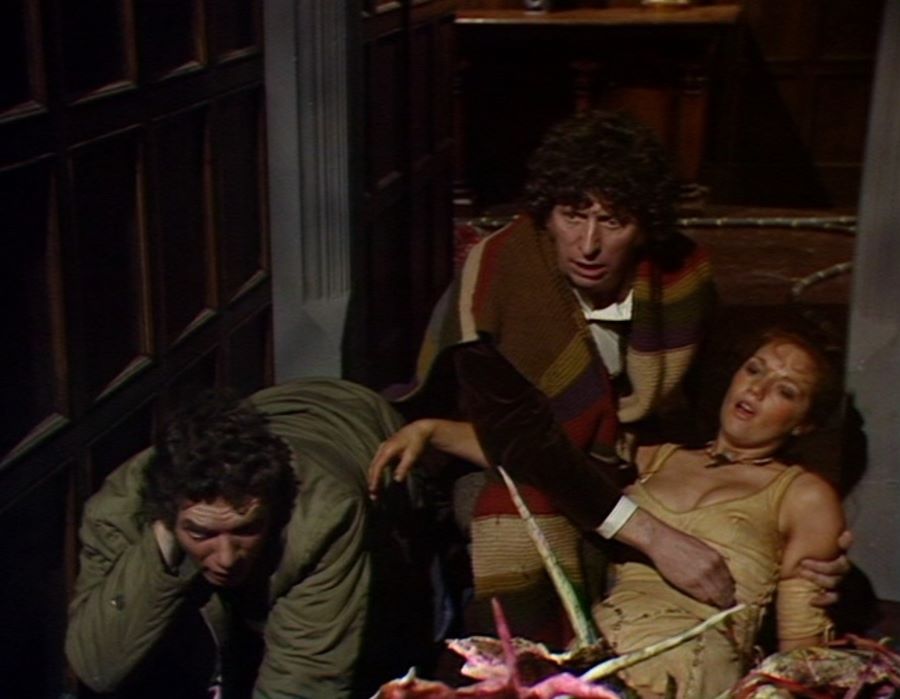
It was funny in ‘Part Four’ when the Doctor checked on Leela after she fired a rifle at a Fendahl creature approaching her and Jack Tyler, before he dropped her to the floor. I could tell Leela was annoyed by that once the Doctor dropped her. I like how well-rehearsed that scene was done between Tom and Louise.
I did feel for Louise Jameson as Leela once seeing her in the night-shoot scenes with the Doctor in her scantily-dressed attire. I’m sure Louise was absolutely freezing when walking about in that attire. This reinforces my point that Leela needs to wear more suitable clothes than the savage outfit she often wore.
There’s a surprising moment where Leela gives Adam Colby a peck on the cheek to wish him “Good luck” before joining the Doctor. I don’t know where that came from since Leela only met Adam briefly in ‘Part Four’. It’s a nice moment and I don’t mind Leela giving Adam a peck on the cheek, but it was unexpected.
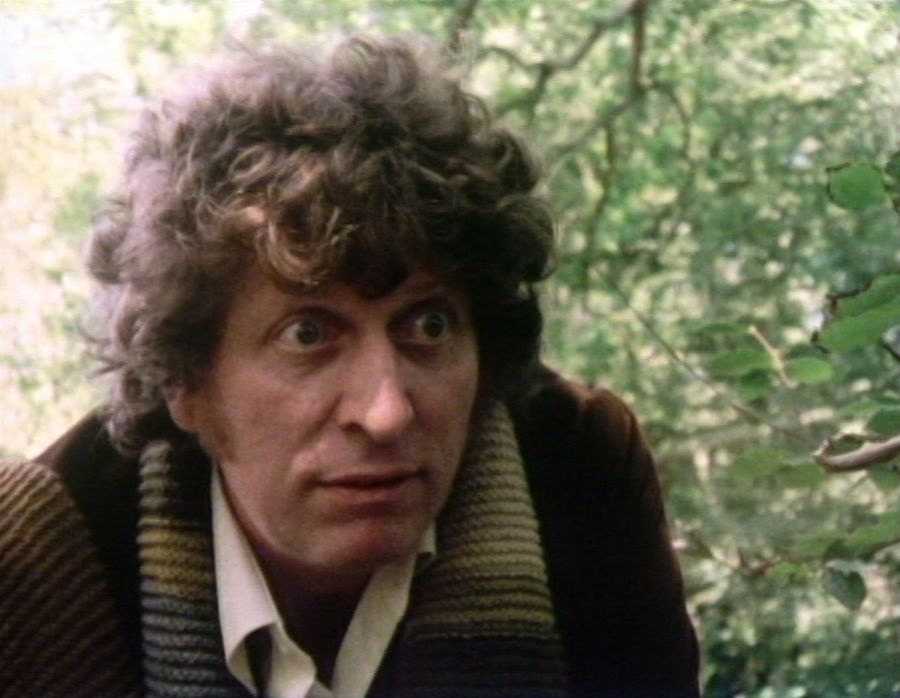
Tom Baker as the Fourth Doctor is at the top of his game in this ‘Doctor Who’ adventure. It’s clear that Tom has settled very well into the role of the Doctor by this point in the classic TV series, especially when portraying the character with great abundance and energy, appealing to many people, no doubt.
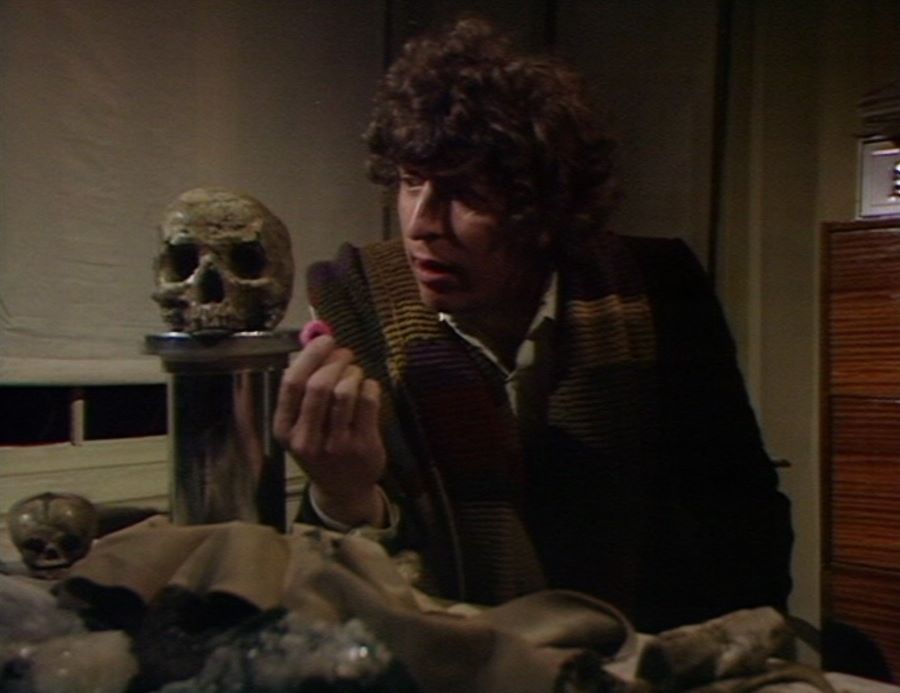
I enjoyed the moment when Tom’s Doctor discovered the Fendahl skull at the end of ‘Part Two’ of the story and he offered a jelly baby to it. That’s such a Tom Baker thing to do. Even Colin Baker predicted it in ‘Behind the Sofa’. That’s of course before the Doctor placed his hand on the skull, and it burned him.
I’d like to think the Doctor’s relationship with Leela has improved greatly in the stories they’ve been together since they first met in ‘The Face of Evil’. There’s still a hint of friction between Tom and Louise in their working relationship behind-the-scenes, but it seems to have mellowed whilst making this story.
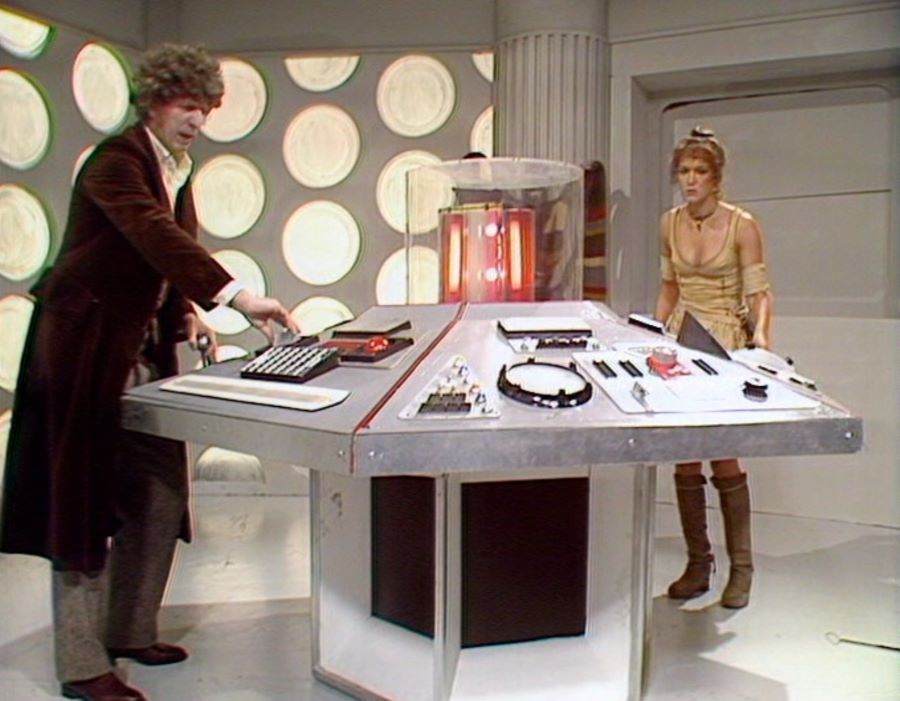
It’s clear that the Doctor and Leela work well as a TARDIS duo by this point in the series and they’re well-recognised as a ‘Doctor Who’ duo from the 1970s. I liked it when the Doctor and Leela discussed the Fendahl in ‘Part Three’ and how dangerous the entity it is once it’s about to be unleashed on Earth.
This is in the scene after Leela rescued the Doctor from the Fendahl skull and when they’re in the TARDIS trying to work out how the Fendahl ended up on Earth in the TARDIS. I liked that moment when Leela told the Doctor she would protect him and he’s quite surprised as soon as she says this. 🙂
It’s shocking when the Doctor fires a rifle at a Fendahl creature as well as giving Max a gun for him to commit suicide. Most of the ‘Behind the Sofa’ contributors, including Colin, Sarah and Janet, were shocked by these moments once they saw it in the story. Colin compared to how his era was treated as violent. 😀
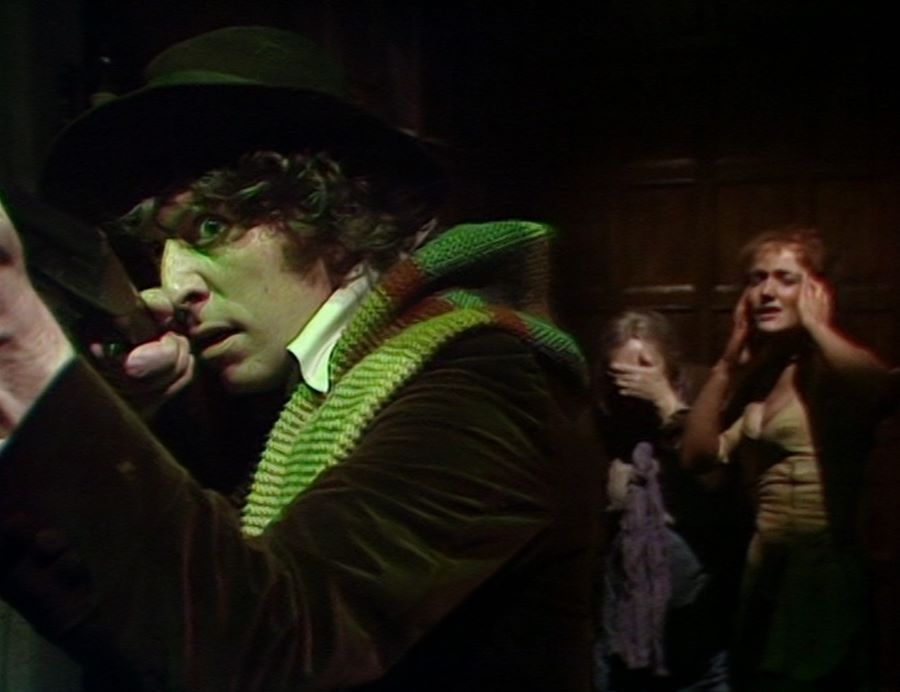
I suppose thinking about it, it would be out-of-character for the Doctor to use a gun to fire on people. Then again, he did use a weapon in ‘Day of the Daleks’ to kill an Ogron, though in the Special Edition version of that, it was in self-defence. He later fired a gun at the Cyber Leader in the TARDIS in ‘Earthshock’. 🙂
I found it funny when Leela told Jack Tyler that the Doctor can be ‘very difficult sometimes, but he has great knowledge and gentleness’. This is before we cut to the Doctor kicking a cardboard box and throwing his sonic screwdriver across the room in frustration. Isn’t that great comedic timing or what?
Incidentally, who let the Doctor out when he was locked in that room in the priory in ‘Part Two’? It’s never explained who it was in the TV story. It wasn’t Thea. I don’t think it was Adam or Fendelman. Was it Max? There’s no explanation provided on who let the Doctor out of that room in ‘Part Two’. 😐
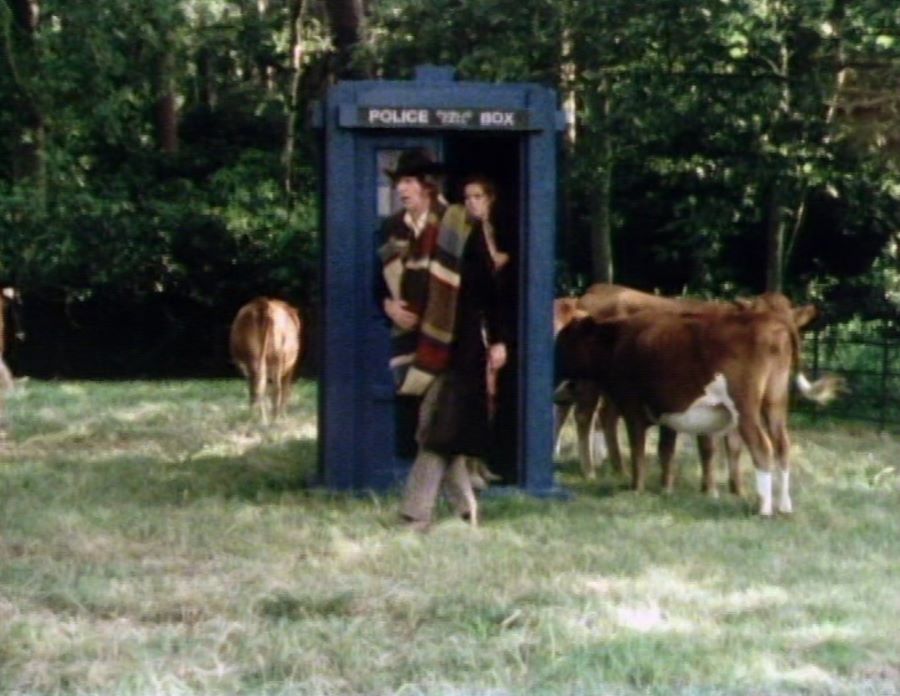
I liked it the TARDIS arrived in Fetchborough, the Doctor stepped out and greeted the cows in the field, saying, “Good morning, ladies!” Once again, another Tom Baker moment that only Tom Baker could do. Perhaps this was the inspiration for the Eleventh and Twelfth Doctors speaking baby and horse. 😀
It’s a shame that K-9 only appears at the beginning and at the end of this ‘Doctor Who’ story and he doesn’t have a part to play. It’s also amusing that as soon as the Doctor and Leela took him aboard the TARDIS since ‘The Invisible Enemy’, he’s in a mess with his circuity mostly all over the TARDIS floor. 😀
It’s also saddening that even after the Doctor called K-9 ‘him’ instead of ‘it’ at the story’s end, all the metal dog could do was droop his head up and down in response. I know it was probably not worth getting John Leeson in at that point, but surely he could have said “Affirmative” to let us know there’s life in him.
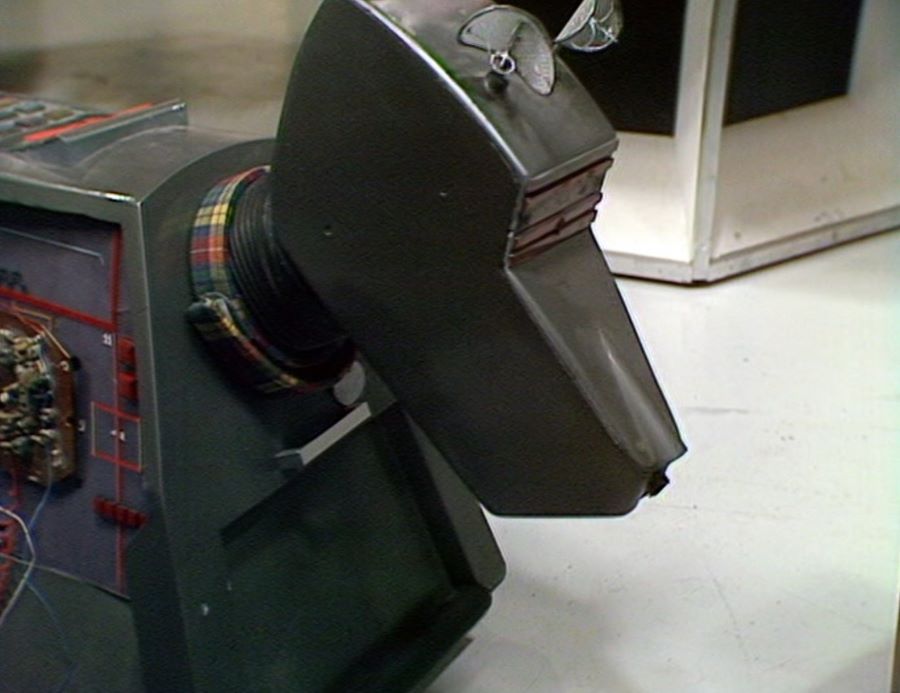
The story’s guest cast includes Wanda Ventham as Thea Ransome, the female scientist who sadly gets taken over by the Fendahl and she becomes the Fendahl Core. This isn’t Wenda Ventham’s first ‘Doctor Who’ story, as she previously played Jean Rock in ‘The Faceless Ones’ with Patrick Troughton.
She would do another ‘Doctor Who’ story after this, which is ‘Time and the Rani’ with Sylvester McCoy. Wanda Ventham also happens to be the mother of Benedict Cumberbatch, who played Sherlock as well as Dr. Strange in the ‘Marvel Cinematic Universe’. She played Sherlock’s mum along with her husband Timothy Carlton as the dad.
Wanda Ventham has also been in other things like ‘A Family at War’ and an episode of the original ‘All Creatures Great and Small’ TV series. It’s astonishing Thea is the only female scientist working with three male scientists on an ancient human skull, before the skull locks itself on her mind without any explanation.
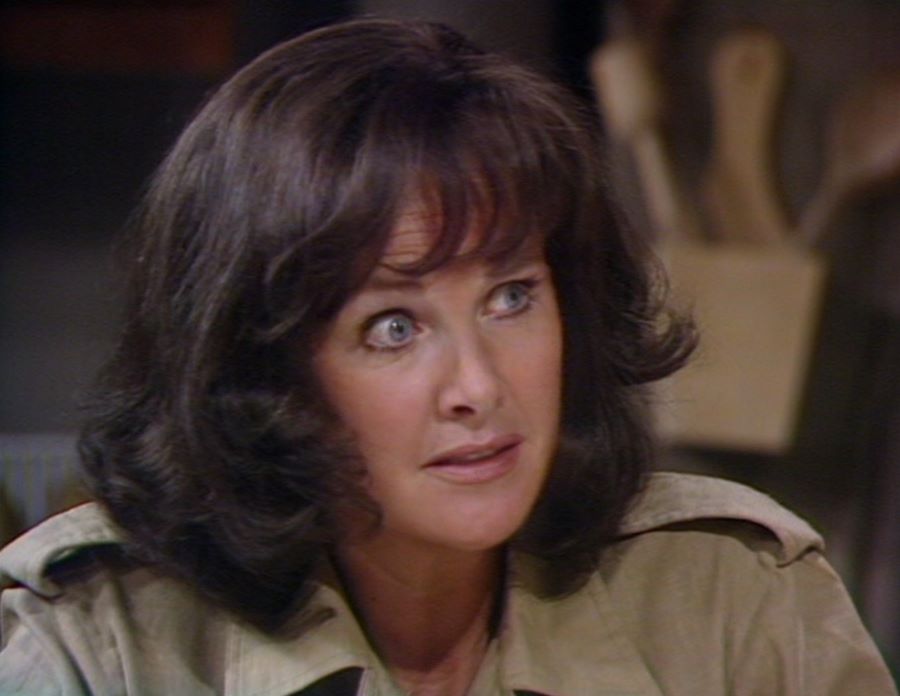
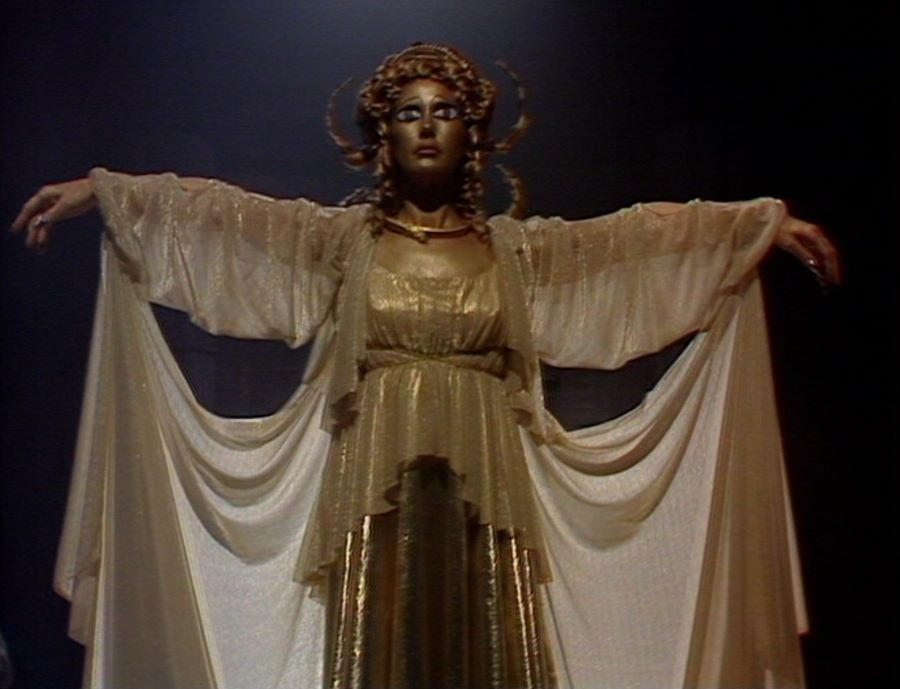
Also, usually, Wanda Venthham has blonde hair, whereas in this story, she has dark hair. Unusual. Thea is chosen to be the Fendahl Core and she transforms into a gold goddess-like being, looking quite scary and sometimes sad. This was Wanda’s opportunity to be like that gold-painted lady in ‘Goldfinger’. 😀
Edward Arthur guest stars as Adam Colby, who I believe is the youngest of the four scientists at the priory. According to Toby Hadoke in the ‘Behind the Sofa’ item of this story, Adam happens to be what could be described as a ‘cool guy’ of the 1970s. 😀 He can be rather sceptical and sardonic in this story.
This is especially when he doubts the fact that the ancient human skull that he and the scientists have found happens to be 12 million years old. Adam makes wisecracks throughout the story, some of which can be quite memorable, including the one he says to the human skull once the story begins. 🙂

Adam: Oh, don’t just sit there, Eustace. Say something.
And of course, there’s that line when he sees Max Stael has turned traitor on him and Dr. Fendelman.
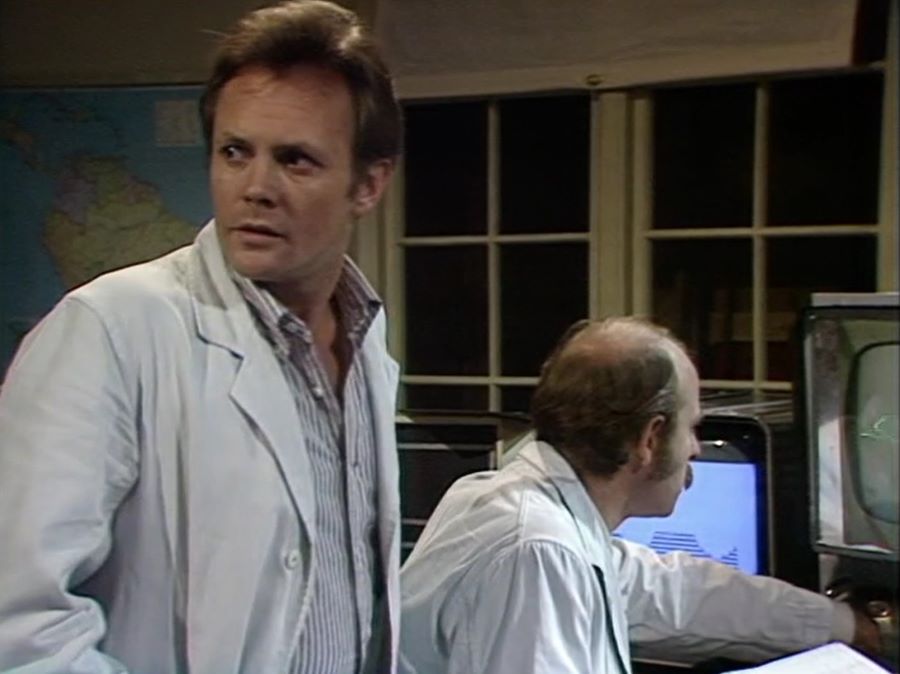
Adam: Dr. Fendelman, I think you have an industrial relations problem.
Despite the wisecracks, scepticism and sarcasm to his character, Adam does have a good heart and a sense of compassion about him. His sense of humour is often masked by a tough edge, but that doesn’t mean he’s unlikeable, even when the Doctor and Leela show up to save him in the events of ‘Part Four’.
I like Adam’s relationship with Thea in ‘Parts One and Two’ before she’s captured and taken over to be the Fendahl Core. As I understand it, Adam has feelings for Thea, which aren’t reciprocated, since she seems to treat him like an older brother. He becomes upset as soon as Thea changes in ‘Part Four’.
Denis Lill guest stars as Dr. Fendelman, who could have almost been in the villain of this ‘Doctor Who’ story, especially when he seems to have a deeper scientific knowledge about the human skull compared to everyone else. He also places security guards throughout the priory house in this story. 😐
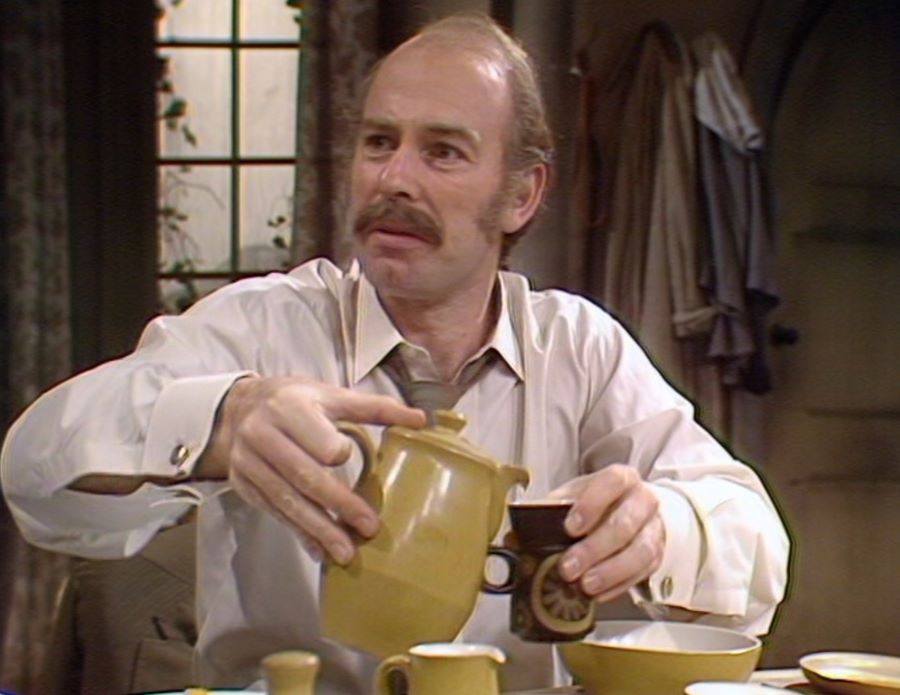
This is when a series of deaths occur when he and Max Steal are conducting experiments connected to the human skull in the priory. But it turns out that Fendelman isn’t exactly the villain as one would expect, though he does reveal disturbing truth about his name, that’s connected to the story’s monster.
I guess it’d be easy to think of Fendelman being the villain once you get into the story itself, particularly when he says ‘Fendelman’ is like ‘Man of the Fendahl’. I suppose it’s a twist that not many people would have seen coming when it turns out he’s not the villain, but he does deliver this incredible dialogue:
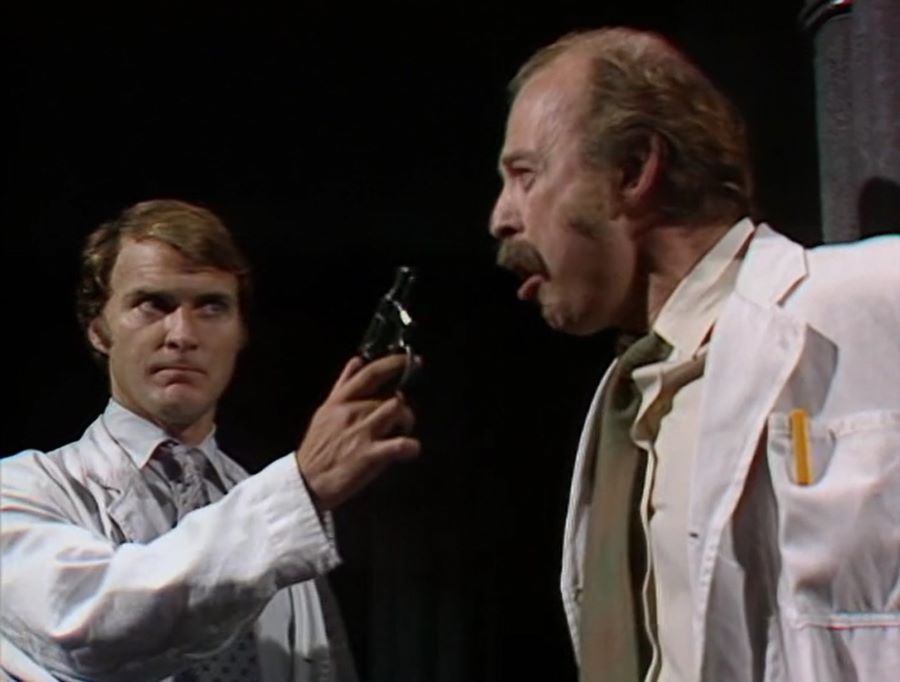
Fendleman: Max, listen! The Doctor asked if my name was real. Fendelman. Man of the Fendahl. Don’t you see? Only for this have the generations of my fathers lived. I have been used! You are being used! MANKIND HAS BEEN USED!!!!!
Also, is the accent Denis Lill using German or Austrian? It’s a shame and quite gory when Fendelman got shot in the head by Max, killing him off in ‘Part Three’. As I said, Colin, Sarah and Janet were shocked by that in ‘Behind the Sofa’. Ah well, at least Denis Lill returns in ‘Doctor Who’ to be in ‘The Awakening’.
Scott Frederick guest stars as Max Stael, the man who rarely smiles but does seem smug at times. 😀 This isn’t Scott Frederick’s first appearance in ‘Doctor Who’, as he previously played Boaz in ‘Day of the Daleks’. He’s also been in the ‘Dad’s Army’ 1971 movie, where he played one of three Nazi soldiers.
As the story progresses, it turns out Max is in charge of a cult that believes in the Fendahl. How this cult was formed at all is not properly explained as far as I’m concerned, but it’s quite tense when Stael shows his true colour as soon as he gags Thea and when he points a gun at Adam and Fendelman in the tale.
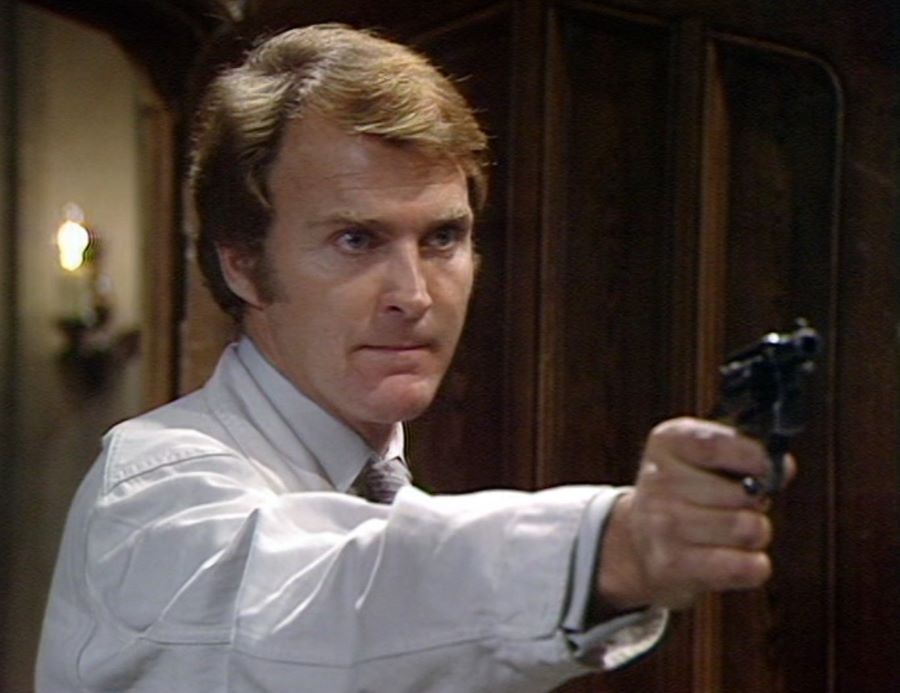
I wonder what made Max think that he’ll become a god once he and the cult do their ritual to summon the Fendahl into being. I like how Scott Frederick plays him in being so calm and not over-the-top, especially when Adam is making wisecracks during his capture. Max just points his gun at Adam’s chin.
It’s clear that Max didn’t think things through once Thea becomes the Fendahl Core and turns cultists like Ted Moss into small Fendahl-like creatures. Even though we don’t see it on-screen, it’s disturbing when Max asks the Doctor to give him the gun so he can commit suicide, which is a very dark moment.
Incidentally, it’s interesting how ‘blind worship without inquiry’ is ‘practically a death sentence’ and that the gods of those blind worshipers have ‘no love for their flock’, according to Wolfie. I find that’s often the case when the Doctor is having to deal with Suketh from ‘Pyramids of Mars’ and the Fendahl.
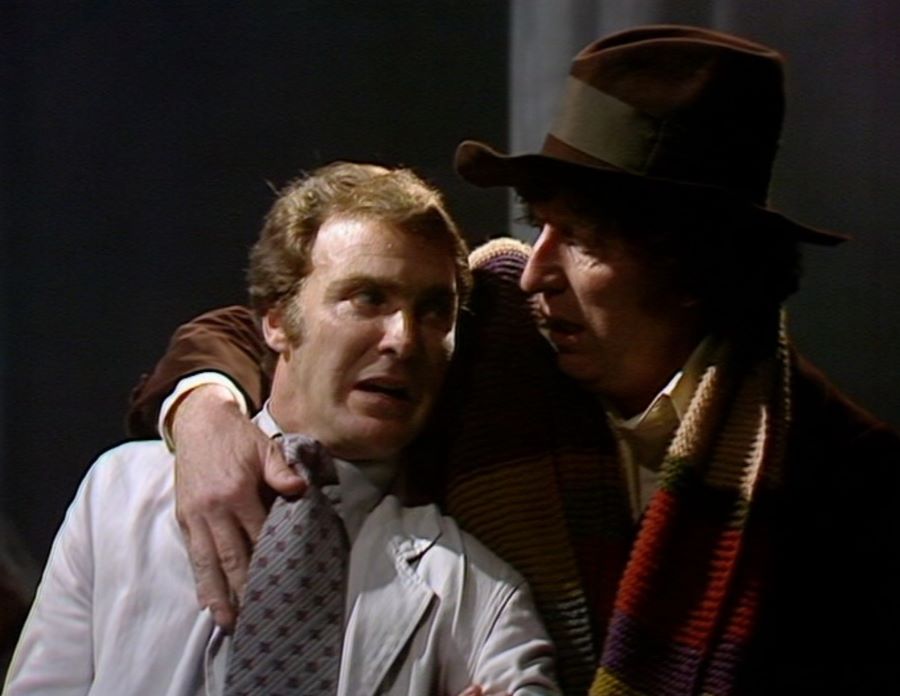
It’s often one of the things I’ve admired about ‘Doctor Who’ in terms of its storytelling. I’m sure the Doctor has said that ‘curiosity without caution’ can often lead people to undignified ends. It’s like how Lesterton became curious about the Daleks in ‘The Power of the Daleks’ before he realised his mistake.
The guest cast also includes Daphne Heard as the old lady Martha Tyler (or Ma Tyler) and Geoffrey Hinsliff as Jack Tyler, Ma Tyler’s grandson. They help the Doctor and Leela to sort out the Fendahl. Ma Tyler’s beliefs in the otherworldly, including giving lucky charms to Leela and Jack, becomes essential here. 🙂
Apparently, those lucky charms contain rock salt, which were also in the cartridges of Jack’s rifle. Geoffrey Hinsliff went on to be in ‘Coronation Street’ after this, according to Toby Hadoke. This story also features Edward Evans as Ted Moss. He, unfortunately, gets turned into a Fendahl creature in this tale.
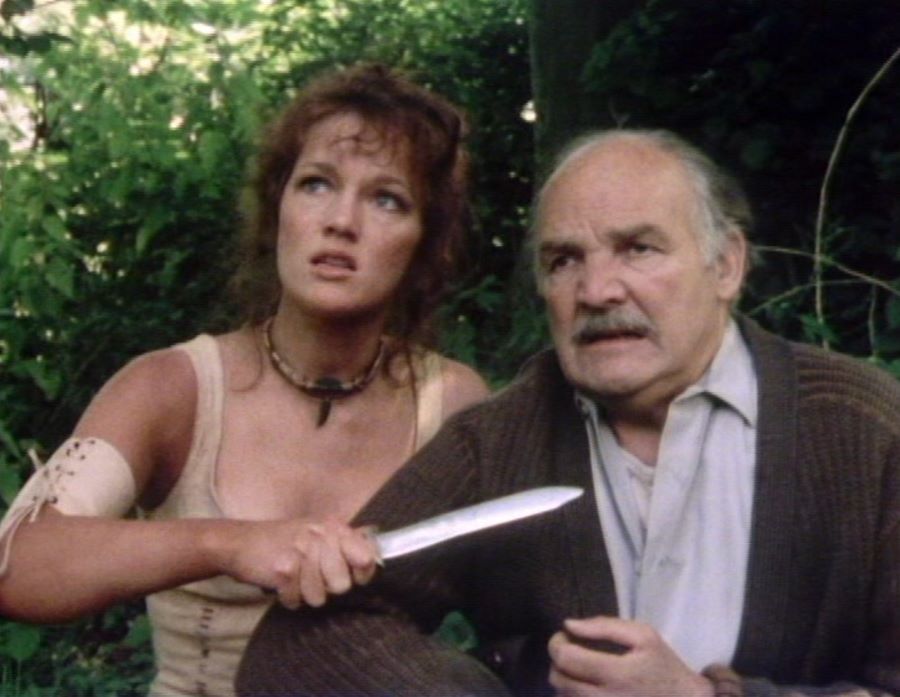
Mind you, he almost shot Leela at the end of ‘Part One’ and the start of ‘Part Two’, which isn’t nice. There’s Graham Simpson as the non-speaking hiker who gets killed in ‘Part One’ of the story. Graham Simpson became the chairman of the English football club Watford in 1999, according to Toby Hadoke.
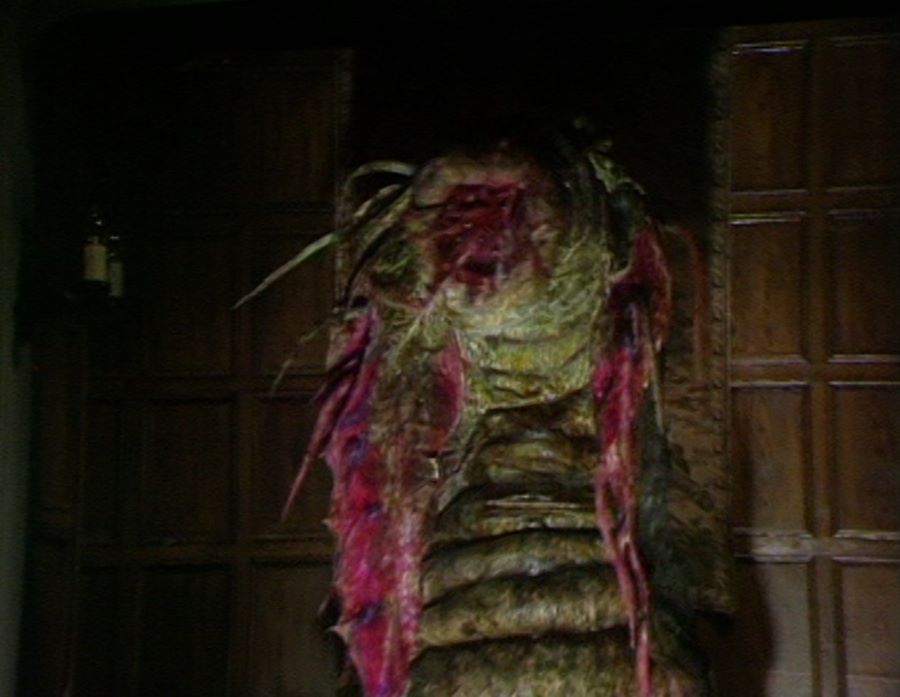
Apart from the gold goddess-like Thea as the Fendahl Core in the story, which I found quite scary and unnerving, I did find the actual Fendahl monsters to be rather disappointing. They looked pathetic, as they turned out to be lumbering snake-like monsters with spaghetti-like tendrils from their mouths. 😦
No doubt an inspiration for the Ood in the ‘Doctor Who’ TV series, even though I do like the Ood. 😀 Some of the Fendahl monsters, including the small Fendahleen creatures are animatronic puppets in the story. Mind you, the Fendahl must have had an impact over the years, including the Big Finish audios. 🙂
I’ve heard the Fendahl make their return in the ‘Doctor Who’ audio story ‘Island of the Fendahl’ with Paul McGann and Sheridan Smith. And they’ve made their return in the ‘Torchwood’ audio story ‘Night of the Fendahl’ with Eve Myles as Gwen Cooper. So, the Fendahl can’t have been totally bad, can they?
It’s fascinating how the story concludes with the Doctor setting the priory to be destroyed, along with the Fendahl Core and the remaining Fendahleen, which has a huge explosion turn into a huge implosion. Adam and the Tylers – Ma and Jack – survive in this story as well as the Doctor and Leela. 🙂
The Doctor and Leela leave in the TARDIS with the Doctor planning to dump the ancient skull, contained in a radiation box, near a supernova, with the intent of ending the Fendahl race forever. And I’m sure we’ll never see or hear the Fendahl again, despite what I’ve claimed earlier in this review.
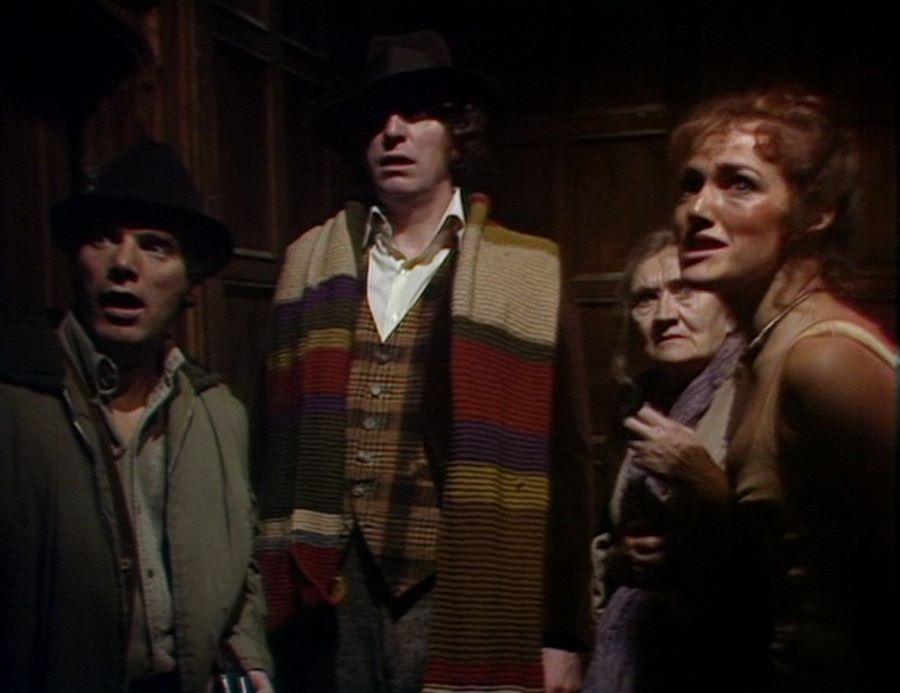
The original DVD special features were as follows. There was the making-of documentary ‘After Image’ with behind-the-scenes cast and crew interviews. There were deleted and extended scenes of the story, a BBC trailer for ‘Part One’ of the story and a photo gallery of the story. There was a dual mono sound audio mix option for the story, and an audio commentary with Tom Baker, Louise Jameson, Wanda Ventham and Edward Arthur. There was an info-text commentary option to enjoy, a ‘Radio Times Listings’ PDF of the story, and a ‘coming soon’ trailer for ‘The Deadly Assassin’, starring Tom Baker (which can now be seen on Disc 2 of the Season 14 Blu-ray box set of ‘Doctor Who’, containing ‘The Hand of Fear’). There was also an Easter Egg to look out for on the DVD, which was Louise Jameson sharing her thoughts on her Leela toy counterpart, now included on Disc 1 of the Season 15 Blu-ray box set (containing ‘Horror of Fang Rock’).
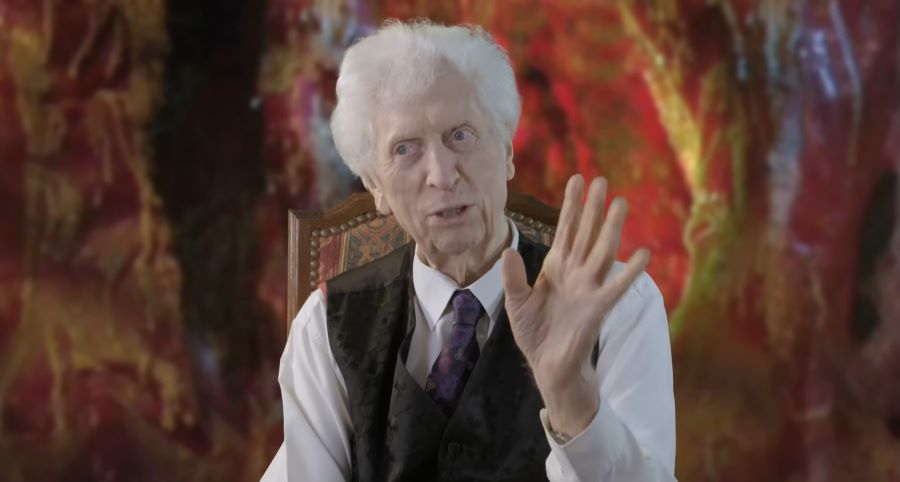
On Disc 3 of the ‘Doctor Who – The Collection – Season 15’ Blu-ray, the ‘After Image’ making-of documentary, the deleted and extended scenes, the dual mono sound audio mix option and the DVD audio commentary can be found on there. The BBC trailer for ‘Part One’ has been updated into BBC trailers and continuity announcements of the story. The photo gallery of the story and the info-text commentary option have been updated for 2024 on the Blu-ray.
The new special features on Blu-ray include the ‘Behind the Sofa’ feature on ‘Image of the Fendahl’ with Louise Jameson (Leela), fan and critic Toby Hadoke and Betsan Roberts, wife of the late director Pennant Roberts as well as Colin Baker (the Sixth Doctor), Sarah Sutton (Nyssa) and Janet Fielding (Tegan) as well as Katy Manning (Jo) and Matthew Waterhouse (Adric). There’s the ‘Hammer Horror’ behind-the-scenes featurette (taken from ‘The Stones of Blood’ DVD), the ‘Tom Talks: Season 15’ interview with Tom Baker, two ‘EMU’s Broadcasting Company’ spoof sketches, and there’s a ‘coming soon’ trailer for ‘The Sun Makers’, starring Tom Baker, Louise Jameson and K-9 (taken from the ‘Paradise Towers’ DVD).
On the PDF front, as well as the ‘Radio Times Listings’ of ‘Image of the Fendahl’, there are production documents, four rehearsal scripts and four camera scripts. You need a special Blu-ray computer drive for that.
‘Image of the Fendahl’ is an eerie and creepy story from the Tom Baker era of ‘Doctor Who’. It would be the last in a long line of gothic adventures with the Fourth Doctor and an enjoyable one with him and Leela. It’s slow-paced at first, but it does get exciting later. I found it very intriguing and fascinating.
It’s clear that this story belongs more to the Philip Hinchcliffe era than the Graham Williams, as the story was commissioned by Robert Holmes leaving as script editor before Anthony Read joined. I appreciate the concerns that were raised by Mary Whitehouse over the horror and violence levels in the TV show.
Sometimes though, the horror and violence levels work well for gripping drama, and it can’t be denied that some of those concerns raised by Mary Whitehouse were a little exaggerated somewhat. From watching the story, it does seem choppy in its slow-pacing and in the editing for the first two episodes.
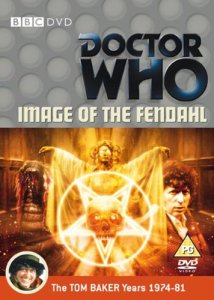
Regardless, I enjoyed watching ‘Image of the Fendahl’ on DVD and recently on Blu-ray. I’m pleased I’ve had my DVD cover of the story signed by Louise Jameson as well as Derek Martin. This is especially since Louise signed my DVD cover of ‘Image of the Fendahl’ for the first time I met her at a convention.
‘Image of the Fendahl’ rating – 7/10
| The previous story
For the Fourth Doctor was For Leela was For K-9 Mk I was |
The next story
For the Fourth Doctor is For Leela is For K-9 Mk I is |
| Return to The Fourth Doctor’s Timeline | |
| Return to Leela’s Timeline | |
| Return to The Timelines of K-9 | |
| Return to The Doctors’ Timelines Index | |
| Return to The Companions’ Timelines Index | |
| Return to Doctor Who Timelines | |
| Return to Doctor Who | |
| Return to Sci-Fi |
 Bradley's Basement
Arh don’t forget a slice of Ma Tyler fruit cake.
Excellent review Tim, if this had been in the previous Hinchcliffe season it would’ve been a far dark adventure, sadly Mary Whitehouse moaning made the BBC review the tone of Doctor Who & decided to tone it down (Boo).
I enjoy this one but the script feels choppy in places especially during the climax but overall this is still a entertaining Fourth Doctor adventure.
LikeLiked by 2 people
Hi Simon.
Glad you enjoyed my review on ‘Image of the Fendahl’.
Yes, clearly this story belongs to the Philip Hinchcliffe era rather than the Graham Williams era, but then this was commissioned by Robert Holmes who was just leaving as script editor at the time of this story. I appreciate Mary Whitehouse’s concerns about the level of horror and violence in ‘Doctor Who’, but sometimes it works for well for gripping drama and perhaps her concerns were a little exaggerated somewhat.
The story did seem choppy and it was slow in building up pace in the early episodes, but I enjoyed this one nonetheless and pleased I’ve had the DVD cover signed by Louise Jameson, which was the first time I met her at a convention. Honest! 😀
Thanks for your comments, Simon.
Tim. 🙂
LikeLiked by 1 person
Wanda Ventham as Thea (and the Fendahl core) is my favourite memory from Image Of The Fendahl. She could have been an interesting Dr. Who herself. Lovely actress. I was surprised to learn that she’s the mother of Benedict Cumberbatch.
After the gothic horror phase of Dr. Who ended, British sci-fi horror TV would soon find such excitements again with Sapphire & Steel and The Omega Factor. Despite the complaints by Mary Whitehouse, the horror formats of Dr. Who opened many doors for television. I’m glad to have known Dr. Who’s Golden Age to start with at a very young age. It truly prepared me for so much from the TV and cinema horror genre.
Thank you, Tim, for your review.
LikeLiked by 2 people
Hi scifimike,
Thanks for sharing your thoughts on ‘Image of the Fendahl’. Glad you enjoyed my review. Wanda Ventham is very good in this story and it’s amazing she did three ‘Doctor Who’ stories in the three different periods of the classic series – ‘The Faceless Ones’ in the 1960s, ‘Image of the Fendahl’ in the 1970s and ‘Time and the Rani’ in the 1980s. It’s funny you should say Wanda Ventham could have been an interesting Doctor, since Timelord007 wants Benedict Cumberbatch to be the Doctor as well. 😀 I’m sure both would be good at the role. And both have been in ‘Sherlock’ run by Steven Moffat and Mark Gatiss. 😀 I’ve also seen Wanda Ventham in ‘A Family at War’.
I can’t say I’m a huge fan of the gothic horror period that was prevalant in the first half of the Tom Baker/Fourth Doctor era, but I appreciate its significance in starting off shows like ‘Sapphire & Steel’ and ‘The Omega Factor’ that have horror elements to them. I’ve not seen those shows yet, but I’m sure they’re good in their way and they’ve clearly found their appeal with audiences, especially in the Big Finish audio productions made of them.
Many thanks,
Tim 🙂
LikeLiked by 1 person
I remember Benedict saying in a interview (at some point during Dr. Who’s 50th Anniversary) that maybe he would want to play the next Dr. Who at some point. I can faintly remember someone saying that Benedict would be better as the next Master. Casting an actor who’s already famous for playing Sherlock Holmes as a new Doctor may in obvious ways seem like typecasting. Personally I think that the most against-type casting choices for Dr. Who like Peter Davison and Jodie Whittaker are all the more fascinating thanks to how much diversity is now welcomed into the role.
LikeLiked by 2 people
Hi scifimike,
In all honesty, I don’t mind who gets cast as the Doctor, so long as the actor whether male or female is good and they can bring something new to the role. I’ve often fancied the idea of actors like Alistair Mackenzie and Stephen Mangan playing the Doctor, but that’s because I enjoyed them in shows like ‘Monarch of the Glen’ and BBC4’s ‘Dirk Gently’, and sometimes I wonder if that’s enough to give them a good reason to be cast as the Doctor. Benedict Cumberbatch would be good as the Master as well as the Doctor. I’ve joked in one of my April Fools videos about Jim Carrey being the Master in ‘Doctor Who’ and I know he was considered to play the Doctor at one time, but again, I have to wonder if having seen him in his comedy films over the years is a good enough reason for him to play the Doctor/the Master.
Thanks,
Tim 🙂
LikeLiked by 1 person
As much as I like Jim Carrey, I for one wouldn’t cast him as Dr. Who or the Master. I remember a Dr. Who fan fiction site by a fan envisioning Rachel Weisz as the 11th Doctor. And I think that Lilly Nelson, who plays the Doctor in The Ginger Chronicles fan series on YouTube, had openly suggested herself to Steven Moffat as a contender for the 12th Doctor.
LikeLiked by 2 people
Hi scifimike,
Yeah, thinking about it, having Jim Carrey cast as the Doctor and the Master might not be such a good idea. Like I said, I joked about Jim Carrey being the Master in an April Fool’s video. With that said, I fancy the idea of writing Jim Carrey as a Soldeed-like villain for one of my ‘Doctor Who’ stories called ‘Realm of the Sgrans’, which is a sequel to ‘The Coins of Deno’. I’ll have to work on that before figuring out how to make Jim Carrey work as an intimidating and comedic villain. 😀
Thanks,
Tim 🙂
LikeLiked by 1 person
“Image of the Fendahl” intrinsically fascinates me. It’s a story of two faces. Like the Roman god, Janus.
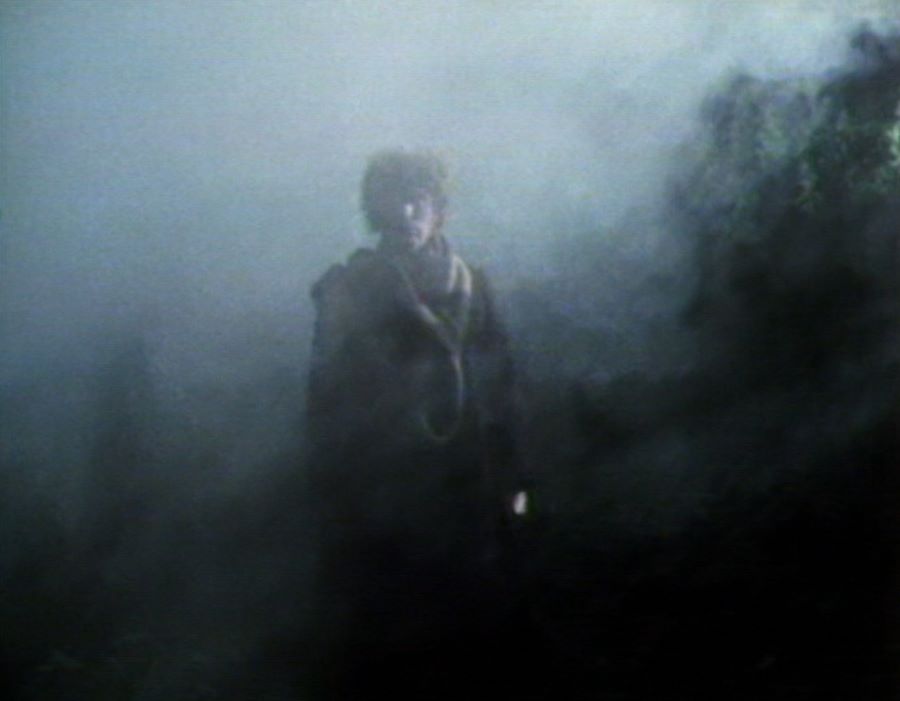
On the one hand, the Fendahl might be one of the most genuinely unnerving creations of the season. A brilliant subversion of the cult sacrifice. The victim themselves becomes the focal point of the summoned creature’s power. A vicarious revenge for the dead exploited by the “head cultist” of the ritual. The Fendahleen, headless cobras with paralytic presences, make a striking appearance when they finally do appear. Well-directed, well-lit, and thoroughly memorable as a cliffhanger. The image of Tom Baker stepping into the emerald-green aura, raising the hunting rifle with wide eyes, certainly lingers in the memory.
On the other, it doesn’t work on a structural level. ‘Part One’ keeps the Doctor and Leela largely uninvolved in the goings on in the Priory. ‘Part Three’ leads them both on a wild goose chase (self-admitted by the Doctor) that takes them out of the setting altogether aboard the TARDIS. It feels almost like the dead end of a Choose-Your-Own-Adventure book. “Image of the Fendahl” also struggles with the Doctor’s role in proceedings. He’s there as a font of information, but does very little to affect the story except remove the Fendahl as a threat at the end. His innate powerlessness here is treated as an obstacle, rather than an interesting point of conflict.
Bring those two halves together and you get a lumpy sort of tale. With the Doctor rendered largely ineffective, other characters step into the breach to accommodate. Instinctive Leela is our window into the occult superstitions of the Tylers and their place in Fetchborough. While Colby — dragged into murder cover-ups and disturbing behaviours among the research team — acts as the driving force for understanding Fendleman’s obsession and Thea’s breakdown. Between them, you get a good understanding of the substance behind the story’s ideas. The bait-and-switch with Fendleman is rather marvellous. We expect him to be yet another mad scientist, but he’s something far more complicated.
Although, speaking of complicated. Strangely… For all the intricacies of the Fendahl itself, we don’t really get a good sense of the cult around it. Stael’s involvement and that of the Fetchborough community feels like it’s brushed away with a hand. They’re a means to an end. Set dressing for the Fendahl. It would’ve been interesting to see what could have come from fleshing that element out. Would it have been like “The Curse of Fenric”, which shares similar roots of manipulated bloodlines? Or more like “The Daemons” with its uniquely sketched group of more conventionally-intimidated villagers?
LikeLiked by 2 people
Hi Wolfie,
Thanks for sharing your thoughts on ‘Image of the Fendahl’. It’s interesting how you’ve identified the strengths and weaknesses of this story. It’s something I hope to expand upon when it comes to updating my reviews on the story and the rest of Season 15. There’s no getting away from the fact that this story has problems in terms of story structure and how characters are developed, but there are some interesting concepts featured throughout. It’s amazing ‘Image of the Fendahl’ has had its legacy, including making a return in a Big Finish audio story called ‘Island of the Fendahl’ with the Eighth Doctor and Lucie as well appearing in a ‘Torchwood’ audio story called ‘Night of the Fendahl’ with Gwen Cooper.
Many thanks for your comments.
Best wishes,
Tim 🙂
LikeLiked by 1 person
Always interesting how originally stand-alone villains in the classic Dr. Who can be brought back via the magic of audio stories.
LikeLiked by 2 people
Hi scifimike,
Indeed. I’ve still yet to hear the ‘Torchwood’ audio ‘The Green Life’, featuring John Barrowman as Captain Jack Harkness and Katy Manning as Jo Jones fighting against the giant maggots from ‘The Green Death’. 😀
Many thanks,
Tim 🙂
LikeLiked by 1 person
The portrayal of people who somehow feel motivated to worship such evil entities to gain power or fulfillment, like Namin worshipping Sutekh as an ultimately dangerous example, may be portrayable in a certain number of ways in Dr. Who. Including spinoffs like K-9 & Company and Downtime. I agree that we didn’t get a good sense of a cult for the Fendahl. But it was a good performance by Scott Fredericks as Stael that helps us to understand how seductive the forces of the Fendahl could be.
LikeLiked by 2 people
Hi scifimike,
Yes, Scott Fredericks is very good as Max Stael in this ‘Doctor Who’ story. I also enjoyed him in ‘Day of the Daleks’ as well as the ‘Dad’s Army’ 1971 movie. It’s fascinating how things came together with Denis Lill as Dr. Fendelman revealing that his name was ‘Man of the Fendahl’ and that “Mankind has been used!”. It makes the supernatural elements of this story unnerving. Again, like I said, there are issues in terms of story structure and character developed, but I enjoyed how things unveiled, especially as the Fourth Doctor and Leela were solving the mystery step by step. Hopefully, I’ll delve more into this when it comes to updating my review for a potential Season 15 Blu-ray box set.
Many thanks,
Tim 🙂
LikeLiked by 1 person
Well, scifimike70, it’s as Sutekh said to the Doctor: “Your evil is my good.” The reverence of fundamentally malevolent forces in ‘Doctor Who’ seems to come from a mistaken belief on the part of the believer. Leela, for instance, warring with the Tesh. In a conflict perpetuated by Xoanon. A hostile, ill-defined presence among the Sevateem that comes from a very real and material thing — a computer in the mountain.
For Namin in “Pyramids of Mars”, it’s the fulfilment of a family duty stretching down the generations. Someone born into a fanatical cult dedicated to the veneration of the Great Ones and to do their will. The novelisation adds the unfortunate crimp that Ibrahim’s faith was designed by the Osirans to *protect* the Pyramid that ensnared Sutekh. Not destroy it. Sutekh took advantage and used the time-worn gap in knowledge to make Namin his agent. With the belief that he was fulfilling his sacred duty. When Scarman arrives, Namin is not punished for his faith, but discarded, instead. His god is a pragmatic being who sees no use in two agents when one is enough.
In Stael’s case, it appears a lot more self-motivated. A desire to be worshipped by others. To attain that sort of power, he hopes to use the Fendahl, but what is “power” in this context, really? Veneration. He’ll call upon a demon to make him a god. Except, after a certain fashion, that power is bestowed upon Thea, instead. Even if Thea herself is lost during the transformation process. Stael’s ultimate fate… Well, it’s an interesting twist. For a man singularly devoted to self-worship, he makes the ultimate sacrifice for the benefit of everyone else. His death stops the Fendahl Core from becoming unbeatable. Unlike Fendleman, who only realised too late, Stael refuses to be used.
I don’t remember the coven in ‘K9 & Company’, but the New World University in “Downtime” has echoes of ‘Dark Season’ and its cyberpunk-adjacent themes. The connection between human consciousness and raw computing power. Victoria becomes the head of a cult that mirrors her own sense of being adrift in Time. Something the Intelligence uses to its own advantage. Another believer following a Lovecraftian higher power with no interest in their worship beyond their “usefulness” to their own schemes.
‘Doctor Who’ seems to often side with the notion that blind worship without inquiry — scientific or otherwise — is practically a death sentence. Especially when said “god” has no love for their flock.
LikeLiked by 2 people
Hi Wolfie,
Thanks for sharing your thoughts about cults and covens featured in stories like ‘Pyramids of Mars’ and ‘Image of the Fendahl’. I should check out the Target novelizaton/audiobook of ‘Pyramids of Mars’ sometime to uncover more about Ibrahim Namin’s motivations in serving Sutekh. It’s been a while since I’ve seen ‘Downtime’, but interesting how you make comparisons between that and ‘Dark Season’, which I saw recently on DVD last year. I hope to revisit ‘Downtime’ again soon, possibly for my blog’s 10th anniversary. Interesting comments you’ve made about how ‘blind worship without inquiry’ is ‘practically a death sentence’ and that the gods of those blind worshippers have ‘no love for their flock’. It’s often the case when the Doctor deals with entities like Sutekh and the Fendahl in the series.
Many thanks for your comments.
Tim 🙂
LikeLiked by 1 person
In the cases of Namin and Ted Moss, Dr. Who has indeed often made the point on how blind worship can lead to an ultimate doom. Even if Stael, after killing Fendelman and subjecting Thea to her fate, had earned some sense of sympathy and redemption in his self-sacrifice and thanks to the Doctor’s own regard for mercy, understanding his misguided lust for power in the first place can be most disturbing in the blunt realization of how vulnerable some people can be. It may ring true for certain cult member tragedies in reality. So perhaps it has become one of Dr. Who’s most important cautionary messages.
LikeLiked by 2 people
Hi scifimike,
I agree. It’s one of the things I’ve admired about ‘Doctor Who’ in terms of its storytelling. I’m sure the Doctor has said it about ‘curiosity without caution’ can often lead people to undignified ends. It’s like how Lesterton became curious about the Daleks in ‘The Power of the Daleks’ before realising the mistake he made in not being cautious first.
Many thanks,
Tim 🙂
LikeLiked by 1 person